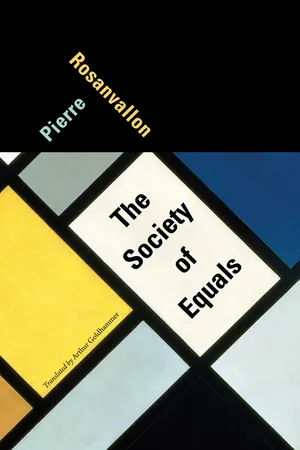
Since the 1980s, society's wealthiest members have claimed an ever-expanding share of income and property. It has been a true counterrevolution, says Pierre Rosanvallon—the end of the age of growing equality launched by the American and French revolutions. And just as significant as the social and economic factors driving this contemporary inequality has been a loss of faith in the ideal of equality itself. An ambitious transatlantic history of the struggles that, for two centuries, put political and economic equality at their heart, The Society of Equals calls for a new philosophy of social relations to reenergize egalitarian politics.
For eighteenth-century revolutionaries, equality meant understanding human beings as fundamentally alike and then creating universal political and economic rights. Rosanvallon sees the roots of today's crisis in the period 1830–1900, when industrialized capitalism threatened to quash these aspirations. By the early twentieth century, progressive forces had begun to rectify some imbalances of the Gilded Age, and the modern welfare state gradually emerged from Depression-era reforms. But new economic shocks in the 1970s began a slide toward inequality that has only gained momentum in the decades since.
There is no returning to the days of the redistributive welfare state, Rosanvallon says. Rather than resort to outdated notions of social solidarity, we must instead revitalize the idea of equality according to principles of singularity, reciprocity, and communality that more accurately reflect today's realities.
- English
- ePUB (mobile friendly)
- Available on iOS & Android
eBook - ePub
The Society of Equals
About this book
Information
Topic
PhilosophySubtopic
Ethics & Moral Philosophy1
THE INVENTION OF EQUALITY
The World of Similar Individuals
To understand how the idea of equality came, in 1789, to be identified with the visceral rejection of privilege, there is no better guide than Abbé Sieyès, the author of Qu’est-ce que le tiers état? (What Is the Third Estate?). “The privileged individual,” Sieyès wrote, “considers himself, along with his colleagues, as constituting a distinct order, a nation of the select within the nation.… The privileged actually come to see themselves as another species of man.”1 Half a century later, Tocqueville significantly hit upon the same words to describe the aristocracy: “They scarcely even think of themselves as belonging to the same humanity,” he observed in a celebrated remark.2 He therefore defined democratic society as the opposite of aristocratic society: une société de semblables, a society of similar individuals.
The Rejection of “Aristocratic Racism”
Today, it is difficult to understand the aspiration to equality as similarity that existed in 1789 without recognizing the degree to which the nobility of that time was animated by the spirit of distinction. To make sense of this, we can once again start with Sieyès. To justify his argument in the Essai sur les privilèges, the father of the first French Constitution appended to his text a damning historical document: a “Petition to the King” by the president of the noble section of the 1614 Estates General. The petition was a response to an appeal by the deputies of the Third Estate to be treated with greater respect. “Treat us as your younger brothers, and we will honor and cherish you,” the commoners said to the representatives of the nobility. The nobility, which took this appeal as an insult, replied with a stinging rebuke:
I am ashamed, Sire, to tell you of the offensive terms in which we have once again been addressed. They compare your state to a family consisting of three brothers. To what wretched condition have we fallen if these words can be taken as true! How can so many services rendered since time immemorial, so many honors and dignities transmitted hereditarily to the nobility and merited by their efforts and loyalty, have been reduced to so little? How can the nobility have been linked with the vulgar in the closest society that exists among men, which is brotherhood.… Render judgment, Sire, and in a declaration steeped in your justice remind them of their duty and order them to recognize what we are, what difference exists between us, and tell them that they can in no way compare themselves to us.3
This petition, intended “to preserve the preeminence of the nobility,” was couched in terms that the Third Estate found intolerable. It made explicit the nobility’s claim to constitute a superior humanity and stigmatized those who “dared to compare themselves” to these superior beings and “thus misunderstood their own condition.”
Since at least the sixteenth century, the nobility in fact openly considered itself to be a separate race. To be sure, the meaning attached to this term was different from the one it has today. It was synonymous with lineage or extraction and was typically a part of the language of aristocrats.4 Although connotations of physiological or ethnic distinctions were absent, the word did denote the idea that certain social qualities are hereditary. Nobles believed that their children were innately equipped to lead. In their eyes, lineages were natural categories. The idea of “race” lay at the root of a hierarchical worldview in which distinctions and conditions stemmed from intrinsic differences. To nobles, this was completely obvious. As they saw it, every social condition corresponded to a certain type of human being. Men shared the same nature but were hereditarily differentiated by their behavior and unequal human value.5
From its inception, the Constituent Assembly set itself the goal of destroying these representations and their concrete consequences in terms of tax privileges, exclusive rights, and professional barriers. All but one aspect of this program, the decree adopted on the night of August 4, 1789, is symbolic of the whole enterprise. One cannot leave it at that, however, if the goal is to characterize the spirit of equality that marked the whole period. The aspiration to constitute a society of similar individuals went far beyond denunciation of the aristocracy’s most outrageous privileges. Sieyès’s attack on privilege aimed at more than just legal exemptions, fantasies of racial superiority, and historical fairy tales. His critique included a much broader range of claims to social superiority and distinction. In his eyes, the “privileged” included all who believed that “they were not made to be confounded, to rub shoulders, to be together.”6 His target was a multifarious propensity to isolation, to separation. The invention of the term “aristocrat,” which dates from this period,7 linked together the many different ways in which commoners experienced social distance, contempt, exclusion, and insuperable social barriers.
America Equally
In fact, this history explains why the stigmatization of aristocracy played as important a structural role in America as in France, even though colonial America had no nobility and none of the legal distinctions that existed in the Old World. Colonial society was nevertheless quite hierarchical, with a very British sense of order and deference, particularly in New England.8 Although Federalist notables long believed in the need for a “natural aristocracy” (an idea on which they harped incessantly), “equality” soon became the great rallying cry of popular protest. In the colonies of the North as well as the South, people voiced disgust with “certain airs of wisdom and superiority” and “affectations of politeness.”9 In Pennsylvania especially, the Revolution was perceived as a conflict between the people and the aristocracy. “Blessed State which brings all so nearly on a level,” said ordinary people exasperated by those whom they characterized as “gentlemen.”10 In 1786, representatives of Pennsylvania formally declared that “a democratic government like ours admits of no form of superiority.”11 Years later, one of the most eminent members of the young Constituent Assembly in France was therefore able to link the two revolutions by saying that “like the Americans, we want to regenerate ourselves.”12 The idea of “regeneration” implied a humanity reconciled with itself, rendered equal and one.
A Legacy of Christianity?
How can we explain the advent of this spirit of equality, which animated the revolution of modernity in its three fundamental manifestations (the United States, France, and Santo Domingo)? Did the emergence of a new world suddenly make equality a novel imperative, or did the advent of modernity simply revive the dormant embers of an ancient hearth? And how exactly should we describe the aspiration to constitute a world of similar individuals that stands out as the chief characteristic of this new spirit of equality? The author of Democracy in America emphasized the importance of religion in his introduction: “Christianity, which made all men equal in the sight of God, will not shrink from seeing all citizens as equals in the eyes of the law.”13 Was democratic equality thus merely the fulfillment of an old promise? Was the modern revolution merely the heir of the Christian revolution? “The most profound geniuses of Greece and Rome, the most comprehensive of ancient minds, never hit upon the very general yet at the same time very simple idea that all men are alike and that each is born with an equal right to liberty.… [I]t took the coming of Jesus Christ to make people understand that all members of the human race are by nature similar and equal.”14 There are many passages of the Bible that might be enlisted in support of this contention. Paul’s Epistle to the Galatians (3:28), “There is neither Jew nor Gentile, neither slave nor free, nor is there male and female, for you are all one in Christ Jesus,” is among those most frequently cited. In support of this interpretation one might also point to the centrality of the theological argument in the work of John Locke, who sought to prove that the principles of the English Revolution originated in the Bible. In his polemic with Robert Filmer, he devoted long chapters of his Treatise of Government to the defense of radical egalitarianism, citing the categorization of species in Genesis.15
The egalitarian aspect of the Gospel message cannot be denied, but the equality in question is not democratic equality. It is essentially spiritual and not directly related to any social or political understanding. Although Christianity never stopped preaching the principle of natural equality, it did not derive any “revolutionary” consequence from its teaching. As evidence of this—but one example among many—we can look to the first major Christian treatise of domestic morality, De Institutione laicali by Jonas, bishop of Orleans. Published after the end of Charlemagne’s reign, the work strongly affirmed the idea that rich and poor, as well as master and slave, were “natural equals,” but it in no way drew from this the conclusion that slavery should be abolished or conditions made more similar.16 The point was to inspire respect and consideration for others, to urge recognition of the unique value of every human being, and to insist that everyone participate in the same economy of salvation. In other words, what was supposed to follow from this religious idea of equality was a morality of charity, not a political or social model of any kind. Hence we need to distinguish what we might call “human equality” and “social equality” in order to move beyond vague suggestions of Christianity’s role in the advent of the modern spirit of equality.
The same can be said about the spirit of equality in America, even though religious references were quite explicit there during the revolutionary period. This is manifestly the case in the first of the truths held to be “self-evident” in the Declaration of Independence (July 4, 1776): “All men are created equal.”17 It is also undeniable that the evangelical movements of the eighteenth century, superimposed on the original Puritan rootstock, found in Scripture language and arguments that colonial militants drew on repeatedly as a ready source of authority. But from these biblical arguments they drew novel and radical consequences. Thus there was a sort of “subversion from within” of the religious message: despite the seeming continuity of the words, a profound rupture was in fact taking place.
The Ambiguities of Natural Equality
In addition to the Christian view of equality, legal and philosophical theories of natural equality also played a key role. These were influential throughout the eighteenth century. Although they retained a certain ambiguity, they contributed to an important rupture. This is clear from the tenor of the Encyclopédie article on the notion.18 “Since human nature is the same in all human beings,” the article states, “it is clear that each person must respect and treat others as individuals naturally equal to him- or herself, that is, as equally human.” The article in no way challenged the existence of the nobility with all its attributes. For the author, the scope of natural equality was strictly limited to the moral dimension, implying nothing more than “duties of charity, humanity, and justice.” This was quite a long way from the hidden power that the idea of an equality of similar individuals turned out to have in 1789, when it raised the prospect of limitless subversion of differences of every kind. The celebrated refrain that rebellious English peasants chanted in 1381, which they took from a sermon by John Ball—“When Adam delved and Eve span, who was then the gentleman?”—was already a good deal more radical. The starting point for Louis de Jaucourt/Sylvain Maréchal was also a stopping point, yet it was ambiguous enough to open the way to democratic equality. Indeed, democratic equality cannot be circumscribed or limited by any definition that would preclude the kinds of interrogation, controversy, and demands to which it gives rise. Conservatives, moreover, have persistently sought to impose such limits.
The Intellectual and Social Revolution of Similarity
In addition to the Christian legacy and the theories of natural right, two other factors contributed in the eighteenth century to the destabilization of early representations of the social bond, thus paving the way for the “revolution of similarity.” The first of these factors was of an anthropological and biological order. It stemmed from the new conception of species made famous by the work of Georges-Louis Leclerc, Comte de Buffon. The second was sociological, associated with the advent of the individual.
It was in 1749 that Buffon inaugurated his Histoire naturelle with an essay “On the Nature of Man.” In it, he described man as a unique and superior being totally distinct from all other animal species, owing to the nature of his understanding, the duration of his life and period of growth, and the existence of a “superior principle” that enabled him to expand his intellectual activity indefinitely, thereby increasing the distance between himself and other animals. Man was also malleable enough to thrive and multiply in all climates thanks to his ability to form complex and diverse societies with others like himself.19 By thus showing that the identity of the human species was a material fact, Buffon changed the way in which it was perceived. This objectification altered understanding and provided a material basis for moral considerations of common dignity. Its tendency was in fact to minimize the differences between “civilized man” and “savage man,” as well as between the inhabitants of different countries. In the concluding chapter of the essay, entitled “Varieties within the Human Species,” Buffon explained that physical differences of appearance and skin color were simply the result of “external and accidental causes” and should be seen as subject to further evolution and even possible reversal.20 For Buffon, then, the human race was originally one and its diversity was merely accidental, thus suggesting that the concept of “species” ought to be based on the notion of similarity. Therein lay the conceptual revolution. “All similar individuals existing on the surface of the earth are regarded as composing the species of such individuals.”21 “Species,”...
Table of contents
- Cover
- Half Title
- Title Page
- Copyright
- Dedication
- Contents
- Introduction: The Crisis of Equality
- 1. The Invention of Equality
- 2. The Pathologies of Equality
- 3. The Century of Redistribution
- 4. The Great Reversal
- 5. The Society of Equals: A Preliminary Outline
- Notes
- Index
Trusted by 375,005 students
Access to over 1.5 million titles for a fair monthly price.
Study more efficiently using our study tools.
Frequently asked questions
Yes, you can cancel anytime from the Subscription tab in your account settings on the Perlego website. Your subscription will stay active until the end of your current billing period. Learn how to cancel your subscription
No, books cannot be downloaded as external files, such as PDFs, for use outside of Perlego. However, you can download books within the Perlego app for offline reading on mobile or tablet. Learn how to download books offline
Perlego offers two plans: Essential and Complete
- Essential is ideal for learners and professionals who enjoy exploring a wide range of subjects. Access the Essential Library with 800,000+ trusted titles and best-sellers across business, personal growth, and the humanities. Includes unlimited reading time and Standard Read Aloud voice.
- Complete: Perfect for advanced learners and researchers needing full, unrestricted access. Unlock 1.5M+ books across hundreds of subjects, including academic and specialized titles. The Complete Plan also includes advanced features like Premium Read Aloud and Research Assistant.
We are an online textbook subscription service, where you can get access to an entire online library for less than the price of a single book per month. With over 1.5 million books across 990+ topics, we’ve got you covered! Learn about our mission
Look out for the read-aloud symbol on your next book to see if you can listen to it. The read-aloud tool reads text aloud for you, highlighting the text as it is being read. You can pause it, speed it up and slow it down. Learn more about Read Aloud
Yes! You can use the Perlego app on both iOS and Android devices to read anytime, anywhere — even offline. Perfect for commutes or when you’re on the go.
Please note we cannot support devices running on iOS 13 and Android 7 or earlier. Learn more about using the app
Please note we cannot support devices running on iOS 13 and Android 7 or earlier. Learn more about using the app
Yes, you can access The Society of Equals by Pierre Rosanvallon, Arthur Goldhammer in PDF and/or ePUB format, as well as other popular books in Philosophy & Ethics & Moral Philosophy. We have over 1.5 million books available in our catalogue for you to explore.