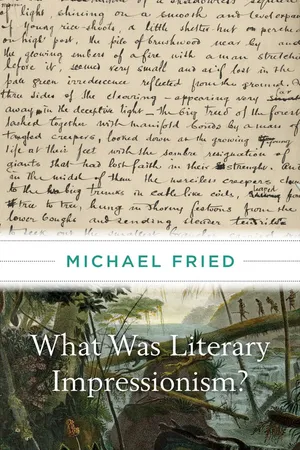
"My task which I am trying to achieve is, by the power of the written word, to make you hear, to make you feel—it is, before all, to make you see. That—and no more, and it is every-thing." So wrote Joseph Conrad in the best-known account of literary impressionism, the late nineteenth- and early twentieth-century movement featuring narratives that paint pictures in readers' minds. If literary impressionism is anything, it is the project to turn prose into vision.
But vision of what? Michael Fried demonstrates that the impressionists sought to compel readers not only to see what was described and narrated but also to see writing itself. Fried reads Conrad, Stephen Crane, Frank Norris, W. H. Hudson, Ford Madox Ford, H. G. Wells, Jack London, Rudyard Kipling, Erskine Childers, R. B. Cunninghame Graham, and Edgar Rice Burroughs as avatars of the scene of writing. The upward-facing page, pen and ink, the look of written script, and the act of inscription are central to their work. These authors confront us with the sheer materiality of writing, albeit disguised and displaced so as to allow their narratives to proceed to their ostensible ends.
What Was Literary Impressionism? radically reframes a large body of important writing. One of the major art historians and art critics of his generation, Fried turns to the novel and produces a rare work of insight and erudition that transforms our understanding of some of the most challenging fiction in the English language.
- 400 pages
- English
- ePUB (mobile friendly)
- Available on iOS & Android
eBook - ePub
What Was Literary Impressionism?
About this book
Information
Index
Note: Page numbers in italics indicate figures.
- Advertising, 87, 153, 153, 293
- After Dinner at Ornans (Courbet), 2, 5
- “Against Theory” (Knapp and Michaels), 26
- Agency, writer’s, 145
- Albino, in The Invisible Man, 84
- Aldington, Richard, 139
- Alliteration, 61, 62, 250, 264
- “Almayer’s Face” (Fried), 23
- Almayer’s Folly (Conrad), 23, 28–57, 146, 311; blankness in, 32–33, 37, 38; desire in, 31; erasure in, 35, 36–37, 38, 39, 42, 49, 127, 252; faces in, 29, 32–33, 35, 37, 43, 126, 275, 347–348n17; first page of, 40; forgiving in, 31; shadows in, 344n7; violence in, 182–183; Wells’s review of, 62
- Ambassadors, The (James), 293
- Anarchists, 184. See also The Secret Agent
- Antitheatricality, 327
- Anxiety, blank page and, 53
- Arctic, 83, 84
- Audience, indifference to, 327
- Aural, relation with visual, 298, 299–301, 304, 308–309, 314
- Author: agency of, 145; invisibility of, 74, 77, 79, 293–294; relation with page, 56
- Authorial double, absence of, 174
- Autobiography: Ford’s (see Portraits from Life; Return to Yesterday); Hudson’s, 93; Wells’s, 74, 84–85, 88, 91, 153, 195–196, 197, 251
- Autobiography of Alice B. Toklas (Stein), 321–322
- “Autocracy and War” (Conrad), 259
- Automatic phenomena, 104
- Automatic writing, 103, 108, 122, 321
- Automatism, 26, 92, 137; in “Bestre,” 319; in Conrad’s works, 180; in Cunninghame Graham’s works, 131; in The Secret Agent, 163, 166
- Automimesis, 22
- Autosuggestion, 22, 372–373n40
- Bailin, Miriam, 105
- Bann, Stephen, 23
- “Beast in the Jungle, The” (James), 23, 156–160, 293
- “Beattock for Moffat” (Cunninghame Graham), 132–133, 298–299
- “Because of the Dollars” (Conrad), 182, 244, 382n20
- Beresford, J. D., 197
- Berryman, John, 7
- “Bestre” (Lewis), 317–320
- Birds, 298; aerial nature of, 64, 65; in Green Mansions, 66–67; Hudson and, 58, 63, 64; language of, 64–66; in Return to Yesterday, 122–123
- Birds and Man (Hudson)...
Table of contents
- Cover
- Frontispiece
- Title Page
- Copyright
- Dedication
- Contents
- Epigraphs
- Introduction: The Upturned Page
- One: Almayer’s Face
- Two: Invisible Writing
- Three: Ford’s Impressionism
- Four: Some Impressionist (and Non-Impressionist) Faces
- Five: “A Blankness to Run At and Dash Your Head Against”
- Six: Maps, Charts, and Mist
- Seven: The Writing of Revolution
- Eight: Versions of Regression
- Nine: How Literary Impressionism Ended
- Coda: Four Modernists
- Notes
- Acknowledgments
- Index
Trusted by 375,005 students
Access to over 1.5 million titles for a fair monthly price.
Study more efficiently using our study tools.
Frequently asked questions
Yes, you can cancel anytime from the Subscription tab in your account settings on the Perlego website. Your subscription will stay active until the end of your current billing period. Learn how to cancel your subscription
No, books cannot be downloaded as external files, such as PDFs, for use outside of Perlego. However, you can download books within the Perlego app for offline reading on mobile or tablet. Learn how to download books offline
Perlego offers two plans: Essential and Complete
- Essential is ideal for learners and professionals who enjoy exploring a wide range of subjects. Access the Essential Library with 800,000+ trusted titles and best-sellers across business, personal growth, and the humanities. Includes unlimited reading time and Standard Read Aloud voice.
- Complete: Perfect for advanced learners and researchers needing full, unrestricted access. Unlock 1.5M+ books across hundreds of subjects, including academic and specialized titles. The Complete Plan also includes advanced features like Premium Read Aloud and Research Assistant.
We are an online textbook subscription service, where you can get access to an entire online library for less than the price of a single book per month. With over 1.5 million books across 990+ topics, we’ve got you covered! Learn about our mission
Look out for the read-aloud symbol on your next book to see if you can listen to it. The read-aloud tool reads text aloud for you, highlighting the text as it is being read. You can pause it, speed it up and slow it down. Learn more about Read Aloud
Yes! You can use the Perlego app on both iOS and Android devices to read anytime, anywhere — even offline. Perfect for commutes or when you’re on the go.
Please note we cannot support devices running on iOS 13 and Android 7 or earlier. Learn more about using the app
Please note we cannot support devices running on iOS 13 and Android 7 or earlier. Learn more about using the app
Yes, you can access What Was Literary Impressionism? by Michael Fried in PDF and/or ePUB format, as well as other popular books in Literature & English Literary Criticism. We have over 1.5 million books available in our catalogue for you to explore.