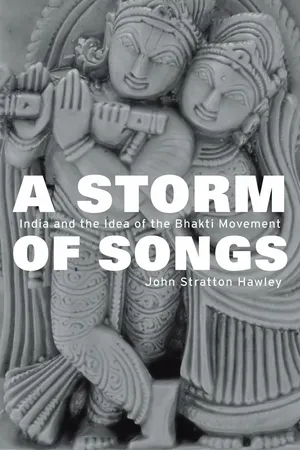
India celebrates itself as a nation of unity in diversity, but where does that sense of unity come from? One important source is a widely-accepted narrative called the "bhakti movement." Bhakti is the religion of the heart, of song, of common participation, of inner peace, of anguished protest. The idea known as the bhakti movement asserts that between 600 and 1600 CE, poet-saints sang bhakti from India's southernmost tip to its northern Himalayan heights, laying the religious bedrock upon which the modern state of India would be built.
Challenging this canonical narrative, John Stratton Hawley clarifies the historical and political contingencies that gave birth to the concept of the bhakti movement. Starting with the Mughals and their Kachvaha allies, North Indian groups looked to the Hindu South as a resource that would give religious and linguistic depth to their own collective history. Only in the early twentieth century did the idea of a bhakti "movement" crystallize—in the intellectual circle surrounding Rabindranath Tagore in Bengal. Interactions between Hindus and Muslims, between the sexes, between proud regional cultures, and between upper castes and Dalits are crucially embedded in the narrative, making it a powerful political resource.
A Storm of Songs ponders the destiny of the idea of the bhakti movement in a globalizing India. If bhakti is the beating heart of India, this is the story of how it was implanted there—and whether it can survive.
- 446 pages
- English
- ePUB (mobile friendly)
- Available on iOS & Android
eBook - ePub
About this book
Information
1
The Bhakti Movement and Its Discontents
The Bhakti Archive
The bhakti archive of India—its corpus of vernacular religious songs ready to be sung at any moment—provides the country with a sense of shared richness that has no peer. Individual gems of Sanskrit poetry may be cut finer, but vernacular bhakti digs deeper into the national soul. Bhakti poems in many Indian languages are sung and recited in homes, in the bazaar, in temples, on cassettes and CDs, in movies, in singing groups, in the fields, on the job. They are on the tongues of millions of individual Indians as they face a personal challenge or feel a moment of joy. They utter humor and protest, suffering and satisfaction; they bring to mind beloved realms of story; they are addressed to many gods, to one god, or none. And there are life stories of the singers to match.1
This living bhakti archive was an immense resource in the cause of national integration. It led everywhere—a gorgeous, finely woven fabric just waiting to be donned by the new nation-state. But why did it need to be narrativized to do so? Why did these expressions of bhakti, coming from all around the subcontinent and from many points in time, need to be consolidated into a single, seemingly definitive narrative as the first decades of the twentieth century progressed?
At a certain level the answer is simple. Nations need histories, as has been stressed in a spate of scholarly studies pioneered by Benedict Anderson’s Imagined Communities and Eric Hobsbawm and Terence Ranger’s The Invention of Tradition.2 Yet the Indian situation was more specific: Indians required a particular kind of history. Taught in British schools, their intellectual leaders were conditioned to expect a broad historiographical scheme that followed a tripartite progression from ancient to medieval to modern.
That framework proved hard to displace. What was easier to do was to reshape the medieval that lay at its core. Rather than assigning the long period between classical Gupta splendor and the latter-day greatness of British modernity to a long intervening lull in which Islamic polities were dominant, as British historians had done, their Indian counterparts worked to make the middle period more distinctively their own. The British largely told the story of their country’s rise to power in India as a benevolent alternative to a weakened Mughal state. Both regimes were foreign in origin, imposing themselves almost necessarily over the weak, balkanized mass that was India itself. Nationalist historians could not accept this. They required a sense of the medieval that gave indigenous coherence to this crucial period, even if its political impact was less than clear. Not only must it serve as a realm that could be interpreted as resisting a rule that was ultimately foreign (some granted that the Mughals eventually became quite domesticated), it had to have sufficient internal coherence to give birth at the same time to a distinctly indigenous modernity. It had to presage the independent Indian state and prepare its way. Appropriately narrativized, bhakti could do this job—and without overly alienating Indian Muslims, many of whom could be seen as forming part of the broader bhakti domain. After all, it was India—and specifically Indian bhakti—that made Indian Islam so different from what was to be seen in the Middle East.3
And so the stage was set, but before we pull back the curtain we need to introduce ourselves briefly to the songs themselves. To do that, suppose we start with Ravidās, whom we have already met. In the poem by which he is perhaps best known—attested already by the end of the sixteenth century—Ravidās speaks, so to speak, with his body. His makes his leatherworker’s stigma a part of the poem and shares it with his Lord, whose good name ironically depends on it. He wonders what the difference between them is anyway:
You and me, me and you: What difference does it make?
It’s like gold and a golden bracelet, water and a wave.
You who have no limits, if I didn’t sin
how could they call you Redeemer of Fallen Men?
You’re Leader, Controller, the one who rules within,
but lords are known by their people, people by their lord.
This body: I’m praying. Turn your thoughts to me.
Ravidās: Who else can explain what this mixing means?4
In another poem, similarly, Ravidās makes his lowly caste occupation serve as the specific theater of bhakti, turning the things of this world on their head:
I’ve never known how to tan or sew,
though people come to me for shoes.
I haven’t the needle to make the holes
or even the tool to cut the thread.
Others stitch and knot, and tie themselves in knots
while I, who do not knot, break free.
I keep saying Rām and Rām, says Ravidās,
and Death keeps his business to himself.5
Where do such poems come from? Not just from the experience of a particular individual—the usual explanation—but from long-shared genres and a deep history of oral intertextuality. Tagore was exploring this reality in “Sweet Mercy” when he attributed Ravidās’s inspiration to Rāmānand, a Vaishnava ascetic of the most expansive sort who was reputed to have been the great messenger between southern and northern bhakti traditions. If we let this hagiographical link be our cue, we can quickly see the kind of thing Tagore could have had in mind. The great ninth-century poet Nammāḻvār, artistic paragon of the Śrī Vaishnava sampradāy to which Rāmānand is held to have belonged, gave us the following meditation on the mystery of the self’s elusive dual/nondual involvement with the Lord, the sort of thing that was exposited by Ravidās in “You and Me.” Here are Nammāḻvār’s Tamil words in A. K. Ramanujan’s translation:
You dwell in heaven
stand on the sacred mountain
sleep on the ocean
roll around in the earth
yet hidden everywhere
you grow
invisibly:
moving within
numberless outer worlds
playing within my heart
yet not showing your body
will you always play hide and seek?6
If we look elsewhere in the great treasury of south Indian bhakti poetry, we can also find precedents for “I’ve never known how to tan or sew.” One interesting example is provided not by a Dalit poet simultaneously announcing and renouncing his stigmatized body and caste occupation, but by a woman poet who implicitly announces her gendered body while at the same time renouncing what the world thinks has to go with it: a decent regimen of garbing. This is the voice of the twelfth-century Kannada Shaiva poet Mahādevīakkā, who insisted on going about in public with no clothes:
People,
male and female,
blush when a cloth covering their shame
comes loose.
When the lord of lives
lives drowned without a face
in the world, how can you be modest?
When all the world is the eye of the lord,
onlooking everywhere, what can you
cover and conceal?7
The four poems we have just heard, with their intriguing pair of parallels, provide us with only a tiny sample of the echoes that sound across the range and depth of India’s bhakti archive, but even this sliver suggests the power of the resource upon which some of the architects of independent India hoped to draw as they advanced the cause of national integration by appealing to this countrywide bhakti legacy. And the more we know about this archive, the stronger seems its appeal. Beyond poems of contestation like these, and beyond the much broader genus to which they belong—poems that appeal to personal experience—lies a vast repertoire of bhakti compositions that open onto a different sort of narrative experience: widely known stories that appear in the Mahābhārata or Rāmāyaṇa, or tales of Krishna such as those that occupy a great swath of the Bhāgavata Purāna. We generally think of the epic texts where these tales appear as having been composed in Sanskrit, and the shoe certainly fits in the case of the Bhāgavata Purāna, but these have vernacular analogues as well—not just because the Sanskrit epics were translated into regional languages in the course of the second millennium C.E. but because the stories they contained had always had lives in the languages people actually spoke.
In Hindi a distinction is commonly made between nirguṇ and saguṇ aspects of bhakti poetry—“without attributes” and “with attributes.” These terms derive from a long-standing theological contrast between two ways of conceiving divinity—apophatic and world-infusing—and the contrasting stances that devotees must cultivate to approach the Deity in these very different modes. In regard to bhakti poetry, however, the contrast comes to have a related meaning: a contrast between the poetry of ordinary life (“attributeless” in this sense: lacking the plot of a divine narrative) and poetry that situates itself in the charmed (“attributeful”) realm of divine play or līlā—stories of how Rām and Sītā, Krishna and Radha, Shiva and Shakti, or a host of other divine figures lived their lives for a time as earthly beings. Bhakti poets speaking every major Indian language have piped into these līlās, creating a polyglot repository of devotional story that can be heard from one end of the country to the other. Poems of this sort complement poems we can imagine as reflecting the individual experience of Ravidās, Nammāḻvār, Mahādevīakkā, or any number of other poet-saints.
We can work back from sixteenth-century north India in this mode too, just as we earlier did with Ravidās. We might begin, for example, with a poem of Sūrdās in which he assumes the persona of a cowherding woman (gopī) who is concerned about a friend—perhaps Radha—who has been deserted by Krishna and is left forlorn. He must have chased off after another beauty, she suspects. Despite the fact that Sūrdās speaks through this woman of Braj, he must also register his own identity, as the Hindi genre in which he works demands, and he does this by “signing” what would originally have been an oral composition in the final verse:
Hand on her cheeks, Mother, arm around her knees,
she’s writing lines with her fingernails.
She sits with her worries and thoughts, lovely woman,
and contemplates his Love-god’s mouth and clothes.
Her eyes fill with tears. She heaves a set of sighs.
Herder girl, she damns the way so many days have passed
With the lotus-eyed one so far off in Mathura,
whose virtues even thousand-hooded serpents do not know.
Kānh has made a lie of the time he said he’d come.
If at night she sees more lightning, friend,
how will she survive?
Sūrdās’s Lord has come in a flash and gone,
a dancing street performer—
many costumes, many roles.8
We do not have to search long to find a parallel for this poem from the earlier south. Take Nammāḻvār. In the poem that follows, unlike that of Sūrdās, the personal presence behind the female persona he adopts is not indicated by an overt signature, but his identity is well understood by those who hear him, since his poems have been so carefully collected and are often performed in a liturgical moment where his role as an exemplary devotee is being celebrated. Here he speaks as a longing gopī:
Evening has come,
but not the Dark One.
The bulls,
their bells jingling,
have mated with the cows
and the cows are frisky.
The flutes play cruel songs,
bees flutter in their bright
white jasmine
and the blue-black lily.
The sea leaps into the sky
and cries aloud.
Without him here,
what shall I say?
how shall I survive?9
In songs such as these, bhakti poets of all regions and periods bivouac on the broad plain of shared Hindu narrative, and there are analogues from the Sufi side of things as well. Those Sufis tended also, however, to celebrate the fact that the world itself is structured as a testament to the imprint of its Creator. A Hindu poet who takes an interest in the fabulous domain of story—a saguṇ poet—may also stop to marvel at how the world is positivity shot through with divinity in its own terms, even before we discover a narrative line to expound and embroider that fact. Thus Tulsīdās, another sixteenth-century figure from north India, spoke for many when he said,
Knowing the whole world to be infused with Sītā and Rām,
I make my obeisance, pressing palm to palm.10
This couplet comes from the opening sections of Tulsī’s renowned Rāmcaritmānas (Spiritual Lake of the Acts of Rām), which he composed in the Avadhi dialect of Hindi, following the pattern of earlier Sufi epics. In many ways their impact on him is clear.11 Whether he was also aware of other vernacular Rāmāyaṇas that had been composed throughout the subcontinent before he attempted his own, we do not know, but by now it will come as no surprise that a Tamil Rāmāyaṇa composed by Kampaṉ preceded Tulsī’s by four centuries. In recasting the Rāmāyaṇa as an Avadhi text, Tulsīdās dr...
Table of contents
- Cover
- Title Page
- Copyright
- Dedication
- Contents
- Acknowledgments
- Transliteration and Pronunciation
- Introduction
- 1. The Bhakti Movement and Its Discontents
- 2. The Transit of Bhakti
- 3. The Four Sampradāys and the Commonwealth of Love
- 4. The View from Brindavan
- 5. Victory in the Cities of Victory
- 6. A Nation of Bhaktas
- 7. What Should the Bhakti Movement Be?
- Notes
- Bibliography
- Index
Trusted by 375,005 students
Access to over 1.5 million titles for a fair monthly price.
Study more efficiently using our study tools.
Frequently asked questions
Yes, you can cancel anytime from the Subscription tab in your account settings on the Perlego website. Your subscription will stay active until the end of your current billing period. Learn how to cancel your subscription
No, books cannot be downloaded as external files, such as PDFs, for use outside of Perlego. However, you can download books within the Perlego app for offline reading on mobile or tablet. Learn how to download books offline
Perlego offers two plans: Essential and Complete
- Essential is ideal for learners and professionals who enjoy exploring a wide range of subjects. Access the Essential Library with 800,000+ trusted titles and best-sellers across business, personal growth, and the humanities. Includes unlimited reading time and Standard Read Aloud voice.
- Complete: Perfect for advanced learners and researchers needing full, unrestricted access. Unlock 1.5M+ books across hundreds of subjects, including academic and specialized titles. The Complete Plan also includes advanced features like Premium Read Aloud and Research Assistant.
We are an online textbook subscription service, where you can get access to an entire online library for less than the price of a single book per month. With over 1.5 million books across 990+ topics, we’ve got you covered! Learn about our mission
Look out for the read-aloud symbol on your next book to see if you can listen to it. The read-aloud tool reads text aloud for you, highlighting the text as it is being read. You can pause it, speed it up and slow it down. Learn more about Read Aloud
Yes! You can use the Perlego app on both iOS and Android devices to read anytime, anywhere — even offline. Perfect for commutes or when you’re on the go.
Please note we cannot support devices running on iOS 13 and Android 7 or earlier. Learn more about using the app
Please note we cannot support devices running on iOS 13 and Android 7 or earlier. Learn more about using the app
Yes, you can access A Storm of Songs by John Stratton Hawley in PDF and/or ePUB format, as well as other popular books in History & Indian & South Asian History. We have over 1.5 million books available in our catalogue for you to explore.