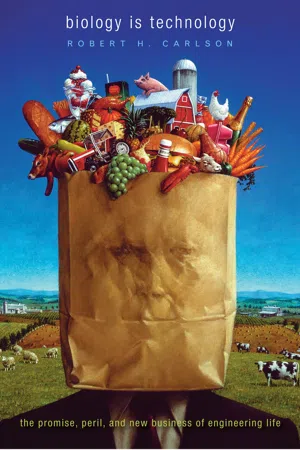
Technology is a process and a body of knowledge as much as a collection of artifacts. Biology is no different—and we are just beginning to comprehend the challenges inherent in the next stage of biology as a human technology. It is this critical moment, with its wide-ranging implications, that Robert Carlson considers in Biology Is Technology. He offers a uniquely informed perspective on the endeavors that contribute to current progress in this area—the science of biological systems and the technology used to manipulate them.
In a number of case studies, Carlson demonstrates that the development of new mathematical, computational, and laboratory tools will facilitate the engineering of biological artifacts—up to and including organisms and ecosystems. Exploring how this will happen, with reference to past technological advances, he explains how objects are constructed virtually, tested using sophisticated mathematical models, and finally constructed in the real world.
Such rapid increases in the power, availability, and application of biotechnology raise obvious questions about who gets to use it, and to what end. Carlson's thoughtful analysis offers rare insight into our choices about how to develop biological technologies and how these choices will determine the pace and effectiveness of innovation as a public good.
eBook - PDF
Biology Is Technology
The Promise, Peril, and New Business of Engineering Life
- 290 pages
- English
- PDF
- Available on iOS & Android
eBook - PDF
About this book
Information
Publisher
Harvard University PressYear
2010Print ISBN
9780674060159
9780674035447
eBook ISBN
9780674053625
Table of contents
- Contents
- Acknowledgments
- 1. What Is Biology?
- 2. Building with Biological Parts
- 3. Learning to Fly (or Yeast, Geese, and 747s)
- 4. The Second Coming of Synthetic Biology
- 5. A Future History of Biological Engineering
- 6. The Pace of Change in Biological Technologies
- 7. The International Genetically Engineered Machines Competition
- 8. Reprogramming Cells and Building Genomes
- 9. The Promise and Peril of Biological Technologies
- 10. The Sources of Innovation and the Effects of Existing and Proposed Regulations
- 11. Laying the Foundations for a Bioeconomy
- 12. Of Straitjackets and Springboards for Innovation
- 13. Open-Source Biology, or Open Biology?
- 14. What Makes a Revolution?
- Afterword
- Notes
- Index
Trusted by 375,005 students
Access to over 1.5 million titles for a fair monthly price.
Study more efficiently using our study tools.
Frequently asked questions
Yes, you can cancel anytime from the Subscription tab in your account settings on the Perlego website. Your subscription will stay active until the end of your current billing period. Learn how to cancel your subscription
No, books cannot be downloaded as external files, such as PDFs, for use outside of Perlego. However, you can download books within the Perlego app for offline reading on mobile or tablet. Learn how to download books offline
Perlego offers two plans: Essential and Complete
- Essential is ideal for learners and professionals who enjoy exploring a wide range of subjects. Access the Essential Library with 800,000+ trusted titles and best-sellers across business, personal growth, and the humanities. Includes unlimited reading time and Standard Read Aloud voice.
- Complete: Perfect for advanced learners and researchers needing full, unrestricted access. Unlock 1.5M+ books across hundreds of subjects, including academic and specialized titles. The Complete Plan also includes advanced features like Premium Read Aloud and Research Assistant.
We are an online textbook subscription service, where you can get access to an entire online library for less than the price of a single book per month. With over 1.5 million books across 990+ topics, we’ve got you covered! Learn about our mission
Look out for the read-aloud symbol on your next book to see if you can listen to it. The read-aloud tool reads text aloud for you, highlighting the text as it is being read. You can pause it, speed it up and slow it down. Learn more about Read Aloud
Yes! You can use the Perlego app on both iOS and Android devices to read anytime, anywhere — even offline. Perfect for commutes or when you’re on the go.
Please note we cannot support devices running on iOS 13 and Android 7 or earlier. Learn more about using the app
Please note we cannot support devices running on iOS 13 and Android 7 or earlier. Learn more about using the app
Yes, you can access Biology Is Technology by Robert H. Carlson in PDF and/or ePUB format, as well as other popular books in Biological Sciences & Business General. We have over 1.5 million books available in our catalogue for you to explore.