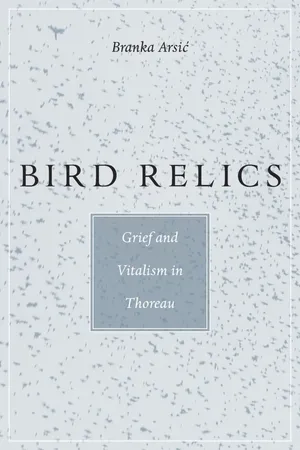
Birds were never far from Thoreau's mind. They wing their way through his writing just as they did through his cabin on Walden Pond, summoned or dismissed at whim by his whistles. Emblematic of life, death, and nature's endless capacity for renewal, birds offer passage into the loftiest currents of Thoreau's thought. What Branka Arsi? finds there is a theory of vitalism that Thoreau developed in response to his brother's death. Through grieving, Thoreau came to see life as a generative force into which everything dissolves. Death is not an annulment of life but the means of its transformation and reemergence.
Bird Relics traces Thoreau's evolving thoughts through his investigation of Greek philosophy and the influence of a group of Harvard vitalists who resisted the ideas of the naturalist Louis Agassiz. It takes into account materials often overlooked by critics: his Indian Notebooks and unpublished bird notebooks; his calendars that rewrite how we tell time; his charts of falling leaves, through which he develops a complex theory of decay; and his obsession with vegetal pathology, which inspires a novel understanding of the relationship between disease and health.
Arsi?'s radical reinterpretation of Thoreau's life philosophy gives new meaning to some of his more idiosyncratic habits, such as writing obituaries for people he did not know and frequenting estate sales, and raises important questions about the ethics of Thoreau's practice of appropriating the losses of others as if they were his own.
- 466 pages
- English
- ePUB (mobile friendly)
- Available on iOS & Android
eBook - ePub
About this book
Information
Part I
Dyonisia, 467 BC: The Mythology of Mourning
Introduction: Perpetual Grief and the Example of the Fish Hawks
IN DISCUSSING Emerson’s understanding of grief, Sharon Cameron argues that grief is for him shallow, because it doesn’t allow for “loss [to] injure the mourner’s bodily integrity, although the primitiveness of supposing it could establishes the fantasy connection” between the griever’s self and materiality of his loss.1 Cameron doesn’t specify why she considers the desire to have mourning alter the body to be primitive, but one might speculate that the primitiveness of such mixing of the self with what is material comes from its violating the presumably sophisticated Platonic-Christian paradigm where selves are ideal entities substantially different from bodies, never mixing with them. Contrary to such a paradigm the fantasy of a mourning that alters the body generates various illicit mixtures, such as that of a word that summons beings, or a mind that enters matter, blurring the boundaries between mourner and mourned, presence and loss—and perhaps even life and death.
But that primitive fantasy of grief is precisely what Thoreau took seriously. As early as 1839 he suggests in a Journal entry that grief is enlivening: “Make the most of your regrets-never smother your sorrow but tend and cherish it till it come to have a separate and integral interest. To regret deeply is to live afresh. By so doing you will be astonished to find yourself restored once more to all your emoluments” (J, 1, 85–86). Far from working on “economizing” his grief, as a modern mourner would do, Thoreau’s mourner is here asked to dedicate himself completely to grief, to intensify it until it occupies him integrally, becoming identical with his life, which it will keep revitalizing (“to regret deeply is to live afresh”). This identification of the mourner’s life with his grief will raise many disturbing questions, not the least of which is the following: if grief is not only a feeling of loss but also the mind’s commitment to what is lost, isn’t Thoreau’s insistence that the mourner’s grief coincide with his life also to be understood as his desire that the mourner’s life somehow coincide with what has been lost?
Already here we can start to register the profound paradoxes of grief that Cameron calls primitive, which the chapters that follow will detail. For instance, if Thoreau imagines grief as the mourner’s becoming who has been lost, what then remains of grief? Isn’t the mourner’s distance from the loss, his maintaining the boundaries of his grieving self, a necessary condition for grief to occur? Moreover, when Thoreau says that deep grief refreshes life, are we to understand this regeneration as merely figural, or as a profound psychological transformation, perhaps, even a sort of actual, as it were, material transmutation? And, if grief is something that brings, as Thoreau puts it, “astonishment” by restoring our once achieved but now lost gains (we will find ourselves “restored once more to all [our] emoluments”), then isn’t it in fact closer to how we understand happiness? And what kind of grief could we imagine as identical with happiness? The Journal entry I quoted above may be too short and cryptic to even begin to answer these questions, and my questions may in turn be too logical—pedantically guided by a categorical belief in noncontradiction, for which Thoreau never had any particular respect—but they point to what will be the major feature of his understanding of grief: grief is uneconomical, committed to the lost rather than to those who survive, and in the end unending.
The most intense challenge to Thoreau’s understanding of grief and commitment to loss came from personal experience. On January 11, 1842, his brother John died. Thoreau reacted to that death by means of the very grief Emerson thought impossible, by ravaging his body, developing symptoms of John’s illness—a reaction to which I later return in detail—as if wanting to die his brother’s death in an effort to defy the boundaries between survivor and the dead. The symptoms withdrew but the grief remained, mobilizing various interests that Thoreau already had—in natural history, ichthyology, epistemology, and Greek mythology—into a theory of grief that Thoreau will call “perpetual.”
That such a theory was in the making can be seen in a letter Thoreau sent to Lucy Brown after John’s death, where he suggested that not humans but “only nature has a right to grieve perpetually” (C, 102). Some critics have understood the phrase “perpetual mourning” metaphorically, while others think it meaningless or obscure. But in the Greek literature Thoreau had been reading both in the original and in translation ever since his Harvard years (some of which he even translated—Homer, Sophocles, Euripides, Pindar), the phrase “perpetual mourning” [álaston pénthos] is imbued with rigorous philosophical meaning. Tros uses it when he laments his son Ganymede in the Homeric Hymn to Aphrodite.2 In the Iliad and Odyssey—arguably Thoreau’s two most important literary texts—it is used numerous times. For instance, it is the phrase used by Achilles, whom Thoreau always praised as the greatest of heroes, in refusing Hector’s desire to “exchange a reciprocal promise not to mutilate the corpse of the dead enemy.”3 Eumaeus uses it in conversing with Odysseus: Butler renders it as perpetual pain (“it always pains me”), Fagels as unstoppable grief (“How I grieve for him now, I can’t stop”), Loraux as “grief without forgetting.”4 Similarly, in book four of the Odyssey, Helen uses a drug to “tear Telemachus and Menelaus away from Odysseus’s álaston pénthos.”5 Famously, at the very end, Eupithes uses the term to refer to his grief for his son Antinous, Odysseus’s first victim (“Old lord Eupithes rose in their midst to speak out. / Unforgettable sorrow wrung his heart for his son, / Antinous, the first that great Odysseus killed”).6 “Unforgettable sorrow” or “unforgetting mourning”7 is in each case álaston pénthos, the phrase by which the Greeks referred to a perpetually self-renewing grief (pénthos) abiding in nonoblivion (álaston).
Nicole Loraux, whose work on “amnesty and its opposite” is perhaps the most systematic engagement with the question of perpetual grief that is available to us, explains that like alétheia [truth], álastos “is built on a negation [á] of the root of oblivion.” It is a negation that generates a radically positive existence in nonoblivion: “In fact, we may guess that, in nonoblivion, the negation must be understood in its performativeness: the ‘unforgetting’ establishes itself.”8 An unforgetting of the loss settles into the mourner, then, as if it were a kind of growing being that expands until the mourner—just as in Thoreau’s description of deep regret—is completely occupied and so identified with it: “there is an obsessive component to álaston, a relentless presence that occupies, in the strong sense of the word, the subject and does not leave.”9 Such a grief can perpetually gesture toward the loss only if it never forgets to grieve, or, as Loraux puts it, only if it turns itself into “the oblivion of nonoblivion,10 “occupying” the grieving subject “in a strong sense”: “nonoblivion is all-powerful insofar as it has no limits—and especially not those of a subject’s interiority.”11 Thus, when Loraux claims that we should think of Greek unforgetting mourning as a performative, she is in fact suggesting that far from resembling the emotional state or psychic pathos of the modern Freudian mourner, álaston pénthos literally changes the mood or modality of an existence. It is less a psychic than an ontological power, capable of creating illicit ontological mixtures between object and subject, mind and matter, living and dead. Above all, as Loraux insists, this grief is material: “concerning nonoblivion, I would prefer to insist on its materiality, indissociable from its psychic dimension.… Encompassing time and space completely, nonoblivion is everywhere.… It is there for the materiality of the álaston that silently keeps watch against oblivion.”12
This nonoblivious grief, which enacts the presence of a loss on the way to completely possessing the survivor, is an obvious paradox. On the one hand, if the álaston pénthos perpetuates itself, it is because it wants to make what is lost constantly visible, drawing it into presence (alétheia). In causing to appear what isn’t or what is not apparent, which for the Greeks is the same thing, grief changes the mode of being—the ontology—of what is not into what is, but it can do so only as long as it perpetuates itself, imbuing what is lost with its own force. Thoreau could have found the example of this uncertain divide between grief and its object in Sophocles’s Antigone, a tragedy that preoccupies him so much that he dedicates to it a series of mediations on burials in A Week. In that play, Creon, bearing the body of his son Haemon, is greeted by a messenger who tells him “master … you have come bearing these griefs in your arms”; or, similarly, after hearing of his son’s death and on being allowed to see the dead body of his wife Eurydice, Creon exclaims “Oimoi, … I see a second grief! … I have just held my son pitifully in my arms, and I behold her, a corpse, before my eyes.”13 Or he could have registered it even more explicitly in Euripides’s Bacchae, also the subject of commentary in A Week. There, Cadmus is seen carrying the remains of his grandson Pentheus and addressing the Theban citizens by saying: “I’ve brought the body back: I searched forever. It was in the folds of Cithaeron, torn to shreds, / scattered through the impenetrable forest, / no two parts of him in any single spot … I turned back again, up to the mountain, where I gathered the body of this boy.… I cannot watch this. This is grief that has no measure.”14 Cadmus’s “extreme grief,” as Loraux also calls it, is not only a state of mind but also the object grieved, for the name of his dead grandson precisely signifies mourning (pénthos). Cadmus grieves the grandson whose dead body embodies mourning itself (when Cadmus later says to Agave “yes, now you know, I mourn Pentheus,” it is as if he were saying “yes, I mourn mourning,” where this second mourning is, in fact, the object that is lost).15 And because his grief transcends the internal condition of his mind, being both an emotional condition and an external object causing that condition, it never reduces to a psychic operation or to the mental labor of recollecting, which it will later become for the Christian mind. As Loraux puts it, it is “much more than a simple inner state. At the same time outside and inside, sinister reality and psychic experience.”16
In Greek tragedy this material mourning expresses itself by means of the interjection aei. Thoreau’s translation of Sophocles renders it as “aie” or “alas, O,” or “Oh, Oh,” but it has the sense of “always.” As Loraux explains, “ ‘always’ is the standard, though imperfect, translation given for the adverb aei. If, however, we wished to examine the meaning of this term more closely, Emile Benveniste’s essay “Expression indo-européenne de l’immortalité” on the notion of aiōn sheds vivid light on the subject.”17 Benveniste’s seminal argument is twofold. On the one hand—and this elucidates why Thoreau correctly understood álaston pénthos as perpetual grief—Benveniste explains how it is that “always” (what is perpetual and, as it were, atemporal) is reconciled with a human temporality (birth, growth, and aging) that is incapable of eternity: “This ‘always’ indicates what perpetually recommences before being a permanent and immobile “always.”18 Benveniste suggests, then, that “always” was not previously understood to mean “stationary”; instead, for many centuries Eastern and Greek thought conceived of eternity not as stagnant but closer to the logic of human time, as incessantly agitated. As Benveniste explains, that agitation interminably perpetuates itself, constantly returning to itself; it is repetitive, ritualistic, and inexhaustible, hence enduring “forever.” On the other hand, which also explains why mourning expressed by aei should be understood as “material,” Benveniste determines a “convergence between aiōn, defined as designating primarily the ‘vital force’ [that is, as ontological force that materially creates beings], and adverbs derived from related forms that in the neuter mean ‘always.’ ”19 After discussing examples from Eastern thought, the Homeric hymn to Hermes, numerous instances from the Iliad and the Odyssey, as well as Pindar’s fragment (111, 5; one should remember here that Thoreau translated Pindar’s fragments for The Dial in 1843) Benveniste concludes:
It is through a vital and immediate experience that the first thinkers of India and Greece conceived of eternity. The history of aei and especially of aiōn teaches us that this concept derives from a human and almost physical representation; the force that animates being and makes it live. This force is both one and double, transitory and permanent, being exhausted and reborn throughout generations, annulling itself in its renewal and subsisting forever by means of its always recommenced finitude. When aiōn becomes the name of “eternity” and therefore the universal mode of becoming, it is understood that the cosmic aiōn reproduces the structure of the human aiōn. There will be a necessary conformity between the two, because the force of life, implying the incessant recreation of the principle that nourishes it, suggests to thinking the most instant image of what is maintained endlessly in the freshness of what is always new.20
In a manner similar to Thoreau’s understanding of the concept, Benveniste’s analysis points to what we modern latecomers disqualify as magical thought, namely, the metaphysical slippage of word into matter and of promise into corporeal regeneration. For when the mournful “always” (aei) is cried out, it doesn’t only promise that the loss will be forever remembered, but also expresses the desire to access loss as a vital force, a force with the capacity to gather bodies into forms. Each time aei is u...
Table of contents
- Cover
- Title Page
- Copyright
- Dedication
- Contents
- Abbreviations
- Epigraph
- Introduction: On Affirmative Reading, or The Lesson of the Chickadees
- Part I: Dyonisia, 467 BC: The Mythology of Mourning
- Part II: Cambridge, Massachusetts, circa 1837: The Science of Life
- Part III: Walden Pond, Concord, Massachusetts, 1845: Epistemology of Change
- Part IV: Ossossané Village, Ontario, 1636: Acts of Recollecting
- Appendix I: Freud and Benjamin on Nature in Mourning
- Appendix II: On Thoreau’s Grave
- Notes
- Acknowledgments
- Index
Trusted by 375,005 students
Access to over 1.5 million titles for a fair monthly price.
Study more efficiently using our study tools.
Frequently asked questions
Yes, you can cancel anytime from the Subscription tab in your account settings on the Perlego website. Your subscription will stay active until the end of your current billing period. Learn how to cancel your subscription
No, books cannot be downloaded as external files, such as PDFs, for use outside of Perlego. However, you can download books within the Perlego app for offline reading on mobile or tablet. Learn how to download books offline
Perlego offers two plans: Essential and Complete
- Essential is ideal for learners and professionals who enjoy exploring a wide range of subjects. Access the Essential Library with 800,000+ trusted titles and best-sellers across business, personal growth, and the humanities. Includes unlimited reading time and Standard Read Aloud voice.
- Complete: Perfect for advanced learners and researchers needing full, unrestricted access. Unlock 1.5M+ books across hundreds of subjects, including academic and specialized titles. The Complete Plan also includes advanced features like Premium Read Aloud and Research Assistant.
We are an online textbook subscription service, where you can get access to an entire online library for less than the price of a single book per month. With over 1.5 million books across 990+ topics, we’ve got you covered! Learn about our mission
Look out for the read-aloud symbol on your next book to see if you can listen to it. The read-aloud tool reads text aloud for you, highlighting the text as it is being read. You can pause it, speed it up and slow it down. Learn more about Read Aloud
Yes! You can use the Perlego app on both iOS and Android devices to read anytime, anywhere — even offline. Perfect for commutes or when you’re on the go.
Please note we cannot support devices running on iOS 13 and Android 7 or earlier. Learn more about using the app
Please note we cannot support devices running on iOS 13 and Android 7 or earlier. Learn more about using the app
Yes, you can access Bird Relics by Branka Arsić in PDF and/or ePUB format, as well as other popular books in Literature & North American Literary Criticism. We have over 1.5 million books available in our catalogue for you to explore.