Noise, as we usually think of it, is background sound that interferes with our ability to hear more interesting sounds. In general terms, though, it is anything that interferes with the reception of signals of any sort. It includes extraneous energy in the environment, degradation of signals in transit, and spontaneous random activity in receivers and signalers. Whatever the cause, the consequence of noise is error by receivers, and these errors are the key to understanding how noise shapes the evolution of communication.
Noise Matters breaks new ground in the scientific understanding of how communication evolves in the presence of noise. Combining insights of signal detection theory with evidence from decades of his own original research, Haven Wiley explains the profound effects of noise on the evolution of communication. The coevolution of signalers and receivers does not result in ideal, noise-free communication, Wiley finds. Instead, signalers and receivers evolve to a joint equilibrium in which communication is effective but never error-free. Noise is inescapable in the evolution of communication.
Wiley's comprehensive approach considers communication on many different levels of biological organization, from cells to individual organisms, including humans. Social interactions, such as honesty, mate choice, and cooperation, are reassessed in the light of noisy communication. The final sections demonstrate that noise even affects how we think about human language, science, subjectivity, and freedom. Noise Matters thus contributes to understanding the behavior of animals, including ourselves.
- 506 pages
- English
- ePUB (mobile friendly)
- Available on iOS & Android
eBook - ePub
About this book
Information
Topic
Ciencias biológicasSubtopic
BiologíaPART ONE
NOISE AND WAYS TO REDUCE IT
REALIZING THE WAYS in which animals manage their lives in a noisy world is a first step in understanding how communication evolves. Noise proves to be a pervasive theme for understanding communication. It takes many forms, as Chapter 1 explains. It also introduces a continuing, although not exclusive, focus of this book on acoustic communication. Sound is particularly easy to study, and thus acoustic communication provides many examples for discussion. Chapters 2 and 3 examine production and perception of sounds as ways to deal with noisy communication. In Chapter 4, the changes in sounds during transmission through natural environments suggest ways that animals might adapt to minimize these changes. Attenuation and degradation of sounds during transmission increase noise, especially at long range, and long-range communication is a specialty of many animals. Chapters 5 and 6 are then in a position to consider more complex ways that signalers and receivers might counteract noise in communication. All of these means for dealing with noise take us a long way in understanding the evolution of communication in noise. Nevertheless, the chapters in Part II will reveal some fundamental issues that remain.
1
NOISE AND SIGNALS INTRODUCED
NOISE AS ERRORS BY RECEIVERS
NOISE, AS WE USUALLY THINK OF IT, is sound that has no interest for us yet makes sounds of interest hard to hear. As a result of noise, we make mistakes. We sometimes misinterpret what we hear or miss important information. However intuitively sensible, this informal understanding of noise has several shortcomings. First, what counts as noise changes from person to person and from situation to situation. It seems entirely subjective. Furthermore, our intuition about noise focuses on sound, but other sensory modalities have similar issues.
To an objective observer, the only sure indication of noise is the receiver’s mistakes. By determining which features of the situation result in mistakes, we can determine the properties of the relevant noise. By focusing on the receiver’s mistakes, we not only avoid the reliance on subjectivity but can easily extend our studies to any modality. The first person to realize that receivers’ errors are the key to understanding noise in communication was Claude Shannon in his seminal 1948 paper “The Mathematical Theory of Communication.” He diagrams noise (see Figure 1.1) as an additional source that becomes mixed with the source of information. To measure noise he proposes “an observer (or auxiliary device) who can see both what is sent and what is recovered (with errors due to noise). This observer notes the errors in the recovered message and [can send data to the receiver] to correct the errors.” His measure of noise is the amount of information necessary to correct the receiver’s errors.
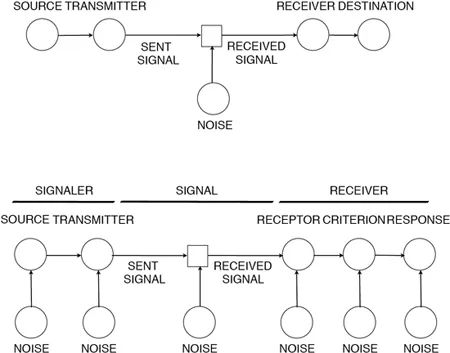
FIGURE 1.1. Diagrams of noisy communication. On top is an adaptation of Shannon’s diagram (1948), which indicates that noise alters a signal during transmission from a signaler to a receiver. He nevertheless describes an independent observer studying noise by recording errors by the receiver. A diagram of noisy communication should thus include not only alterations during transmission but alterations (errors) by the receiver and also alterations (errors) by the signaler. The bottom diagram shows this comprehensive view of noisy communication. It also includes the components of a signaler and a receiver, described in more detail in Part II.
Shannon’s insight that noise is measured by a receiver’s errors makes it clear that we cannot separate the notion of noise from receivers’ errors. The causes of these errors are manifold. Not all of them originate in the receiver itself. They include extraneous sources of energy that mix with signals and mask them or otherwise confuse receivers. In addition, noise results from any degradation of signals that makes them less certainly detected or discriminated. Noise also results from internal errors of signalers as well as those of receivers. In all cases, though, the consequence of noise is error by receivers.
AN AVIAN EXAMPLE
Consider a songbird, such as the Hooded Warbler that my students and I studied for more than a decade in North Carolina. During spring and summer, male Hooded Warblers produce loud songs within their territories, areas some 10 hectares (25 acres) in size that are defended aggressively against other males of the same species. Our experiments, described in more detail in later chapters, showed that these songs are signals that males use in order to advertise their territories and that other males use to recognize the presence and identity of rivals or neighbors. It is possible that they are also signals that females use in making their choices of where and with whom to mate. A male Hooded Warbler sings its ten or so patterns over and over. Each pattern varies only slightly in successive performances, so in this respect they are like human songs with a recognizable melody. Each of these patterns has features shared by the songs of all Hooded Warblers, but each also has some features peculiar to the individual singer. By the time the sound of one of these songs has traveled 50 and even as much as 200 meters through a forest to a potential listener, it has changed considerably. Reverberations as a result of reflections from solid surfaces, such as trunks and foliage of trees, and attenuation, as a result of scattering from foliage and absorption by molecules in the atmosphere, in addition to spreading, alter almost every feature of the song. The song has been transformed. Comparisons of a song recorded close to a singing male and at a distance through a forest show that most of the details vanish in transmission.
In addition to signals, which are those patterns of energy of interest to a receiver, there is always energy of no interest to a receiver but nevertheless affecting its sensory receptors. A warbler listening to singing males also hears other sound. Some extraneous sound comes from nearly “white” noise (with a wide spectrum of frequencies) from rustling of nearby foliage or from “pink” noise (with low frequencies predominating) of traffic on highways up to two or more kilometers away. Rain and running water produce noise in a wide spectrum of frequencies and patterns too. In rain many birds simply stop singing (and presumably listening too).
A listening Hooded Warbler also has to deal with many other species signaling at the same time. Of species in the same forest where we worked, the Red-eyed Vireo routinely produces a song that so closely resembles a Hooded Warbler’s song at a distance that I myself never managed to avoid momentary false alarms when listening for distant warblers. It remains an unanswered question whether or not Hooded Warblers are similarly misled. It is also possible that some of the songs of these warblers are deceptive. One reason neighboring males share similar song patterns could be that inexperienced young males mimic established older males in order to improve their chances of attracting females or discouraging intruders. For some potential listeners, these deceptive signals might result in erroneous responses.
Finally, there is variation in the physiology of the cells in the warblers’ nervous systems. Singing males do not, and presumably cannot, produce exact copies of any one song pattern. Male birds are remarkably good at replicating their song patterns, but careful analysis of their songs shows that they are not perfect. Listeners are also not perfect. Our experiments with playbacks of Hooded Warblers’ songs revealed that responses by listening warblers are obviously less than perfectly predictable, even when variation in the signal and in the situation are standardized.
The example of Hooded Warblers introduces all of the sources of noise in communication. The first category of noise is extraneous energy that affects the sensory receptors of receivers. Often this includes random energy in the environment, diffuse sources of energy that are predictable only as statistical ensembles. On some occasions, however, this background energy includes particular patterns, such as signals of other species, that resemble signals of interest to a particular receiver. Furthermore, some patterns of irrelevant energy not only resemble signals of interest by chance but have so evolved to deceive a receiver. A second category of noise arises from degradation of signals during transmission from the sender to the receiver. This degradation usually includes random changes, so the receiver encounters signals partially altered in unpredictable ways from their original structure. These two sources of noise are environmental. A third category of noise arises within the signaler or the receiver. Both parties’ nervous systems have an element of randomness, so some noise in communication must result from the participants’ internal errors in producing or responding to signals. Shannon recognized this source of noise also (although it is omitted from his diagram). He described a noisy channel as one in which “the signal is perturbed by noise during transmission or at one or the other of the terminals.” There are thus internal sources of noise as well as external ones.
The first category of noise comprises three progressively more specific forms of extraneous energy affecting a receiver’s sensory receptors. First is energy from inanimate sources. More specific is that from other species’ signals. Finally there is energy from signals of other individuals of the same species but nevertheless not relevant for a particular receiver. The last two categories result from deterioration of a signal’s properties and associations, either during transmission between signaler and receiver or during internal processing by signaler or receiver. All result in the characteristic feature of noise—errors in receivers’ responses to signals.
SIGNALS AS THE MEDIUM FOR INFORMATION
The example of the warblers also emphasizes another important feature of communication—information. Shannon’s paper, in addition to providing a clear proposal for measuring noise, did the same for measuring information. He proposed that the amount of information in a series of signals depends on the probabilities of those signals. In his widely known equation, the amount of information (H) equals –1 times the grand sum of the probability of occurrence of each signal times the logarithm of its probability: H = −Σ pi log2 pi, with pi = probability of occurrence of signal i. Notice that the logarithms are taken with a base of 2 (not the usual 10 or e). Shannon and Warren Weaver in their well-known 1963 book describe how this formula is not only the simplest one that satisfies our intuitive idea of an “amount of information” but also has a straightforward interpretation. It is intuitive because a series of the same signal repeated without alternatives (pi = 1.0) conveys no information, and a series of n signals in which each signal occurs with pi = 1/n conveys the most information possible for a series of that length. With logarithms to the base 2, H becomes the average number of binary (yes-or-no) questions necessary to guess the next signal in a series. The more guesses necessary, on average, the more information is conveyed by the arrival of the next signal. A signal conveys a lot of information when it settles a lot of questions. The upshot is that signals with greater unpredictability encode more information. Information is the negative of predictability.
What Shannon and Weaver do not emphasize is what constitutes a signal. Yet it is clear from Shannon’s discussion of noise and information that a signal must be energy or matter that a receiver can discriminate from other sources of energy or matter. In other words, a signal must have identifying features or properties. In could be a single feature in a restricted place or time, such as a spot of matter that reflects light with the wavelengths of red or a sound of limited duration with a particular wavelength.
Wavelength is directly related to the velocity of a wave and inversely related to its frequency (at least for light and sound as we normally experience them): wavelength equals velocity divided by frequency. Frequency (and hence wavelength) determine the color of light (visible electromagnetic radiation) and the pitch of sound (waves of pressure). So the dominant pitch of a middle A on a piano has a frequency of 440 Hz (hertz, the standard international unit for cycles per second). The velocity of sound in air on the surface of the earth is about 340 meters per second. So the wavelength of a middle A is slightly more than 3/4 meter. Hitting a middle A on a piano produces a signal that we can discriminate from a signal produced by hitting a middle C or any other note.
Suppose we wanted to know what tune a pianist would play next (let’s assume the pianist is a beginner and only picks out tunes with one finger, one note at a time). The first note this pianist hits provides some information about the tune that is coming. There are 88 keys on a standard piano these days, so the information from the first key might be H = −88 (1/88) log2 (1/88) = 6.46 bits (short for binary digits because we are using logarithms to the base 2) or the average number of yes-or-no questions we would need to guess this key. Actually, the bits of information would be considerably fewer, because tunes usually start with a note near the middle of the keyboard, so the actual probability of different starting notes is much higher than 1/88.
To revert to the previous example, notice that our Hooded Warblers face a similar problem. What species’ (and perhaps what individual’s) song do I (speaking for a warbler) hear? The first note provides some information, which in principle is measurable, as just described. The first note is usually not enough, however, to identify the species and individual, any more than a single note can identify a human tune. Signals usually do not consist of a single feature at a particular time or place, but instead a combination of features arranged in time and space. In other words, signals are patterns of features in time and space. They might be a pattern of tones in time (such as our beginning pianist might play or a bird might sing). It could have extraordinary complexity, such as a romantic symphony or some birds’ songs. It could consist of multiple frequencies (tones) at a time, or multiple simultaneous frequencies varying in time. The pattern could be a spatial arrangement of colors. Simultaneous colors (frequencies of light waves) might vary in space to produce varying hues in complex spatial arrangements. A signal could be a dollop of molecules emitted into the air or water or deposited on a twig or the ground. The dollop might contain several kinds of molecules.
In all cases a signal is the predictable temporal and spatial association of its features. The predictable association of features makes a pattern. To the extent that they are predictably associated, the different features of a signal do not themselves convey information. They instead serve to differentiate one signal from other possible signals and from irrelevant features of the environment, the background against which a receiver perceives the signal. To respond to a signal, receivers must detect it (determine that it has occurred) and usually must discriminate it from others (distinguish it from other possible signals that might occur). Signals in the form of patterns of energy or matter serve for both detection and discrimination.
Another issue that Shannon and Weaver do not discuss is what kind of information a signal conveys (as opposed to how much information it conveys). To tell the truth, their discussion of information often seems diametrically opposed to any commonsense understanding of information. Most people think of information as about something, and their primary concern is the reliability of information. The quantity of information, as discussed by Shannon and Weaver, and its quality, as conceived by most people, constitute two distinct aspects of information. On the one hand, the quantity of information a signal conveys, as Shannon explains, is related to how unexpected it is. A signal that can be predicted with high assurance cannot provide much information for a receiver, regardless of what the information is about. On the other hand, the quality of information conveyed by a signal is related to which events or situations are associated with its occurrence.
For instance, signals correlated with the presence of a potential predator or a potential mate might be similarly unexpected, and thus might convey similar amounts of information, but nevertheless might evoke contrasting responses from a receiver—at least from one that maximizes its survival and reproduction. Shannon’s formula is the appropriate measure for the amount of information conveyed by signals; the statistical correlation or association between signals and other events or situations is the appropriate measure for the quality of information. The stronger the statistical corre...
Table of contents
- Cover
- Title Page
- Copyright
- Dedication
- Contents
- List of Figures
- Introduction
- Part One: Noise and Ways to Reduce It
- Part Two: Evolution of Signalers and Receivers
- Part Three: Altered Perspectives
- Part Four: Far Horizons
- Conclusion
- Bibliographic and Other Notes
- Acknowledgments
- Index
Trusted by 375,005 students
Access to over 1.5 million titles for a fair monthly price.
Study more efficiently using our study tools.
Frequently asked questions
Yes, you can cancel anytime from the Subscription tab in your account settings on the Perlego website. Your subscription will stay active until the end of your current billing period. Learn how to cancel your subscription
No, books cannot be downloaded as external files, such as PDFs, for use outside of Perlego. However, you can download books within the Perlego app for offline reading on mobile or tablet. Learn how to download books offline
Perlego offers two plans: Essential and Complete
- Essential is ideal for learners and professionals who enjoy exploring a wide range of subjects. Access the Essential Library with 800,000+ trusted titles and best-sellers across business, personal growth, and the humanities. Includes unlimited reading time and Standard Read Aloud voice.
- Complete: Perfect for advanced learners and researchers needing full, unrestricted access. Unlock 1.5M+ books across hundreds of subjects, including academic and specialized titles. The Complete Plan also includes advanced features like Premium Read Aloud and Research Assistant.
We are an online textbook subscription service, where you can get access to an entire online library for less than the price of a single book per month. With over 1.5 million books across 990+ topics, we’ve got you covered! Learn about our mission
Look out for the read-aloud symbol on your next book to see if you can listen to it. The read-aloud tool reads text aloud for you, highlighting the text as it is being read. You can pause it, speed it up and slow it down. Learn more about Read Aloud
Yes! You can use the Perlego app on both iOS and Android devices to read anytime, anywhere — even offline. Perfect for commutes or when you’re on the go.
Please note we cannot support devices running on iOS 13 and Android 7 or earlier. Learn more about using the app
Please note we cannot support devices running on iOS 13 and Android 7 or earlier. Learn more about using the app
Yes, you can access Noise Matters by R. Haven Wiley in PDF and/or ePUB format, as well as other popular books in Ciencias biológicas & Biología. We have over 1.5 million books available in our catalogue for you to explore.