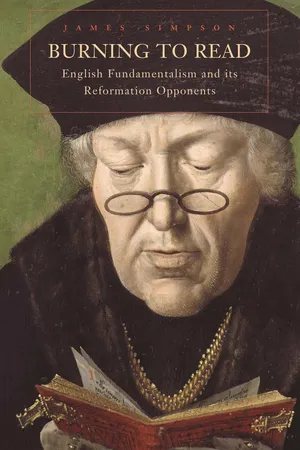
The evidence is everywhere: fundamentalist reading can stir passions and provoke violence that changes the world. Amid such present-day conflagrations, this illuminating book reminds us of the sources, and profound consequences, of Christian fundamentalism in the sixteenth century.
James Simpson focuses on a critical moment in early modern England, specifically the cultural transformation that allowed common folk to read the Bible for the first time. Widely understood and accepted as the grounding moment of liberalism, this was actually, Simpson tells us, the source of fundamentalism, and of different kinds of persecutory violence. His argument overturns a widely held interpretation of sixteenth-century Protestant reading--and a crucial tenet of the liberal tradition.
After exploring the heroism and achievements of sixteenth-century English Lutherans, particularly William Tyndale, Burning to Read turns to the bad news of the Lutheran Bible. Simpson outlines the dark, dynamic, yet demeaning paradoxes of Lutheran reading: its demands that readers hate the biblical text before they can love it; that they be constantly on the lookout for unreadable signs of their own salvation; that evangelical readers be prepared to repudiate friends and all tradition on the basis of their personal reading of Scripture. Such reading practice provoked violence not only against Lutheranism's stated enemies, as Simpson demonstrates; it also prompted psychological violence and permanent schism within its own adherents.
The last wave of fundamentalist reading in the West provoked 150 years of violent upheaval; as we approach a second wave, this powerful book alerts us to our peril.
- 361 pages
- English
- PDF
- Available on iOS & Android
eBook - PDF
About this book
Information
Topic
Theology & ReligionSubtopic
British HistoryTable of contents
- Contents
- Introduction
- 1 Two Hundred Years of Biblical Violence
- 2 Good Bible News
- 3 Salvation, Reading, and Textual Hatred
- 4 The Literal Sense and Predestination
- 5 Bible Reading, Persecution, and Paranoia
- 6 History as Error
- 7 Thomas More and Textual Trust
- 8 The Tragic Scene of Early Modern Reading
- Abbreviations
- Notes
- Index
Trusted by 375,005 students
Access to over 1.5 million titles for a fair monthly price.
Study more efficiently using our study tools.
Frequently asked questions
Yes, you can cancel anytime from the Subscription tab in your account settings on the Perlego website. Your subscription will stay active until the end of your current billing period. Learn how to cancel your subscription
No, books cannot be downloaded as external files, such as PDFs, for use outside of Perlego. However, you can download books within the Perlego app for offline reading on mobile or tablet. Learn how to download books offline
Perlego offers two plans: Essential and Complete
- Essential is ideal for learners and professionals who enjoy exploring a wide range of subjects. Access the Essential Library with 800,000+ trusted titles and best-sellers across business, personal growth, and the humanities. Includes unlimited reading time and Standard Read Aloud voice.
- Complete: Perfect for advanced learners and researchers needing full, unrestricted access. Unlock 1.5M+ books across hundreds of subjects, including academic and specialized titles. The Complete Plan also includes advanced features like Premium Read Aloud and Research Assistant.
We are an online textbook subscription service, where you can get access to an entire online library for less than the price of a single book per month. With over 1.5 million books across 990+ topics, we’ve got you covered! Learn about our mission
Look out for the read-aloud symbol on your next book to see if you can listen to it. The read-aloud tool reads text aloud for you, highlighting the text as it is being read. You can pause it, speed it up and slow it down. Learn more about Read Aloud
Yes! You can use the Perlego app on both iOS and Android devices to read anytime, anywhere — even offline. Perfect for commutes or when you’re on the go.
Please note we cannot support devices running on iOS 13 and Android 7 or earlier. Learn more about using the app
Please note we cannot support devices running on iOS 13 and Android 7 or earlier. Learn more about using the app
Yes, you can access Burning to Read by James Simpson in PDF and/or ePUB format, as well as other popular books in Theology & Religion & British History. We have over 1.5 million books available in our catalogue for you to explore.