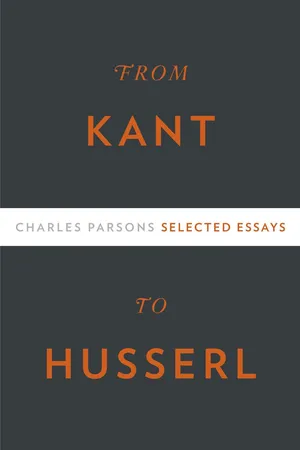
In From Kant to Husserl, Charles Parsons examines a wide range of historical opinion on philosophical questions, from mathematics to phenomenology. Amplifying his early ideas on Kant's philosophy of arithmetic, Parsons uses Kant's lectures on metaphysics to explore how his arithmetical concepts relate to the categories. He then turns to early reactions by two immediate successors of Kant, Johann Schultz and Bernard Bolzano, to shed light on disputed questions regarding interpretation of Kant's philosophy of mathematics. Interested, as well, in what Kant meant by "pure natural science," Parsons considers the relationship between the first Critique and the Metaphysical Foundations of Natural Science. His commentary on Kant's Transcendental Aesthetic departs from mathematics to engage the vexed question of what it tells about the meaning of Kant's transcendental idealism.
Proceeding on to phenomenology, Parsons examines Frege's evolving idea of extensions, his attitude toward set theory, and his correspondence, particularly exchanges with Russell and Husserl. An essay on Brentano brings out, in the case of judgment, an alternative to the now standard Fregean view of negation, and, on truth, alternatives to the traditional correspondence view that are still discussed today. Ending with the question of why Husserl did not take the "linguistic turn," a final essay included here marks the only article-length discussion of Husserl Parsons has ever written, despite a long-standing engagement with this philosopher.
- English
- ePUB (mobile friendly)
- Available on iOS & Android
eBook - ePub
About this book
Information
Topic
PhilosophySubtopic
Logic in PhilosophyPART I
KANT
NOTE TO PART I
In these essays the Critique of Pure Reason is cited in the usual A/B manner. Other writings of Kant are cited by volume and page of the Academy edition, Gesammelte Schriften, which are given in the translations I have used and in many other translations, including those of the Cambridge edition. In Essays 1, 2, and 3 the Critique is quoted in Kemp Smith’s translation, sometimes modified. In Essay 4 and the Postscript the Guyer and Wood translation is used for quotations.
I use the following short titles and other translations:
(Inaugural) Dissertation: De mundi sensibilis atque intelligibilis forma et principiis (2:385–419). Translated by G. B. Kerferd in Kant, Selected Pre-Critical Writings, ed. Kerferd and Walford.
Metaphysical Foundations (of Natural Science): Metaphysische Anfangsgründe der Naturwissenschaft (4:467–565). Translated by James Ellington.
Prolegomena (4:255–382). Translated by Lewis White Beck (revising earlier translations).
“Regions in Space”: “Von dem ersten Grunde des Unterschiedes der Gegenden im Raume” (2:377–383). Translated by D. E. Walford in Kerferd and Walford, op. cit.
Theology lectures: Religionslehre Pölitz (28:989–1126). Translated by Allen W. Wood and Gertrude M. Clark as Lectures on Philosophical Theology. Ithaca, N.Y.: Cornell University Press, 1978.
Translations other than those cited here are my own.
1
THE TRANSCENDENTAL AESTHETIC
Among the pillars of Kant’s philosophy, and of his transcendental idealism in particular, is the view of space and time as a priori intuitions and as forms of outer and inner intuition respectively. The first part of the systematic exposition of the Critique of Pure Reason is the Transcendental Aesthetic, whose task is to set forth this conception. It is then presupposed in the rest of the systematic work of the Critique in the Transcendental Logic.
I
The claim of the Aesthetic is that space and time are a priori intuitions. Knowledge is called a priori if it is “independent of experience and even of all impressions of the senses” (B2). Kant is not very precise about what this “independence” consists in. In the case of a priori judgments, it seems clear that being a priori implies that no particular facts verified by experience and observation are to be appealed to in their justification. Kant holds that necessity and universality are criteria of apriority in a judgment, and clearly this depends on the claim that appeal to facts of experience could not justify a judgment made as necessary and universal.1 Because Kant is quite consistent about what propositions he regards as a priori and about how he characterizes the notion, the absence of a more precise explanation has not led to its being regarded in commentary on Kant as one of his more problematic notions, even though a reader of today would be prepared at least to entertain the idea that the notion of a priori knowledge is either hopelessly unclear or vacuous.
It is part of Kant’s philosophy that not only judgments but also concepts and intuitions can be a priori. In this case the appeal to justification does not obviously apply. It is harder to separate what their being a priori consists in from an explanation that Kant offers, that they are contributions of our minds to knowledge, “prior” to experience because they are brought to experience by the mind. However, I believe a little more can be said. For a representation to be a priori it must not contain any reference to the content of particular experiences or to objects whose existence is known only by experience. A priori concepts and intuitions are in a way necessary and universal in their application (so that their content is spelled out in a priori judgments). In fact, Kant apparently holds that if a concept is a priori, its objective reality can be established only by a priori means; that seems to be Kant’s reason for denying that change and physical motion are a priori concepts.2 Although this consideration leads into considerable difficulties, they do not affect the apriority of the concepts of space and time or of mathematics.
The concept of intuition requires more discussion. Kant begins the Aesthetic as follows:
In whatever manner and by whatever means a mode of knowledge may relate to objects, intuition is that through which it is in immediate relation to them. (A19/B33)
Later he writes of intuition that it “relates immediately to the object and is singular,” in contrast with a concept which “refers to it mediately by means of a feature which several things may have in common” (A320/B377). To this should be compared the definition of intuition and concept in his lectures on Logic:
All modes of knowledge, that is, all representations related to an object with consciousness, are either intuitions or concepts. The intuition is a singular representation (repraesentatio singularis), the concept a general (repraesentatio per notas communes) or reflected representation (repraesentatio discursiva).3
An intuition, then, is a singular representation; that is, it relates to a single object. In this it is the analogue of a singular term. A concept is general.4 The objects to which it relates are evidently those that fall under it. That it is a repraesentatio per notas communes is just what the Critique says in saying that it refers to an object by means of a feature (Merkmal, mark) which several things may have in common.
In both characterizations in the Critique, an intuition is also said to relate to its object “immediately.” Kant gives little explanation of this “immediacy condition,” and its meaning has been a matter of controversy. It means at least that it does not refer to an object by means of marks. It seems that a representation might be singular but single out its object by means of concepts; it would be expressed in language by a definite description. One would expect such a representation not to be an intuition. And in fact, in a letter to J. S. Beck of July 3, 1792, Kant speaks of “the black man” as a concept (11:347). Apparently he does not, however, have a category of singular non-immediate representations (i.e., singular concepts). He says that the division of concepts into universal, particular, and singular is mistaken. “Not the concepts themselves, but only their use, can be divided in that way.”5 Kant does not say much about the singular use of concepts, but their use in the subject of singular judgments is evidently envisaged. The most explicit explanation is in a set of student notes of his lectures on logic, where after talking of the use of the concept house in universal and particular judgments, he says:
Or I use the concept only for a single thing, for example: this house is cleaned in such and such a way. It is not concepts but judgments that we divide into universal, particular, and singular.6
Thus it is not clear that there are singular representations that fail to satisfy the immediacy condition.
Assuming that there are none, it does not follow that, as Jaakko Hintikka maintained in his earlier writings, the immediacy condition is just a “corollary” of the singularity condition,7 since the fact that the only “intrinsically” singular representations are intuitions would not follow from the singularity and immediacy conditions without the further substantive thesis that it is only the “use” of concepts that can be singular. Moreover, we have so far said little about what the immediacy condition means.
Evidently concepts are expressed in language by general terms. It would be tempting to suppose that, correlatively, intuitions are expressed by singular terms. This view faces the difficulty that Kant’s conception of the logical form of judgment does not give any place to singular terms. In Kant’s conception of formal logic, the constituents of a judgment are concepts, and concepts are general. We are inclined to think of the most basic form of proposition as being ‘a is F’ or ‘Fa’, where ‘a’ names an individual object, to which the predicate ‘F’ is applied. How is such a proposition to be expressed if it must be composed from general concepts? Evidently the name must itself involve a singular use of a concept. Kant does offer examples involving names as cases of singular judgments,8 but also judgments of the form ‘This F is G’.9 Kant’s acceptance of the traditional view that in the theory of inference singular judgments do not have to be distinguished from universal ones (A71/B96) implies that the subject concept in a singular judgment can also occur in an equivalent universal judgment.10
Relation to an object not by means of concepts, that is to say not by attributing properties to it, naturally suggests to us the modern idea of direct reference. That that was what Kant intended has been proposed by Robert Howell.11 It appears from the above that Kant’s view must be that judgments cannot have any directly referential constituents, and indeed it has been persuasively argued that Kant has to hold something like a description theory of names.12 This is, however, not a decisive objection, since intuitions are not properly speaking constituents of judgments. This conclusion still leaves some troubling questions, particularly concerning demonstratives. If we render the form of a singular judgment as ‘The F is G’, then the question arises how we are to understand statements of the form ‘This F is G’ or even those of the form ‘This is G’. The latter form might plausibly (at least from a Kantian point of view) be assimilated to the former, on the ground that with ‘this’ is implicitly associated a concept, in order to identify an object for ‘this’ to refer to. But now how are we to understand the demonstrative force of ‘this’ in ‘This F is G’? It only shifts the problem to paraphrase such a statement as ‘The F here is G’. Although there is no doubt something conceptual in the content of ‘this’ or ‘here’ (perhaps involving a relation to the observer), in many actual contexts it will be understood and interpreted with the help of perception. It is hard to escape the conclusion, which seems to be the view of Howell,13 that in such a context intuition is essential not just to the verification of such a judgment and to establishing the nonvacuity of the concepts in it, but also to understanding its content. But it would accord with Kant’s general view that the manifold of intuition cannot acquire the unity which is already suggested by the idea of intuition as singular representation without synthesis according to concepts, that one should not be able to single out any portion of a judgment that represents in a wholly nonconceptual way.
In the Aesthetic, the logical meaning of the immediacy condition that we have been exploring is not suggested. Following the passage cited above Kant says that intu...
Table of contents
- Cover
- Half Title
- Title Page
- Dedication
- Contents
- Preface
- Copyright
- Part I: Kant
- Part II: Frege and Phenomenology
- Bibliography
- Copyright Acknowledgments
- Index
Trusted by 375,005 students
Access to over 1.5 million titles for a fair monthly price.
Study more efficiently using our study tools.
Frequently asked questions
Yes, you can cancel anytime from the Subscription tab in your account settings on the Perlego website. Your subscription will stay active until the end of your current billing period. Learn how to cancel your subscription
No, books cannot be downloaded as external files, such as PDFs, for use outside of Perlego. However, you can download books within the Perlego app for offline reading on mobile or tablet. Learn how to download books offline
Perlego offers two plans: Essential and Complete
- Essential is ideal for learners and professionals who enjoy exploring a wide range of subjects. Access the Essential Library with 800,000+ trusted titles and best-sellers across business, personal growth, and the humanities. Includes unlimited reading time and Standard Read Aloud voice.
- Complete: Perfect for advanced learners and researchers needing full, unrestricted access. Unlock 1.5M+ books across hundreds of subjects, including academic and specialized titles. The Complete Plan also includes advanced features like Premium Read Aloud and Research Assistant.
We are an online textbook subscription service, where you can get access to an entire online library for less than the price of a single book per month. With over 1.5 million books across 990+ topics, we’ve got you covered! Learn about our mission
Look out for the read-aloud symbol on your next book to see if you can listen to it. The read-aloud tool reads text aloud for you, highlighting the text as it is being read. You can pause it, speed it up and slow it down. Learn more about Read Aloud
Yes! You can use the Perlego app on both iOS and Android devices to read anytime, anywhere — even offline. Perfect for commutes or when you’re on the go.
Please note we cannot support devices running on iOS 13 and Android 7 or earlier. Learn more about using the app
Please note we cannot support devices running on iOS 13 and Android 7 or earlier. Learn more about using the app
Yes, you can access From Kant to Husserl by Charles Parsons in PDF and/or ePUB format, as well as other popular books in Philosophy & Logic in Philosophy. We have over 1.5 million books available in our catalogue for you to explore.