This compact history traces the computer industry from its origins in 1950s mainframes, through the establishment of standards beginning in 1965 and the introduction of personal computing in the 1980s. It concludes with the Internet's explosive growth since 1995. Across these four periods, Martin Campbell-Kelly and Daniel Garcia-Swartz describe the steady trend toward miniaturization and explain its consequences for the bundles of interacting components that make up a computer system. With miniaturization, the price of computation fell and entry into the industry became less costly. Companies supplying different components learned to cooperate even as they competed with other businesses for market share. Simultaneously with miniaturization—and equally consequential—the core of the computer industry shifted from hardware to software and services. Companies that failed to adapt to this trend were left behind.
Governments did not turn a blind eye to the activities of entrepreneurs. The U.S. government was the major customer for computers in the early years. Several European governments subsidized private corporations, and Japan fostered R&D in private firms while protecting its domestic market from foreign competition. From Mainframes to Smartphones is international in scope and broad in its purview of this revolutionary industry.
eBook - ePub
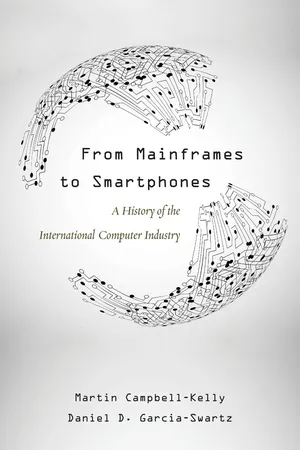
From Mainframes to Smartphones
A History of the International Computer Industry
- 240 pages
- English
- ePUB (mobile friendly)
- Available on iOS & Android
eBook - ePub
From Mainframes to Smartphones
A History of the International Computer Industry
About this book
Information
PART I
ORIGINS OF THE COMPUTER INDUSTRY
1950–1965
CHAPTER ONE
The Mainframe Computer Industry
Chapters 1, 2, and 3 focus on the period from 1950 to 1965, the first 15 years in the life of the international computer industry. One could characterize this as an era without standards, because no computer model (or family of models) became dominant enough to dictate the competitive dynamics of the industry as a whole.
In the United States, this time frame witnessed the rise of the first computer start-ups in the late 1940s and early 1950s, the computer forays of a variety of incumbent firms from the office-equipment and electronics-control industries, and also the irruption, in the late 1950s and early 1960s, of a few firms dedicated exclusively to computer design and production for specific market niches. Computer developments in other countries, including Britain, France, Germany, and Japan, occurred during this period as well, but they took place somewhat later than in the United States and at a more leisurely pace. American computer manufacturers—IBM especially—penetrated foreign markets, but foreign producers failed to establish a presence in the American market.1
The first “mainframe” computers were large, room-sized systems that were housed in air-conditioned environments. The images of computers shown in films such as Desk Set (1957) and Billion Dollar Brain (1967) give a good impression of what early computers looked like.
The first computers were serviced by a staff of operators and programmers numbering at least a dozen, and often many more. Computer users spent as much in computer-staff compensation as they paid for the computer rental itself—typically $15,000 per month in the 1950s.2 Despite the enormous cost, computers were expected to have long-term benefits for corporations and government organizations. In any case, there was a need for enterprises to be seen as modernizers, even if the cost-benefit analysis of computers was hard to implement in a rigorous manner.
The modern computer—technically known as a stored-program computer—was invented by the mathematician John von Neumann and others as a mathematical instrument toward the end of World War II at the Moore School of Electrical Engineering at the University of Pennsylvania. In the first two or three years of peace that followed war’s end, several entrepreneurs saw a market opportunity for scientific computers and began manufacturing them in small numbers.
By the beginning of the 1950s, however, the traditional office-machine companies (notably IBM and Remington Rand) had started considering the possibility that a volume market for business data-processing computers might develop; they decided to take steps to hedge their bets. These firms were shortly joined by their principal business-machine rivals, Burroughs and National Cash Register (NCR). A number of major control engineering and electrical engineering firms also saw a market opportunity for computers, of which Honeywell, the Radio Corporation of America (RCA), and General Electric (GE) were the most prominent. Because of its superior execution in almost every respect, IBM soon dominated the industry—which journalists began to describe as “IBM and the seven dwarfs.”
The motivations for entering the computer industry varied, and there were conflicting opinions within each one of these companies as to the costs and benefits of entering. For the office-equipment companies, the risk of staying on the sidelines was that the development of a volume market for commercial computers might cause a collapse in the demand for traditional data-processing equipment. This was more of a problem for companies that were narrowly focused on punched-card equipment, such as IBM, than it was for diversified conglomerates such as Remington Rand (later Sperry Rand), and this fact probably goes a long way toward explaining why IBM entered computers more decidedly. For the electronics-control firms, entering the computer business was simply moving into an adjacent market, one for which they already had—or at least thought they had—most of the required capabilities.
COMPUTER START-UPS: ERA, EMCC, CRC, AND ELECTRODATA
The first commercial computer companies—such as Engineering Research Associates (ERA), the Eckert-Mauchly Computer Corporation (EMCC), Computer Research Corporation (CRC), and Electrodata—were founded by small groups of physicists and engineers who had come to understand computer technology through their involvement in military projects. All of the start-ups discussed here were later acquired either by one of the traditional data-processing companies or by one of the electronics-control conglomerates that entered the computer industry.
ERA was established by a group of engineers who had participated in the U.S. Navy’s cryptanalytic activities during World War II and had accumulated substantial knowledge of cutting-edge computer technologies.3 The navy promised them that, if they were able to find private capital to set up a company, the U.S. government would provide a steady flow of (classified) computer-related R&D contracts. In 1946, under the leadership of Howard Engstrom and William Norris and with financial backing from an investment banker, ERA was founded in St. Paul, Minnesota.
With funding from its first navy contract, ERA developed the Atlas, a stored-program computer. After obtaining the government’s permission, ERA marketed the Atlas commercially as the 1101 system (1950). (Unless otherwise noted, we follow the convention of reporting between parentheses the year when a system was first installed.) The company later developed other computers within the same line, and by late 1952 it reportedly accounted for 80 percent of the value of electronic computers installed in the United States at the time.4
The company that eventually became the Eckert-Mauchly Computer Corporation was also established in 1946. John Mauchly had taught physics at Ursinus College in the 1930s and later joined the faculty of the University of Pennsylvania’s Moore School of Electrical Engineering as an instructor. There he met J. Presper Eckert, who had graduated from the Moore School with a bachelor of science degree and a master’s in electrical engineering. At the Moore School, Mauchly and Eckert developed a large-scale electronic digital computer, the ENIAC (an acronym for Electronic Numerical Integrator and Computer), for the Ballistic Research Labs of the U.S. Army Ordnance Corps in Aberdeen, Maryland. Delivered in 1946, the ENIAC remained in use for about a decade. From 1944, von Neumann was a regular visitor to the group, and they jointly specified a far more efficient and general-purpose design (the stored-program computer), which is the ancestral blueprint for almost all subsequent computers.
In mid-1946, Eckert and Mauchly left the University of Pennsylvania and set up a partnership, the Electronic Control Company, in Philadelphia. Having attracted outside investors, the partnership became EMCC in late 1947. In its early days, the new venture relied mostly on one client—the U.S. Commerce Department’s Bureau of the Census, which was interested in acquiring a digital computer for processing the census of 1950. While working on this Universal Automatic Computer (UNIVAC), EMCC also developed the one-of-a-kind Binary Automatic Computer (BINAC) for Northrop Aircraft, a West Coast defense contractor. Because it greatly underestimated development costs, by early 1950 EMCC found itself under strong financial pressure.
CRC had its roots in a group of Northrop engineers who worked on the design and manufacturing of a small computer, the digital differential analyzer or DIDA, for the Snark missile.5 The device was completed in 1949 and von Neumann was commissioned to provide an evaluation. Then at the Institute for Advanced Study in Princeton, New Jersey, von Neumann assessed the DIDA computer in highly optimistic terms. Northrop, however, failed to grasp the technology’s potential, which prompted the engineers to leave and set up CRC in the summer of 1950. The computers the company developed in the early 1950s were used primarily for scientific computing, including solving complex differential equations and determining the location of an airplane in flight.
Around the same time, Consolidated Engineering Corporation (CEC), a small company involved in data recording and the manufacturing of scientific instruments, established a computer division named Electrodata in Pasadena, California. CEC developed a digital data processor, the CEC 202/203, which later became the Datatron 203/204. Electrodata, which was spun off from CEC in early 1954, sold its first Datatron system to the Jet Propulsion Laboratory in mid-1954. Within a few months, several more systems were sold to the U.S. Navy Ordnance Laboratory, Purdue University, and Allstate Insurance. Although the Datatron was originally marketed as a scientifically oriented system, after securing the Allstate contract Electrodata searched for further opportunities in the commercial market, where the Datatron competed mainly with the IBM 650 (discussed later).
REMINGTON RAND AND IBM
The skirmishes between two of the leading data-processing companies of the time—Remington Rand (later Sperry Rand) and IBM—shaped the competitive dynamics of the American computer industry in the 1950s.6
Remington Rand was established in 1927 as a holding company whose subsidiaries operated independently but cooperated in sales and manufacturing. The company marketed punched-card equipment, adding machines, typewriters, and filing and record-keeping systems. In 1928, Remington Rand had sales of roughly $60 million, about three times as much as IBM recorded.7
During the Great Depression, business-equipment manufacturers saw their sales decline by about 50 percent. IBM managed to weather the Depression and prepare for the upturn better than Remington Rand. When the demand for business equipment started recovering around 1935 with President Franklin D. Roosevelt’s New Deal, IBM was in an optimal position to take advantage of the upsurge. By 1948, IBM ranked first in assets ($242 million) and second in annual revenues (with $162 million versus NCR’s $168 million) among the leading business-machine manufacturers, whereas Remington Rand ranked second and third respectively.8 Remington Rand entered the computer industry by acquiring EMCC in 1950 and ERA in 1952.
International Business Machines (IBM) was established in 1896 as the Tabulating Machine Company, which participated in a three-way merger with the Computing Scale Company and the International Time Recording Company in 1911; the resulting corporation was named the Computing-Tabulating-Recording Company (C-T-R). Thomas J. Watson became its general manager in 1914. Watson had enjoyed a stellar career in sales at NCR between 1895 and 1914, but he left the company after a confrontation with John Patterson, NCR’s founder. C-T-R, renamed IBM in 1924, manufactured and sold card punches, readers, sorters, tabulators, and (from 1935) electric typewriters.
Whereas Remington Rand entered the computer industry via acquisition, IBM established relationships with some of the organizations and institutions that developed computer know-how in the 1940s and early 1950s, and then used that knowledge as the foundation to enter the computer business. Between 1937 and 1943, working with the Harvard University researcher Howard Aiken, IBM constructed a large electromechanical computer, the Automatic Sequence Controlled Calculator (ASCC) or Harvard Mark I, for the university. After that project was completed, the company built the Selective Sequence Electronic Calculator (SSEC) in collaboration with Wallace Eckert of Columbia University. A one-of-a-kind, partially electronic and partially electromechanical digital computer, the SSEC took three years to develop and was finally shown to the public in 1948. Although both machines were specified by academic scientists, they were designed and constructed by IBM, giving its engineers early expertise in large-scale computing-machine development.
Some of IBM’s engineers acquired direct exposure to the navy’s cryptanalytic activities. Ralph Palmer, an electrical engineering graduate from Union College, joined IBM’s Endicott Laboratory in 1932, rising to head of the electrical department in 1940. Three years later, Palmer joined the U.S. Navy and spent some time at the Naval Computing Machinery Laboratory, located at an NCR plant in Dayton, Ohio. It was there that he became familiar with electronic cryptanalytic devices. After returning to IBM in 1945, Palmer formed an electronics group in the Poughkeepsie laboratory, which designed a sequence of products that led the firm directly into electronic digital computers.
IBM gained extensive experience with protocomputers in the 1940s and early 1950s, introducing the IBM 603 Electronic Multiplier, the first commercial product to incorporate electronic arithmetic circuits, in 1946. It decided to limit production of the device to 100 units and replace it with a better product, the IBM 604 Electronic Calculating Punch in 1948, which became a major commercial success.
In 1949, the IBM 604 morphed into the IBM Card-Programmed Electronic Calculator (CPC) after Northrop prompted IBM to combine the electronic calculator with other equipment for improved computational functionality. Northrop was particularly interested in interconnecting pieces of equipment for calculating guided-missile trajectories. The CPC, which combined an IBM 604 Electronic Calculating Punch with an accounting machine and an electromechanical storage unit, sold extremely well—about 700 machines—in the first half of the 1950s.9 Even though the CPC was not technically a stored-program computer, it satisfied a swath of computer demand before stored-program computers became commercially available.
One of IBM’s most important external relations was with von Neumann. The design choices made for his computer under construction at the Institute for Advanced Study, which became public in 1946–1948, inspired the architecture of IBM’s first mainframe, the 701. Von Neumann himself was hired as an IBM consultant in 1952.
In the 1950s, IBM also established an extremely fruitful working relationship with MIT in the context of the SAGE (an acronym for Semi-Automatic Ground Environment) air defense system. After the Soviet Union demonstrated its first nuclear weapon in 1949, the U.S. Air Force decided to fund the development of an early-warning defense system, and IBM was selected to work with MIT from a group of candidates that also included RCA, Raytheon, Remington Rand, and Sylvania. The SAGE project grew out of work on an earlier Air Force project led by Jay Forrester at MIT’s Lincoln Laborator...
Table of contents
- Cover
- Title Page
- Copyright
- Contents
- Introduction
- Part I: Origins of the Computer Industry, 1950–1965
- Part II: The Impact of IBM’s System/360, 1965–1980
- Part III: The Rise of the Personal Computer, 1980–1995
- Part IV: The Internet Era, 1995–2010
- Conclusions
- Notes
- Index
Trusted by 375,005 students
Access to over 1.5 million titles for a fair monthly price.
Study more efficiently using our study tools.
Frequently asked questions
Yes, you can cancel anytime from the Subscription tab in your account settings on the Perlego website. Your subscription will stay active until the end of your current billing period. Learn how to cancel your subscription
No, books cannot be downloaded as external files, such as PDFs, for use outside of Perlego. However, you can download books within the Perlego app for offline reading on mobile or tablet. Learn how to download books offline
Perlego offers two plans: Essential and Complete
- Essential is ideal for learners and professionals who enjoy exploring a wide range of subjects. Access the Essential Library with 800,000+ trusted titles and best-sellers across business, personal growth, and the humanities. Includes unlimited reading time and Standard Read Aloud voice.
- Complete: Perfect for advanced learners and researchers needing full, unrestricted access. Unlock 1.5M+ books across hundreds of subjects, including academic and specialized titles. The Complete Plan also includes advanced features like Premium Read Aloud and Research Assistant.
We are an online textbook subscription service, where you can get access to an entire online library for less than the price of a single book per month. With over 1.5 million books across 990+ topics, we’ve got you covered! Learn about our mission
Look out for the read-aloud symbol on your next book to see if you can listen to it. The read-aloud tool reads text aloud for you, highlighting the text as it is being read. You can pause it, speed it up and slow it down. Learn more about Read Aloud
Yes! You can use the Perlego app on both iOS and Android devices to read anytime, anywhere — even offline. Perfect for commutes or when you’re on the go.
Please note we cannot support devices running on iOS 13 and Android 7 or earlier. Learn more about using the app
Please note we cannot support devices running on iOS 13 and Android 7 or earlier. Learn more about using the app
Yes, you can access From Mainframes to Smartphones by Martin Campbell-Kelly,Daniel D. Garcia-Swartz in PDF and/or ePUB format, as well as other popular books in Economics & IT Industry. We have over 1.5 million books available in our catalogue for you to explore.