American social critics in the 1970s, convinced that their nation was in decline, turned to psychoanalysis for answers and seized on narcissism as the sickness of the age. Books indicting Americans as greedy, shallow, and self-indulgent appeared, none more influential than Christopher Lasch's famous 1978 jeremiad The Culture of Narcissism. This line of critique reached a crescendo the following year in Jimmy Carter's "malaise speech" and has endured to this day.
But as Elizabeth Lunbeck reveals, the American critics missed altogether the breakthrough in psychoanalytic thinking that was championing narcissism's positive aspects. Psychoanalysts had clashed over narcissism from the moment Freud introduced it in 1914, and they had long been split on its defining aspects: How much self-love, self-esteem, and self-indulgence was normal and desirable? While Freud's orthodox followers sided with asceticism, analytic dissenters argued for gratification. Fifty years later, the Viennese émigré Heinz Kohut led a psychoanalytic revolution centered on a "normal narcissism" that he claimed was the wellspring of human ambition, creativity, and empathy. But critics saw only pathology in narcissism. The result was the loss of a vital way to understand ourselves, our needs, and our desires.
Narcissism's rich and complex history is also the history of the shifting fortunes and powerful influence of psychoanalysis in American thought and culture. Telling this story, The Americanization of Narcissism ultimately opens a new view on the central questions faced by the self struggling amid the tumultuous crosscurrents of modernity.
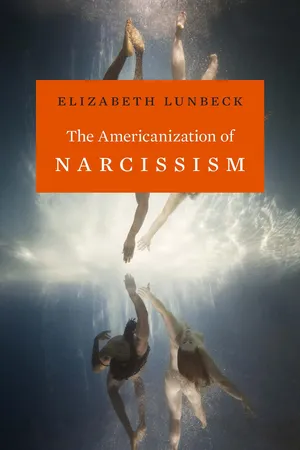
- English
- ePUB (mobile friendly)
- Available on iOS & Android
eBook - ePub
The Americanization of Narcissism
About this book
Information
PART II
Dimensions of Narcissism from Freud to the Me Decade and Beyond
Four
SELF-LOVE
AMONG THE MANY CHARACTEROLOGICAL TRAITS associated with narcissism, none has proven more central and enduring than self-love. The Narcissus of classical mythology, whose name the first psychoanalysts appropriated, died of what the English philosopher Francis Bacon called “rapturous admiration of himself.” Fatally transfixed by his own image, Narcissus had long served in the Western tradition as an object lesson in the dangers of excessive love of self, and it is thus not surprising that analysts’ narcissism connoted an all-enveloping vanity and admiration of self. The sexologist Havelock Ellis, who is usually credited with having coined the term in 1898, used it in reference to a state of absorbed contemplation and sometimes-erotic self-admiration, invoking as exemplary of this “exquisite” mental state the words of two nineteenth-century women, narcissists avant la lettre: “I love myself; I am my God” and “this unique and marvelous me, by which I am enchanted, and which I adore like Narcissus.” Other nineteenth-century observers described similar states of erotic reverie in men, involving mirrors, masturbation, and “voluptuous emotions.” Freud, in perhaps the first recorded analytic discussion of narcissism, in 1909 explained to his Viennese colleagues that “being enamoured of oneself,” and, he added parenthetically, “of one’s own genitals,” was “not an isolated phenomenon.” Narcissism was “a necessary developmental stage in the transition from autoerotism to object love,” he added, part of “the regular constitution of all men.”1
In his 1914 essay “On Narcissism,” Freud maintained that narcissism was not a perversion but normal, a form of self-interested egoism found in “every living creature.” Some early analysts wrestled with this and followed suit. Freud’s colleague Isidor Sadger emphasized that self-love was at work in all love, proposing that everyone, both homosexual and heterosexual, sought aspects of themselves in others “in addition to the characteristics of the individuals who are loved.” As he explained, “everyone is in some degree in love with himself.” Early analysts also linked narcissism in men to homosexuality, which they considered a sexual deviation. As one of them proclaimed to his assenting colleagues, everyone knew “that intensive autoerotism must lead to homosexuality.”2 Freud, discussing narcissism in print for the first time, in his 1910 book Leonardo da Vinci and a Memory of His Childhood, argued that Leonardo’s homosexuality was rooted in a narcissistic love of self and that a disabling incapacity for relationship followed from this. Leonardo sealed the deal. Narcissism and homosexuality were fatefully intertwined. Not all of the narcissistically inclined were homosexual, but it quickly became an analytic commonplace that all homosexuals were narcissistic.
Analysts labored for decades to free narcissism from the developmental telos that cast it as a stage to be transcended and, in cases of developmental arrest, as an impediment to mature object love. That Freud himself never resolved the tension between his contradictory understandings of narcissism as both normal and pathological, as a disposition both found in everyone and seen only in developmentally arrested homosexuals, made this all the more difficult. A number of analysts working in Freud’s wake pointed to the unsettled nature of his legacy around narcissism to authorize their theoretical forays beyond the bounds of orthodoxy; some conceptualized narcissism in terms of normal self-esteem regulation. Heinz Kohut’s reorientation of the analytic field in the 1960s and 1970s brought their efforts into focus and eventually into the mainstream of psychoanalysis. He attacked the Freudian developmental model that saw narcissism superseded by object-love, arguing instead that narcissism followed its own developmental course from the primitive to the adaptive and mature. The classicists’ vaunted object love could be seen in narcissists and nonnarcissistic persons alike; narcissism, he proposed, “can lead to very strong interpersonal relationships.”3 Kohut’s normalization of self-love under the rubric of “healthy narcissism” undermined the axiomatic association of narcissism and homosexuality: it was only when narcissism became healthy that homosexuals were no longer considered de facto narcissists. And he contributed to the transformation of the heavily freighted self-love into the more neutral self-esteem, setting the stage for a spirited and sometimes fractious public debate about the point at which positive self feeling shaded into pathology.
All Leonardo
Freud first described the opposition between love of self and love of the other in Leonardo. In Freud’s account, which figured centrally in analytic discussions of male homosexuality for more than half a century following its publication, homosexuals were characterized by a preference for sameness over difference in their choice of love object. Freud located the psychic roots of this preference in a surfeit of maternal attention combined with a deficient paternal presence. The growing boy’s “very intense erotic attachment” to his mother, first nurtured by too much tenderness and then of necessity repressed, survived in his identification with her. Putting “himself in her place,” he was fated to seek love objects modeled on himself, whom he could love as his mother had once loved him. Unable to make the “correct decision,” to love “someone of the opposite sex,” the boy, Freud wrote, “has become a homosexual.” Choosing autoeroticism over object-love, from that point on he traveled “the path of narcissism.”4
Freud had long been interested in Leonardo and, notably, in Leonardo’s homosexuality. He read widely in the Leonardo literature, poring over biographies; the Russian novelist Dmitry Merezhkovsky’s biographical study appeared in 1907 on a list of books he had most enjoyed reading. By the autumn of 1909, the subject was by his own telling an obsession, and soon after he embarked on his study with an intensity that Ernest Jones thought exceptional. A lecture on the topic in December to his Viennese colleagues left him exasperated and dissatisfied, unhappy with his grasp of the issues despite the fulsome praise it elicited. Dry spells alternating with frenzied bouts of productivity ensued. There were patients to see and professional disputes to manage, but, Freud wrote to Carl Jung in early March, “otherwise I am all Leonardo.” Within several more weeks, it was in press, published in May 1910. The first “psychoanalytic pathography”—the encomium is Sándor Ferenczi’s, who predicted in an idealizing flourish that it would “serve as a model for all time”—the work would prove Freud’s favorite, in his words “the only truly beautiful thing I have ever written.”5
It was also, in Jones’s estimation, in many respects an autobiography, informed by issues that had arisen in Freud’s self-analysis and, as such, offering a window onto his personality. Jones found it suggestive that Freud’s Leonardo exhibited a “passion for natural knowledge” and even more so that his essay “illuminated the inner nature of that great man” by tracing the source of Leonardo’s conflicts, which Jones framed as between a passion for artistic creation and a passion for science, to “the events of his earliest childhood.” Missing from Jones’s construal of Leonardo as thinly veiled autobiography, however, is any account of Freud’s contemporaneous struggles with, and panicked disavowal of, his own homosexual currents. As Freud stressed in the book, infantile sexuality held the key to the artist’s character; the “riddle” of it identified, its constitutive threads—the child’s stymied quest for knowledge, homosexuality, mother love, and artistic creation—were opened to analysis. Leonardo, Freud wrote to Jung as he embarked on his study, was a man who “converted his sexuality into an urge for knowledge” and was from that point on never able to bring any project to completion. He was, Freud argued, “sexually inactive or homosexual.”6
Freud’s simmering conflict over what he called “my homosexuality”—and over mutuality and dependence, which he consistently cast as feminine—would reach a crisis after the publication of Leonardo, in a dramatic confrontation with Ferenczi that occurred while the two were on holiday together in Palermo, on the island of Sicily. Freud interpreted his own psychology at this point in terms of triumph and mastery of the homosexual feelings he had struggled with since the end of his relationship with Wilhelm Fliess, the Berlin ear, nose, and throat physician with whom he had carried on an intensely intimate correspondence in the 1890s. Analysts and historians have seen aspects of Freud’s self-understanding mirrored in his presentation of Leonardo, but they have for the most part focused on his identification with the artist as scientific genius. Peter Gay, characterizing Freud as “always prepared to translate private turmoil into analytic theory,” focused attention elsewhere, arguing that the “secret energy” animating Freud’s obsession with Leonardo lay in his “unconscious homoerotic feelings” toward Fliess.7 In this respect, too, Leonardo was autobiography.
What little was known to Freud of the historical Leonardo’s childhood may be briefly stated. The artist was born the illegitimate son of a notary and a poor peasant girl, Caterina, in the town of Vinci, near Florence in 1452. The same year, his father married Donna Albieri, “a lady of good birth” who would bear no children of her own. Sometime before the age of five, the boy was moved to his father’s household, remaining there until he was apprenticed to the painter Andrea del Verrocchio. Caterina would marry a local man, and all traces of her would vanish from the record of Leonardo’s life; his father would twice again marry. Most tantalizing to Freud, Leonardo would later note that one of his earliest memories was of being in his cradle when a kite—mistakenly rendered as a vulture in the translation Freud consulted—swooped down on him and, he wrote, “opened my mouth with its tail, and struck me many times with its tail against my lips.” Admitting this was meager evidence, Freud nevertheless constructed an imaginative and, in the estimation of many, persuasive account of Leonardo’s perplexing personality—chiefly, of his homosexuality, which in the days of his apprenticeship had been the grounds for a charge of forbidden practices brought against him, of which he was acquitted, and which was later evident in his surrounding himself “with handsome boys and youths whom he took as pupils.” Inhibited and repressed, Leonardo never enjoyed what Freud called “a real sexual life.” He was, rather, “emotionally homosexual.”8
Freud explained why this was so in a virtuosic if highly speculative reading of the childhood memory of the vulture—a memory he saw as a passive homosexual fantasy of taking the penis in the mouth and sucking on it—that took readers on a wild ride from Richard Krafft-Ebing’s Psychopathia Sexualis to a discussion of the vulture-headed Mother Goddess in Egyptian mythology. Of everything Freud gathered from his varied sources, the most significant as he saw it was that in ancient natural histories the vulture was a female creature, impregnated only by the wind. Freud confidently concluded that Leonardo, taken from his mother to join his father and Donna Albieri, had transformed pleasurable memories of being nursed by his mother into the unmistakably homosexual fantasy of taking the vulture’s penis-tail in his mouth and sucking on it—in this reminiscence substituting the vulture for the mother who had suckled him. Writing that he was “completely ignorant” of the age at which Leonardo actually exchanged “his poor, forsaken, real mother” for life with “a parental couple,” Freud argued that “it fits in best with the interpretation of the vulture phantasy” if that age were to be set at three at the least, at five at most. That early experiences were determinative of lifelong patterns underwrote Freud’s favoring the later age, which rendered Leonardo fatherless longer; paternal absence figured centrally in the histories of his and his colleagues’ homosexual patients. Further, contended Freud, surely only “years of disappointment” would have persuaded the barren Donna Albieri to accept the illegitimately born boy into her household as her own; it would have been highly unusual for her to have adopted him earlier. To put Freud’s account in its simplest terms: Leonardo was raised by his “real” mother, and—like legions of homosexuals subjected to analytic scrutiny—deformed by her attentions, in Freud’s words robbed “of a part of his masculinity.”9
In Freud’s theorizing, the “bliss and rapture” enjoyed mutually by mother and infant was “in the nature of a completely satisfying love-relation,” fulfilling at once a mental wish and physical need. So satisfying is this love that even in happy families fathers see their sons as rivals for womanly attentions, calling forth a deep-rooted antagonism against their male offspring and suggesting it was not only the boy who had to master his oedipal feelings. The suckling child at the maternal breast, Freud had written five years before Leonardo appeared, was “the prototype of every relation of love.” The mutually enjoyed “erotic bliss” on display in this “first and most significant of all sexual relations” between mother and son was, in the normal developmental sequence, inevitably succeeded by loss in the process of weaning and separation, culminating in the oedipal moment of renunciation of childish things.10 It was a species of satisfaction that in Freud’s view would never again be attained.
Freud held that men, both those who would turn out homosexual and their heterosexual brethren, eventually repressed their mother attachments. The latter, subjected to paternal authority and oedipal terror, identified with their fathers and entered the company of civilized men. The former, prompted by motive forces Freud argued were not yet understood, narcissistically identified with their mothers and put themselves in her place, fated forever to love boys as their mothers had loved them, forever faithful to their mothers in running away from erotic engagements with other women.
Maternal attention, in the Freud of these years, was a double-edged sword. He conceived of it in his other writings as blissfully erotic and completely satisfying, a foundation for worldly success in later life. Those fortunate enough to grow up as their mother’s favorites, he wrote, often exhibited an enviable if “peculiar self-reliance and an unshakeable optimism” that could appear as indubitably masculinist “heroic attributes.” But in Leonardo he focused on the “violence” of the maternal caress, the menace of the single mother’s “tender seductions,” the “excessive tenderness” visited on the hapless son by the unsatisfied mother-without-a-mate. Starved for a husband’s caresses, the “poor forsaken” Caterina, “like all unsatisfied mothers,… took her little son in place of her husband,” with this move determining “his destiny and the privations that were in store for him.”11 Attempting to satisfy her own unmet longings, she awakened Leonardo’s eroticism too early.
Freud’s construal of mother love as menace here is striking, especially because it coincided with his normalization of paternal aggression in the Oedipus complex. In Leonardo Freud cast the mother, not the father, as the real threat to the boy. Freud positioned Woman in opposition to civilization, a masculine enterprise held together by “social feelings … of a homosexual nature,” arguing in a presentation to his colleagues in 1912 that she rendered man asocial, representing both unbridled nature and what he later specified as the “retarding and restraining” interests of the family and sexual life. The menacing, seductive, and unsatisfied mother of Leonardo—a masculine woman, “able to push the father out of his proper place”—stands here in sharp contrast to the pure and tender mother found elsewhere in Freud’s writings.12 The germ of the overbearing Mom of midcentury American analysis and popular criticism, who in her ministrations spawned a generation of homosexual sissies, can be glimpsed in the predatory preoedipal Caterina.
Sitting Pretty
Concurrent with the writing of Leonardo, the seeds were being sown of a fateful confrontation between Freud and his epistolary intimate Ferenczi, a confrontation in which self-sovereignty and mastery, dependency and homosexuality figured centrally. Freud would emerge from the clash proclaiming his independence and mastery, while Ferenczi would agonize over the rupture that followed until the day he died. By the time the two embarked on their Italian journey at the end of the summer of 1910, the dynamic that would characterize their relationship for the next twenty years had already been established. Freud would repeatedly offer himself up as the plenitudinous father to Ferenczi’s needy baby, exacting from Ferenczi a constant stream of idealizations, and would then castigate him for the same, claiming to have no need of them.
“Let’s go to Sicily together, then,” Freud wrote to Ferenczi in the spring of 1910, finding himself “correcting Leonardo and otherwise doing nothing.” They had met two years earlier when Ferenczi traveled to Freud’s consulting room in Vienna from his home in Budapest, where he had been lecturing on psychoanalytic topics and treating patients for years. They immediately entered into an easy and increasingly intimate correspondence—playful, engaged, and, for a pen-and-ink age, remarkably contemporary in its urgent, rapid-fire feel. Freud was fifty-two, Ferenczi thirty-five. By the time Freud proposed the Sicil...
Table of contents
- Cover
- Half Title
- Title Page
- Copyright
- Dedication
- Contents
- Introduction
- I. Narcissism in the Me Decade
- II. Dimensions of Narcissism from Freud to the Me Decade and Beyond
- Conclusion: Narcissism Today
- Abbreviations
- Notes
- Acknowledgments
- Index
Trusted by 375,005 students
Access to over 1.5 million titles for a fair monthly price.
Study more efficiently using our study tools.
Frequently asked questions
Yes, you can cancel anytime from the Subscription tab in your account settings on the Perlego website. Your subscription will stay active until the end of your current billing period. Learn how to cancel your subscription
No, books cannot be downloaded as external files, such as PDFs, for use outside of Perlego. However, you can download books within the Perlego app for offline reading on mobile or tablet. Learn how to download books offline
Perlego offers two plans: Essential and Complete
- Essential is ideal for learners and professionals who enjoy exploring a wide range of subjects. Access the Essential Library with 800,000+ trusted titles and best-sellers across business, personal growth, and the humanities. Includes unlimited reading time and Standard Read Aloud voice.
- Complete: Perfect for advanced learners and researchers needing full, unrestricted access. Unlock 1.5M+ books across hundreds of subjects, including academic and specialized titles. The Complete Plan also includes advanced features like Premium Read Aloud and Research Assistant.
We are an online textbook subscription service, where you can get access to an entire online library for less than the price of a single book per month. With over 1.5 million books across 990+ topics, we’ve got you covered! Learn about our mission
Look out for the read-aloud symbol on your next book to see if you can listen to it. The read-aloud tool reads text aloud for you, highlighting the text as it is being read. You can pause it, speed it up and slow it down. Learn more about Read Aloud
Yes! You can use the Perlego app on both iOS and Android devices to read anytime, anywhere — even offline. Perfect for commutes or when you’re on the go.
Please note we cannot support devices running on iOS 13 and Android 7 or earlier. Learn more about using the app
Please note we cannot support devices running on iOS 13 and Android 7 or earlier. Learn more about using the app
Yes, you can access The Americanization of Narcissism by Elizabeth Lunbeck,Elizabeth Lunbeck in PDF and/or ePUB format, as well as other popular books in Psychology & North American History. We have over 1.5 million books available in our catalogue for you to explore.