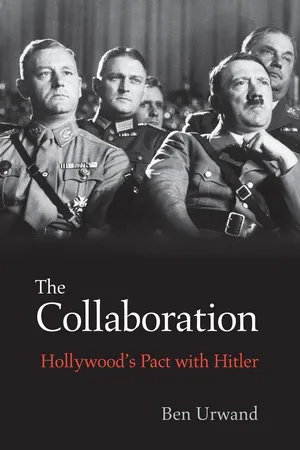
To continue doing business in Germany after Hitler's ascent to power, Hollywood studios agreed not to make films that attacked the Nazis or condemned Germany's persecution of Jews. Ben Urwand reveals this bargain for the first time—a "collaboration" (Zusammenarbeit) that drew in a cast of characters ranging from notorious German political leaders such as Goebbels to Hollywood icons such as Louis B. Mayer.
At the center of Urwand's story is Hitler himself, who was obsessed with movies and recognized their power to shape public opinion. In December 1930, his Party rioted against the Berlin screening of All Quiet on the Western Front, which led to a chain of unfortunate events and decisions. Fearful of losing access to the German market, all of the Hollywood studios started making concessions to the German government, and when Hitler came to power in January 1933, the studios—many of which were headed by Jews—began dealing with his representatives directly.
Urwand shows that the arrangement remained in place through the 1930s, as Hollywood studios met regularly with the German consul in Los Angeles and changed or canceled movies according to his wishes. Paramount and Fox invested profits made from the German market in German newsreels, while MGM financed the production of German armaments. Painstakingly marshaling previously unexamined archival evidence, The Collaboration raises the curtain on a hidden episode in Hollywood—and American—history.
- English
- ePUB (mobile friendly)
- Available on iOS & Android
eBook - ePub
About this book
Information
NOTES
PROLOGUE
1. King Kong, directed by Merian C. Cooper and Ernest B. Schoedsack (RKO, 1933).
2. Oberprüfstelle report 6910, “King Kong,” September 15, 1933, Deutsches Filminstitut, Frankfurt (henceforth Deutsches Filminstitut). All translations are my own unless otherwise noted. In the first half of this introduction, I have turned the record of the discussion at the censorship meeting into direct speech. I have preserved the original meaning throughout.
3. My emphasis.
4. Oberprüfstelle report 6910, “King Kong,” September 15, 1933.
5. Ibid. My emphasis.
6. Ibid. My emphasis.
7. Oberprüfstelle report 6910, “King Kong,” October 5, 1933, Deutsches Filminstitut. My emphasis.
8. Ibid.
9. Ibid.
10. Thomas Jefferson, Notes on the State of Virginia [1785] (New York: Penguin, 1999), 145.
11. Oberprüfstelle report 6910, “King Kong,” October 5, 1933.
12. Ibid.
13. George Canty, “Economic and Trade Notes 158,” January 25, 1934, Commercial Attachés in Germany 1931–1940, RG 151, National Archives and Records Administration, College Park, Maryland (henceforth National Archives); advertisements for King Kong, Der Angriff, November 30, 1933, 15, and December 1, 1933, 7.
14. “Filmtechnik besiegt die Urwelt: ‘Die Fabel von King-Kong,’ ” Völkischer Beobachter, December 3–4, 1933, 5–6.
15. “Die Fabel von King Kong,” Der Angriff, December 2, 1933, 6.
16. Ernst Hanfstaengl, Zwischen Weissem und Braunem Haus: Memoiren eines politischen Aussenseiters (Munich: R. Piper & Co. Verlag, 1970), 314.
17. André Bazin, What Is Cinema? vol. 1 (Berkeley: University of California Press, 1967), 29. For accounts of the studio system in the golden age, see David Bordwell et al., The Classical Hollywood Cinema: Film Style & Mode of Production to 1960 (New York: Columbia University Press, 1985); Thomas Schatz, The Genius of the System: Hollywood Filmmaking in the Studio Era (New York: Pantheon Books, 1988).
18. The records of the Bureau of Foreign and Domestic Commerce at the National Archives (RG 151) contain twenty-two boxes of reports of American commercial attachés stationed in Berlin in the 1930s. These reports include statistics on how long American movies remained in theaters in their first runs. The classic studies of German cinema and German censorship do not discuss the popularity of Hollywood movies in the Third Reich. See Gerd Albrecht, Nationalsozialistische Filmpolitik: Eine soziologische Untersuchung über die Spielfilm des Dritten Reichs (Stuttgart: Ferdinand Enke Verlag, 1969); Wolfgang Becker, Film und Herrschaft: Organisationsprinzipien und Organisationsstrukturen der nationalsozialistischen Filmpropaganda (Berlin: Verlag Volker Spiess, 1973); Jürgen Spiker, Film und Kapital: Der Weg der deutschen Filmwirtschaft zum nationalsozialistischen Einheitskonzern (Berlin: Verlag Volker Spiess, 1975); Kraft Wetzel and Peter A. Hagemann, Zensur—Verbotene deutsche Filme 1933–1945 (Berlin: Verlag Volker Spiess, 1978); Klaus-Jürgen Maiwald, Filmzensur im NS-Staat (Dortmund: Nowotny, 1983); David Welch, Propaganda and the German Cinema, 1933–1945 [1983] (New York: I.B. Tauris, 2001). There is a chapter on the impact of Hollywood movies on Nazi cinema in Eric Rentschler, The Ministry of Illusion: Nazi Cinema and Its Afterlife (Cambridge, MA: Harvard University Press, 1996), 99–122.
19. Prior books on this subject have not uncovered the collaboration between the American studios and the Nazi regime. One book provides a rich exploration of archival materials: Markus Spieker, Hollywood unterm Hakenkreuz: Der amerikanische Spielfilm im Dritten Reich (Trier: Wissenschaftlicher Verlag Trier, 1999). A more recent book provides a lively account, but one that is limited to reports that appeared in American trade papers: Thomas Doherty, Hollywood and Hitler, 1933–1939 (New York: Columbia University Press, 2013). More general studies of Hollywood’s portrayal of foreign dictators include Benjamin L. Alpers, Dictators, Democracy, and American Public Culture: Envisioning the Totalitarian Enemy, 1920s–1950s (Chapel Hill: University of North Carolina Press, 2003); David Welky, The Moguls and the Dictators: Hollywood and the Coming of World War II (Baltimore, MD: Johns Hopkins University Press, 2008). Also see Anthony Slide, “Hollywood’s Fascist Follies,” Film Comment (July–August 1991): 62–67.
20. The Tramp and the Dictator, directed by Kevin Brownlow and Michael Kloft (Photoplay Productions, 2002). Budd Schulberg is best known for his controversial novel about Hollywood, What Makes Sammy Run? According to Schulberg, when his novel was released, Louis B. Mayer told his father, B. P. Schulberg (a former executive at Paramount), “You know what we should do with him? We should deport him!” Budd Schulberg, “What Makes Sammy Keep Running?” Newsday, August 2, 1987, 9. Also see Schulberg, Moving Pictures: Memories of a Hollywood Prince (New York: Stein and Day, 1981).
21. For accounts of Hollywood’s anti-fascism, see Colin Schindler, Hollywood Goes to War: Films and American Society, 1939–1952 (Boson: Routledge, 1979); Edward F. Dolan Jr., Hollywood Goes to War (Twickenham: Hamlyn, 1985); Clayton R. Koppes, Hollywood Goes to War: How Politics, Profits, and Propaganda Shaped World War II Movies (Berkeley: University of California Press, 1987); Allen L. Woll, The Hollywood Musical Goes to War (Chicago: Nelson-Hall, 1983); Michael S. Shull and David E. Wilt, Doing Their Bit: Wartime American Animated Short Films, 1939–1945 (Jefferson, NC: McFarland & Company, 1987); Bernard F. Dick, The Star-Spangled Film: The American World War II Film (Lexington: University Press of Kentucky, 1985); Thomas Doherty, Projections of War: Hollywood, American Culture, and World War II (New York: Columbia University Press, 1993); Michael S. Shull and David E. Wilt, Hollywood War Films, 1937–1945: An Exhaustive Filmography of American Feature-Length Motion Pictures Relating to World War II (Jefferson, NC: McFarland & Company, 1996); Michael E. Birdwell, Celluloid Soldiers: The Warner Bros. Campaign against Nazism (New York: New York University...
Table of contents
- Cover
- Half Title
- Title Page
- Copyright
- Contents
- Prologue
- One: Hitler’s Obsession with Film
- Two: Enter Hollywood
- Three: “Good”
- Four: “Bad”
- Five: “Switched Off”
- Six: Switched On
- Epilogue
- Notes
- Acknowledgments
- Index
Trusted by 375,005 students
Access to over 1.5 million titles for a fair monthly price.
Study more efficiently using our study tools.
Frequently asked questions
Yes, you can cancel anytime from the Subscription tab in your account settings on the Perlego website. Your subscription will stay active until the end of your current billing period. Learn how to cancel your subscription
No, books cannot be downloaded as external files, such as PDFs, for use outside of Perlego. However, you can download books within the Perlego app for offline reading on mobile or tablet. Learn how to download books offline
Perlego offers two plans: Essential and Complete
- Essential is ideal for learners and professionals who enjoy exploring a wide range of subjects. Access the Essential Library with 800,000+ trusted titles and best-sellers across business, personal growth, and the humanities. Includes unlimited reading time and Standard Read Aloud voice.
- Complete: Perfect for advanced learners and researchers needing full, unrestricted access. Unlock 1.5M+ books across hundreds of subjects, including academic and specialized titles. The Complete Plan also includes advanced features like Premium Read Aloud and Research Assistant.
We are an online textbook subscription service, where you can get access to an entire online library for less than the price of a single book per month. With over 1.5 million books across 990+ topics, we’ve got you covered! Learn about our mission
Look out for the read-aloud symbol on your next book to see if you can listen to it. The read-aloud tool reads text aloud for you, highlighting the text as it is being read. You can pause it, speed it up and slow it down. Learn more about Read Aloud
Yes! You can use the Perlego app on both iOS and Android devices to read anytime, anywhere — even offline. Perfect for commutes or when you’re on the go.
Please note we cannot support devices running on iOS 13 and Android 7 or earlier. Learn more about using the app
Please note we cannot support devices running on iOS 13 and Android 7 or earlier. Learn more about using the app
Yes, you can access The Collaboration by Ben Urwand in PDF and/or ePUB format, as well as other popular books in History & German History. We have over 1.5 million books available in our catalogue for you to explore.