The New Deal is often said to represent a sea change in American constitutional history, overturning a century of precedent to permit an expanded federal government, increased regulation of the economy, and eroded property protections. John Compton offers a surprising revision of this familiar narrative, showing that nineteenth-century evangelical Protestants, not New Deal reformers, paved the way for the most important constitutional developments of the twentieth century.
Following the great religious revivals of the early 1800s, American evangelicals embarked on a crusade to eradicate immorality from national life by destroying the property that made it possible. Their cause represented a direct challenge to founding-era legal protections of sinful practices such as slavery, lottery gambling, and buying and selling liquor. Although evangelicals urged the judiciary to bend the rules of constitutional adjudication on behalf of moral reform, antebellum judges usually resisted their overtures. But after the Civil War, American jurists increasingly acquiesced in the destruction of property on moral grounds.
In the early twentieth century, Oliver Wendell Holmes and other critics of laissez-faire constitutionalism used the judiciary's acceptance of evangelical moral values to demonstrate that conceptions of property rights and federalism were fluid, socially constructed, and subject to modification by democratic majorities. The result was a progressive constitutional regime—rooted in evangelical Protestantism—that would hold sway for the rest of the twentieth century.
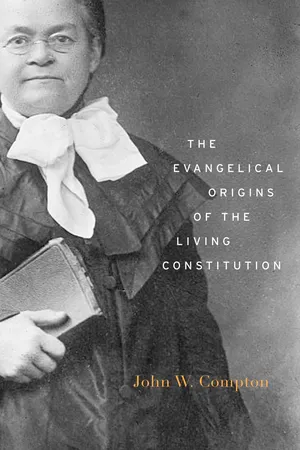
- 261 pages
- English
- ePUB (mobile friendly)
- Available on iOS & Android
eBook - ePub
The Evangelical Origins of the Living Constitution
About this book
Information
1
The Evangelical Challenge to American Constitutionalism
A religious sect may degenerate into a political faction in a part of the Confederacy; but the variety of sects dispersed over the entire face of it must secure the national councils against any danger from that source.
—James Madison, Federalist 10
The constitutional system that emerged from the Philadelphia Convention has been aptly described as a “commercial republic.”1 The label highlights what is perhaps the most striking feature of the framers’ handiwork: their subordination of traditional moral and religious purposes to the worldly goals of protecting property and promoting economic development. At a time when official references to the Almighty were commonplace, the framers took the surprising step of creating an essentially secular document: the text did not invoke God’s blessing, nor did it even mention Him, save in a single reference in the signatory section to the “Year of Our Lord.” More important, when leading Federalists were asked to explain the republic’s ultimate purposes, they consistently spurned appeals to the divine in favor of appeals to their readers’ material self-interest. As the authors of The Federalist explained, the principal purposes of the new governing arrangements would be to protect “private rights,” promote “commercial prosperity,” and bolster “the national security.”2
This is not to suggest that the framers were hostile to religion or that they opposed efforts to promote a virtuous citizenry. Indeed, many clearly supported official regulation of religion and morality, at least so long as these functions were carried out at the state and local levels.3 But they also recognized that traditional republican theories of politics, which viewed the cultivation of a virtuous and homogenous citizenry as the key to a republic’s survival, were ill suited to American conditions. Simply put, the American nation was geographically larger, more populous, and more socially and economically diverse than previous republics. These factors made the cultivation of broadly shared norms and religious creeds—the traditional republican remedy for the evils of faction—practically impossible. Some other foundation for the American republic would have to be found, and so the framers turned to material prosperity and procedural consensus to serve as “surrogates” for the shared norms which classical thinkers had deemed so essential.4 Turning the conventional republican wisdom on its head, they “reduc[ed] the scope of politics” to its lowest common denominators: “self-preservation and economic self-interest.”5
But while the idea of the “commercial republic” may have seemed the perfect theoretical solution to the problem of reconciling republicanism with size and diversity, a successful transition from theory to practice was by no means assured. For, as Sheldon Wolin has written, the ratification process “did not adopt a constitution in anything but the most formal sense of a paper document.” Rather, it endorsed “a sophisticated theory of a constitution, as represented most brilliantly by The Federalist Papers, but a theory with only a minimally developed practice or a supporting culture of its own.”6 Much would depend on the fit between the Constitution’s institutional innovations, on the one hand, and existing political cultures and practices, on the other. And it is here that the Federalist vision was—perhaps unavoidably—shortsighted, in the sense that it assumed a background of social conditions that were in hindsight merely transient features of American life. In particular, it assumed an underlying society that would endorse, or at least acquiesce in, the severing of law and virtue and the identification of economic development as the primary end of national union.
These assumptions appeared reasonable enough in the early years of the republic. Indeed, at a time when a traditional, Puritan-inspired system of morals regulation was disintegrating and the influence of organized religion in decline, a Federalist-dominated judiciary experienced relatively little difficulty in translating the commercial republic ideal into the binding language of constitutional doctrine.7 In particular, the landmark decisions of the Marshall Court firmly established congressional authority over interstate commerce, while also significantly restraining the power of state and local governments to interfere with vested property rights.8 But the apparent fit between constitution and society proved fleeting. By the 1830s, organized Protestantism had reemerged as a significant political force, and large numbers of Americans were dedicating themselves to the task of abolishing liquor, lotteries, slavery, and other immoral forms of property. Where the framers had sought to protect established property rights and insulate interstate markets from excessive state and local regulation, the aims of the Protestant reformers were precisely the opposite: to constrain property rights and interstate markets in the name of the public good. The problem, of course, was that the first of these two policy visions was by this point thoroughly ensconced in state and federal constitutional doctrine. And for this reason, the reformers could not achieve their aims through moral suasion or statutory prohibitions alone. Rather, they would have to attempt to dismantle significant features of the Founding generation’s handiwork.
In order to appreciate the full extent of the Revival’s impact on American constitutionalism, however, we must also come to grips with a second critical feature of the Constitution of 1787: its assumptions regarding language. For it was not only the substantive policy choices of the framers that proved problematic in the wake of the Revival, but also their conviction that the meanings of key constitutional concepts like “property,” “contract,” and “commerce” were essentially static, or at least amenable to relatively precise definition.9 Stated otherwise, the framers seem not to have contemplated the possibility that mores might evolve in ways that would reconfigure language itself, so as to render key constitutional concepts virtually unworkable. And yet American society underwent precisely such a revolution in the 1820s and 1830s. With the onset of the post-Revival reform movements, even constitutional categories with ancient lineages in Anglo-American common law were destabilized by the growing conviction that newly immoral forms of property should be excluded from the ambit of legal protection altogether. This was a deeply troubling development. Indeed, the idea that it was possible for a given entity to move between constitutional categories—to move, for example, from the category of “property” to the category of “nuisance”—threatened to discredit the very idea of what Hamilton termed the “limited constitution.”10 For how could textual provisions serve as meaningful constraints on official power if the Constitution’s most basic concepts and categories were constantly in flux? Although the full extent of this problem will become clear only when we turn to case law in Chapters 2 through 4, the present chapter concludes by identifying three specific “sites” of constitutional conflict, or points where the new post-Revival morality tested the limits of Founding-era constitutional principles.
The Demise of the Puritan Worldview and the Enervation of the Religious Sphere
The institutionalization of the Federalist constitutional vision would not have been possible if not for the prior marginalization of an older and once-powerful strand of American political thought, one that rejected as illegitimate all attempts to separate the moral and legal spheres. In the Puritan worldview, which pervaded American intellectual life through the middle of the eighteenth century, political authorities were expected not only to secure the property and bodily safety of the citizenry but also to make “a regular effort to establish and uphold high standards of [citizen] conduct.”11 Thus the Cambridge Platform of Church Discipline, drafted by John Cotton in 1648, explained that it was “the duty of the Magistrate” to enforce “the duties commanded in the first, as well as . . . the duties commanded in the second table [of the Decalogue].”12 During the seventeenth and early eighteenth centuries, the influence of the Puritan worldview was evident in the famously rigid criminal codes of the American colonies, which typically punished a range of “crimes” that would today be regarded as minor vices. Regional variations existed, of course, but virtually all of the colonial statute books contained prohibitions against blasphemy, profanity, Sabbath-breaking, gambling, and marital infidelity.13 Such laws were designed to transform colonial villages into tiny, self-policing communities of virtue, and there is good evidence that they succeeded in this regard, at least for a time. Legal historians have demonstrated that, through the mid-eighteenth century, laws governing personal morality were strictly enforced; indeed, morals offenses appear to have made up the bulk of the judicial workload at the lower levels of government in most of the colonies.14 Moreover, because colonial-era morals laws depended upon citizen informers to report abuses, there is reason to believe that efforts to police personal morality enjoyed broad public support.15
By the revolutionary period, however, a subtle transformation had taken place in Americans’ understanding of the law-morality relationship. While leading ministers and other public figures continued to condemn the usual list of vices, calls to subject personal moral failings to civil punishment became increasingly rare.16 Moreover, the underlying rationale for holding one’s self (and others) to a high standard of moral conduct began to evolve as well. In particular, the classic Calvinist virtues of hard work, temperance, and frugality ceased to be viewed as ends in themselves, that is, as ends that were to be pursued solely for the glory of God.17 In the new understanding, the primary motive for adhering to the traditional virtues was not because they “functioned in the divine plan of salvation,” but rather because debt, idleness, and intemperance were viewed as the most common causes of earthly “dependence and misery.” Pursuit of the traditional virtues thus became “a device for procuring [one’s own] security and advantage.”18 This is not to suggest that Founding-era Americans were indifferent to the moral character of their society; on the contrary, improving the morals of the citizenry remained an instrumentally important goal, since the pursuit of virtue allowed “individuals and the nation as a whole [to] grow more prosperous, safer, and stronger in world trade.” But furthering this goal would henceforth be the responsibility of private individuals and religious societies rather than the state.19 Even John Adams, the founder who was perhaps most influenced by the Puritan worldview, conceded in 1778 that in America “the foundations of national Morality would be laid in private Families” and not in the statute books.20
That the demise of the Puritan worldview affected all levels of American society is confirmed by evidence demonstrating a near-total collapse of morals enforcement in the decades preceding the Revolution. Studies of local court records in Massachusetts, for example, have found that the judicial caseload in the early eighteenth century was dominated by morals offenses, with more than half of all prosecutions involving sexual crimes (adultery, fornication, prostitution) or religious offenses (blasphemy, Sabbath-breaking, profanity). Remarkably, prosecutions for strictly moral and religious offenses declined to a miniscule portion of total prosecutions in the decades following the Revolution, as prosecutors shifted their attention to economic crimes such as theft.21 In addition, the same period witnessed what might be termed a routinization of morals enforcement: adultery and fornication were increasingly addressed with fines (designed to prevent illegitimate offspring from becoming public charges) instead of corporal punishment or public humiliation.22 Similarly, the formerly cumbersome process of applying for a liquor license—a process designed to establish the moral character of the applicant—was in many areas reduced to a simple administrative proceeding.23 As Lawrence Friedman has written, American law had by the Revolutionary period ceased to function as “guardian of a code of sexual and social behavior” and become instead the “defender of an economic and political order.”24
The first precondition for the institutionalization of the commercial republic, then, was the erosion of the Puritan ideal of the virtuous, self-policing community. Absent this sea change in American thinking about the proper function of law, a constitutional order centered around the protection of established property rights and the promotion of commercial “intercourse”—a code word for national networks of exchange that would inevitably disrupt local patterns of regulation—would almost certainly have been unthinkable.25 Yet it is also worth noting a second feature of Founding-era society that was arguably of equal importance in facilitating the rise of an essentially secular constitutional order: namely, the fact that the religious sphere, the natural repository of Puritan ideals, was numerically weak, institutionally divided, and increasingly liberal in its theological orientation.
Indeed, the ratio of churches to population experienced a significant decline over the course of the eighteenth century, as Mark Noll and others have demonstrated.26 By the time of the Revolution, only 17 percent of Americans were attached to a particular religious congregation (as compared to 37 percent at the time of the Civil War), and few denominations were “adding enough new members to replace those who died.”27 Also contributing to the overall weakness of the religious sphere was the fact that the bulk of nation’s religious adherents were more or less equally divided between the Congregational, Presbyterian, Anglican, and Baptist denominations (with the remaining 20 percent composed of Quakers, Methodists, various Reformed sects, and a small number of Roman Catholics).28 To be sure, denominational diversity was hardly a new feature of the American religious landscape. Yet it is important to note that the cleavages which had long marred American Protestantism were growing more severe during the early years of the republic. In New England, the protracted conflict between the Congregationalist establishment and Baptist dissenters over issues of religious taxation and incorporation was nearing a head at precisely this point.29 In Virginia, Baptists and Anglicans remained at war over a similar set of questions. Meanwhile, the Congregationalists of New England were beginning to experience bitter internal sc...
Table of contents
- Cover
- Title Page
- Copyright
- Dedication
- Contents
- Introduction
- 1. The Evangelical Challenge to American Constitutionalism
- 2. Moral Reform and Constitutional Adjudication, 1830–1854
- 3. The Triumph of Evangelical Public Morality in the States
- 4. The Triumph of Evangelical Public Morality in the Supreme Court
- 5. Reexamining the Collapse of the Old Order
- Conclusion: The Evangelical Origins of the Modern Constitutional Order
- Notes
- Acknowledgments
- Index
Trusted by 375,005 students
Access to over 1.5 million titles for a fair monthly price.
Study more efficiently using our study tools.
Frequently asked questions
Yes, you can cancel anytime from the Subscription tab in your account settings on the Perlego website. Your subscription will stay active until the end of your current billing period. Learn how to cancel your subscription
No, books cannot be downloaded as external files, such as PDFs, for use outside of Perlego. However, you can download books within the Perlego app for offline reading on mobile or tablet. Learn how to download books offline
Perlego offers two plans: Essential and Complete
- Essential is ideal for learners and professionals who enjoy exploring a wide range of subjects. Access the Essential Library with 800,000+ trusted titles and best-sellers across business, personal growth, and the humanities. Includes unlimited reading time and Standard Read Aloud voice.
- Complete: Perfect for advanced learners and researchers needing full, unrestricted access. Unlock 1.5M+ books across hundreds of subjects, including academic and specialized titles. The Complete Plan also includes advanced features like Premium Read Aloud and Research Assistant.
We are an online textbook subscription service, where you can get access to an entire online library for less than the price of a single book per month. With over 1.5 million books across 990+ topics, we’ve got you covered! Learn about our mission
Look out for the read-aloud symbol on your next book to see if you can listen to it. The read-aloud tool reads text aloud for you, highlighting the text as it is being read. You can pause it, speed it up and slow it down. Learn more about Read Aloud
Yes! You can use the Perlego app on both iOS and Android devices to read anytime, anywhere — even offline. Perfect for commutes or when you’re on the go.
Please note we cannot support devices running on iOS 13 and Android 7 or earlier. Learn more about using the app
Please note we cannot support devices running on iOS 13 and Android 7 or earlier. Learn more about using the app
Yes, you can access The Evangelical Origins of the Living Constitution by John W. Compton in PDF and/or ePUB format, as well as other popular books in Política y relaciones internacionales & Historia de Norteamérica. We have over 1.5 million books available in our catalogue for you to explore.