A millennium ago, Baghdad was the capital of one of history's greatest civilizations. A new Islamic era was under way. Yet despite the profound cultural achievements, many Muslims felt their society had gone astray. Shi?a Muslims challenged the dominant narrative of Islamic success with stories of loss. Faithful Muslims have long debated whether Sunni caliphs or Shi?a imams were the true heirs of the Prophet Muhammad. More influential has been the way Muslim communities remembered those disputes through stories that influenced how to think and feel about them, Matthew Pierce argues.
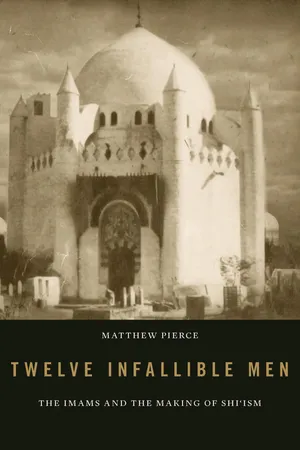
Twelve Infallible Men focuses on the role of narratives of the imams in the development of a distinct Shi?a identity. During the tenth century, at a critical juncture in Islamic history, a group of scholars began assembling definitive works containing accounts of the twelve imams' lives. These collective biographies constructed a sacred history, portraying the imams as strong, beautiful, learned, and pious. Miracles surrounded their birth, and they became miracle workers in turn, but were nevertheless betrayed and martyred by enemies.
These biographies inspired and entertained, but more importantly they offered a meaningful narrative of history for Muslims who revered the imams. The accounts invoked shared memories and shaped communal responses and ritual practices of grieving. Mourning the imams' tragic fates helped nascent Shi?a communities resist the pressure to forget their story. The biographies of the imams became a focal point of cultural memory, inspiring Shi?a religious imagination for centuries to come.
- 254 pages
- English
- ePUB (mobile friendly)
- Available on iOS & Android
eBook - ePub
About this book
Information
Topic
Theology & ReligionSubtopic
European Medieval HistoryCHAPTER ONE
Setting the Stage
If poetry is the “archive of the Arabs,” biography is the archive of the Muslims.
—Michael Cooperson1
ONE THOUSAND YEARS AGO, Baghdad was embroiled in a sectarian controversy that polarized the city and contributed to the destabilization of a fractured empire. During the years 1003, 1008, and 1018, large riots and massive street brawls led to politically sanctioned executions, and entire quarters of the city were burned to the ground. Religious celebrations and parades staged by one group and opposed by another were often flashpoints for violent clashes. Historians have long framed the Baghdad riots as Sunni-Shiʿa conflicts, and it is tempting to see them as early manifestations of the same sectarian disputes that plague Baghdad today. But there are reasons to revisit these assumptions. Hidden layers of history need to be uncovered and considered.
To describe the riots in Baghdad a thousand years ago as Sunni-Shiʿa debates is not an anachronism. The sources closest to the period describe them as such.2 The problem is that the definition and attribution of “Sunni” and “Shiʿa” have shifted over time. The disputes in Baghdad occurred in a turn-of-the-millennium context in which sectarian identities were still unsettled. Participants in the street brawls of late tenth and early eleventh century were unlikely to have considered themselves “Sunni” as opposed to “Shiʿa.” At that time “Sunni” meant something akin to “orthodox,”3 and the typical form of the term, ahl al-sunna, was championed by traditionalist circles that discouraged speculative readings of texts and philosophically based hermeneutics. The term “traditionalist,” as I am using it, is not to refer to someone who collected hadith traditions (a “traditionist”), but denotes a person who adopted a scripturalist approach to interpretive questions rather than the methods outlined by various theological and philosophical schools. The groups that used “Sunni” as a self-appellation were spearheaded by a traditionalist group in Baghdad, namely the Hanbalis, and their opponents were all those they considered heretical (no small number of people). These included not only the Shiʿa in their various forms, but also members of prominent theological schools, like the ʿAsharis and Muʿtazilis. Many people who came to be included in the fold of Sunni Islam, including most Shafiʿi and Hanafi Muslims, would not have been considered Sunni by the groups who championed this term. Even the so-called “Sunni revival” of the tenth to twelfth centuries was really a traditionalist resurgence opposed to a wide array of other interpretive communities.4 Islamic orthodoxy was only beginning to coalesce, and using the term “Sunni” for a group was not so much a description as it was an assertion.
Likewise, the communities that might be called “Shiʿa” in the tenth century had a mix of loyalties that did not always align with how the term would be defined in subsequent centuries. The biological descendants of ʿAli b. Abi Talib (known as ʿAlids) were often categorized along with the various forms of Shiʿism.5 Moreover, traditionalists often saw any sympathy for Shiʿism as evidence of conspiracy with the Ismaʿili Shiʿa dynasty that threatened western ʿAbbasid lands. The Twelver Shiʿism that would later rise to prominence was still in its nascent form, occupying a small but expanding portion of a nebulous Shiʿa landscape. The core concepts and rituals that later bound Twelver Shiʿa Muslims together were not yet fully developed, nor was it clear what relationship Shiʿism had to traditionalist orthodoxy. Tellingly, Shiʿa literatures did not typically use the term “Sunni” as a description for any particular group.
Members of the educated urban classes in this period were connected to one another by a complex web of political, familial, and scholastic loyalties. These communal bonds were animated by competing ritual practices and interpretations of the Qurʾan, but the differences cannot always be reduced to the paradigm of religious sectarian identity. Several more centuries would pass before the Sunni-Shiʿa divide commonly functioned as a binary. Many scholars of the period whom later generations of Shiʿa considered one of their own did not publicly identify as such during their lifetimes. To identify as Shiʿa prior to the tenth century was tantamount to declaring political rebellion. Being a “Shiʿa” (literally, “partisan”) of someone other than the caliph—whether that someone was a living imam or the long-dead ʿAli—was synonymous with denying loyalty to the caliph. Making such a claim was generally done in secret or on the fringes of the empire where the caliph had tenuous control.
A vast borderland existed between explicit Shiʿism (adherence to an identified imam and the secret or public rebellion that entailed) and the (subsequently described as) Sunni default position of coming to terms with the powers that were. Numerous scholars of the period did not fit either category, and some may best be described as both.6 For example, Abu ʿAbd al-Rahman al-Nasaʾi (d. 830/915), author of one of the six semicanonical collections of Sunni hadith, was believed to have been killed precisely for his ʿAlid sympathies.7 Such instances are common in the historical record. Many prominent figures that were criticized for their Shiʿa proclivities would come to be seen by later historians as unquestionably Sunni, based on later uses of the term. And even as late as the twelfth century, some Sunni communities participated in the commemorations of ʿAshuraʾ.8 Thus trying to determine whether a particular figure from this period is better understood as Sunni or Shiʿa becomes an anachronistic exercise borne out of assumptions about religious commitments that were not fully formed until later centuries.9 In the early eleventh century, the conception of an Islam comprised of two divergent—and irreconcilable—branches had simply not coalesced. In fact, we should keep in mind that the absolute separation between Sunni and Shiʿa Muslims has never been comprehensively actualized (either socially or religiously), and some Muslims have attempted, especially in the modern period, to try to harmonize the two categories.10
And yet most Muslims were divided. The centuries-long process of separation into conceptually and socially distinct Sunni and Shiʿa communities had begun.11 Numerous scholars have explored how and why this process occurred. Some have focused on legal differences between the two groups, while others have examined theological arguments or political confrontations. No single angle provides a comprehensive explanation of this development, but each area of focus gives us additional insight into one of the most complex and enduring disputes of Islamic history. How Shiʿa groups would tell their own story of origin undoubtedly has relevance to this conversation.
A new form of religious literature emerged in the tenth century. Scholars within Shiʿa circles began to record the life stories of their twelve imams, collating the biographies of their community’s most holy figures into single works. By the twelfth century, the collective biographies of the imams, as I call it, had come to look like a subgenre of its own. The parameters had been set, and works within the genre utilized a common religious vocabulary and drew upon an established canon of themes and motifs.12
The stories of the imams were not written in a vacuum, and our study of this literature must begin with an understanding of the religious, political, and literary contexts in which it was written. This chapter provides a brief sketch of key events leading up to the tenth century and a review of the religious and literary culture of the central ʿAbbasid lands. This background information gives us a sense of some of the implications of writing about the imams, and it enables us to discern the issues at stake for those who wrote the five works at the heart of this study.
History and the Literatures of Memory
In the year 945, just four years after the twelfth imam was said to have gone into the semipermanent period of hiding known as the “greater occultation,” the city of Baghdad fell under the control of a powerful family known as the Buyids, inhabitants of a mountainous region called the Daylam located on the southern shores of the Caspian Sea. The occupiers were ethnically and culturally foreign to most residents of Baghdad, but the Buyids justified their actions by questioning the legitimacy of ʿAbbasid rule, a sentiment shared by many.
Political authority was a matter of legitimacy as well as strength. Leadership by the descendants of the Prophet’s family had long held widespread appeal, especially in times of political and institutional corruption and mismanagement. For many Muslims, the ahl al-bayt (a ubiquitous term referring to the Prophet’s family) was a powerful symbol of justice, resistance to oppression, and hope for a reorganized society.13 This wasn’t limited to the Shiʿa.
The seventh, eighth, and ninth centuries saw a slew of uprisings against central powers, most of them carried out by—or at least in the name of—a member of the Prophet’s family. The ʿAbbasids themselves had risen to power on the slogan of “The Chosen from the Family” (al-rida min ahl al-bayt), a promise many took to mean that the revolution would put political rule in the hands of the Prophet’s progeny.14 The first caliph of the ʿAbbasid dynasty, Abu al-ʿAbbas al-Saffah, was in fact connected to the Prophet’s family (he was descended from ʿAbbas, the Prophet’s uncle), though his ascension to political power was a surprise and disappointment to many in the movement.
The sentiments that helped bring the ʿAbbasids to power returned to plague the dynasty in the ninth and tenth centuries. The dynasty’s claim to legitimacy had appeas...
Table of contents
- Cover
- Title Page
- Copyright
- Dedication
- Contents
- Note on Dates and Transliteration
- Prologue
- 1. Setting the Stage
- 2. Consolation for a Community
- 3. Betrayal and the Boundaries of Faithfulness
- 4. Vulnerable Bodies and Masculine Ideals
- 5. Entering the Cosmos
- Epilogue
- Appendix 1. The Fourteen Infallibles: A Quick Guide
- Appendix 2. Collective Biographies of the Imams: A Genre Survey
- Abbreviations
- Notes
- Select Bibliography
- Acknowledgments
- Index
Trusted by 375,005 students
Access to over 1.5 million titles for a fair monthly price.
Study more efficiently using our study tools.
Frequently asked questions
Yes, you can cancel anytime from the Subscription tab in your account settings on the Perlego website. Your subscription will stay active until the end of your current billing period. Learn how to cancel your subscription
No, books cannot be downloaded as external files, such as PDFs, for use outside of Perlego. However, you can download books within the Perlego app for offline reading on mobile or tablet. Learn how to download books offline
Perlego offers two plans: Essential and Complete
- Essential is ideal for learners and professionals who enjoy exploring a wide range of subjects. Access the Essential Library with 800,000+ trusted titles and best-sellers across business, personal growth, and the humanities. Includes unlimited reading time and Standard Read Aloud voice.
- Complete: Perfect for advanced learners and researchers needing full, unrestricted access. Unlock 1.5M+ books across hundreds of subjects, including academic and specialized titles. The Complete Plan also includes advanced features like Premium Read Aloud and Research Assistant.
We are an online textbook subscription service, where you can get access to an entire online library for less than the price of a single book per month. With over 1.5 million books across 990+ topics, we’ve got you covered! Learn about our mission
Look out for the read-aloud symbol on your next book to see if you can listen to it. The read-aloud tool reads text aloud for you, highlighting the text as it is being read. You can pause it, speed it up and slow it down. Learn more about Read Aloud
Yes! You can use the Perlego app on both iOS and Android devices to read anytime, anywhere — even offline. Perfect for commutes or when you’re on the go.
Please note we cannot support devices running on iOS 13 and Android 7 or earlier. Learn more about using the app
Please note we cannot support devices running on iOS 13 and Android 7 or earlier. Learn more about using the app
Yes, you can access Twelve Infallible Men by Matthew Pierce in PDF and/or ePUB format, as well as other popular books in Theology & Religion & European Medieval History. We have over 1.5 million books available in our catalogue for you to explore.