In her lifetime Elizabeth Bishop was appreciated as a writer's writer (John Ashbery once called her "the writer's writer's writer"). But since her death in 1979 her reputation has grown, and today she is recognized as a major twentieth-century poet. Critics and biographers now habitually praise Bishop's mastery of her art, but all too often they have little to say about how her poetry does its sublime work—in the ear and in the mind's eye.
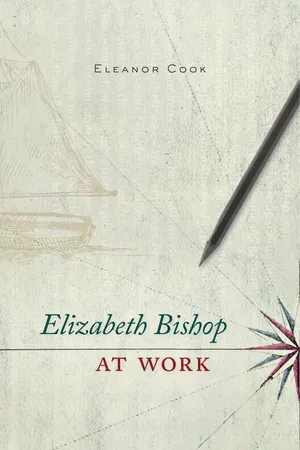
Elizabeth Bishop at Work examines Bishop's art in detail—her diction, syntax, rhythm, and meter, her acute sense of place, and her attention to the natural world. It is also a study of the poet working at something, challenging herself to try new things and to push boundaries. Eleanor Cook traces Bishop's growing confidence and sense of freedom, from her first collection, North & South, to Questions of Travel, in which she fully realized her poetic powers, to Geography III and the breathtaking late poems, which—in individual ways—gather in and extend the poet's earlier work. Cook shows how Bishop shapes each collection, putting to rest the notion that her published volumes are miscellanies.
Elizabeth Bishop at Work is intended for readers and writers as well as teachers. In showing exactly how Bishop's poems work, Cook suggests how we ourselves might become more attentive readers and better writers. Bishop has been compared to Vermeer, and as with his paintings, so with her poems. They create small worlds where every detail matters.
- 308 pages
- English
- ePUB (mobile friendly)
- Available on iOS & Android
eBook - ePub
Elizabeth Bishop at Work
About this book
Information
CHAPTER ONE
Land, Water, Fire, Air: Two Poems
Playing Detective
It was pure serendipity. I had walked over to the main library at Vassar College, which I was visiting for the first time. The June morning was bright and fresh, and the campus with its huge old trees was inviting. So when I discovered that Archives and Special Collections did not open until ten A.M., I was tempted to stroll around campus. Instead, being a little tired from traveling, I opted for a quick exploration of the library and a glance over some new books, shelved in a corner in the main foyer. Alan Gurney’s Compass: A Story of Exploration and Innovation was one, and I pulled it down because I have always been interested in exactly where I am located in the world — not just the name of my home city, Toronto, but its latitude, its relation to the great lake that it borders, and more. Similarly when I was traveling up the Hudson Valley the day before. It was my first trip at ground level, though I’d seen it often enough from the air, and I followed it on a map, being fond of reading maps, both modern and ancient. In that, I have a temperamental affinity with Elizabeth Bishop, the writer whose papers I had come to read. I remember reading sections of Gurney’s book with interest and then rather idly looking in the index for the place-names from “The Map,” the first poem of her first collection: “Norway,” “Newfoundland,” “Labrador.” This in turn led to a section on the magnetic north and to several pages with illustrations of the compass rose. At that sight, I sat up abruptly, because I knew what Bishop had chosen for a cover design for her first book, North & South (1946): a compass rose. I sat up for another reason too. Directions in “The Map” are highlighted, and “North” is one of them. I needed to think a bit more about that compass rose and also about the magnetic north and what part it played, if any, in Bishop’s work.
A compass rose is a navigational device, familiar from some old maps or from modern charts. It consists of four main petal-like extensions from a central point, indicating north at the top, south at the bottom, east to the right, and west to the left. In the spaces between the main petals of a compass rose are four shorter petals, marking the forty-five-degree angles of northeast, southeast, southwest, and northwest. In the form that Bishop chose, there are eight, yet shorter petals indicating north-northeast and so on. She also chose straight-line petals in a diamond shape rather than curved ones. All the petals are shaded down one half of their length, so that adjacent half petals are always contrasted, making the directions easier to read. A circle encloses the entire compass rose, whose four large petals touch the perimeter. The device is repeated on the title page of North & South and also on Bishop’s half-title page, but with a difference. Here, the letter N appears in large script at the center top above the compass rose, the letter S similarly at the center bottom, and the ampersand is centered on the right-hand side.
The compass rose is an essential device on any navigational chart, whether for mariners, fliers, or others. When navigating, you plot your course from point A to point B. Then by means of parallel rulers, you transfer it to the compass rose so that it passes through zero degrees. After that, you must make two simple mathematical calculations because of the magnetic north. You must take into account the angle of deviation between the true north and the magnetic north. You must also take into account the variation of the magnetic north, because it moves around, changing over many years.1 Local magnetic forces, such as the strong magnetic force at the northernmost tip of Labrador, may or may not be pertinent. Without these calculations, you will be following a “false north.” In the first draft of Bishop’s last published poem, “Sonnet,” the phrase “the false north” is attached to lines about the compass needle.2 The metaphorical possibilities of a true north and a magnetic north are obvious.
It is a pity that the device was not reprinted in Bishop’s 1969 Complete Poems or her Complete Poems, 1927–1979 (1984) or her Poems (2011). Bishop cared about book design, and a thrice-repeated device calls attention to itself. (She even cared about the ampersand: “Don’t you think the title would look well as North & South, using the ‘&’ sign? It seems more forceful that way to me” [22 Jan. 1945, L 125].) The compass rose suggests something more than a collection of northerly and southerly poems. It suggests voyaging, sailing, and above all navigating — all the more if we happen to know that Bishop came from a seafaring family on her mother’s side and was an ardent sailor herself. She told friends about her great-grandfather, who sailed the North and South American coasts and maybe more in the nineteenth century and who went down with his ship and all hands off Sable Island in 1866.3 In her teens, she went to a camp at Wellfleet, Massachusetts, for the summers of 1924 through 1929, where she excelled at swimming and sailing and performing sea shanteys too (“Chronology,” L xxiii). She was good enough at age eighteen to sail a fifteen-foot sailboat, along with two young friends, from Plymouth to York Harbor in Maine, arriving to the shock of one friend’s parents.4 Bishop was a water person. All her life, she lived on or near the ocean, and she loved to fish and to swim. “I love to go fishing, you know — any kind of fishing,” she wrote to her Aunt Grace in 1963 when planning a visit to Nova Scotia (to Grace Bowers, 28 Oct. 1963, Vassar 25.11). Her 1932 Newfoundland travel diary mentions a sudden high dive into a gorge “amid loud cries,” when a schooner sailed into sight of a swimmer clad as nature intended.5 A friend recalled “very clearly” from a student summer on Cape Cod that Bishop said, “If anything ever happens to me, take me to the ocean.”6
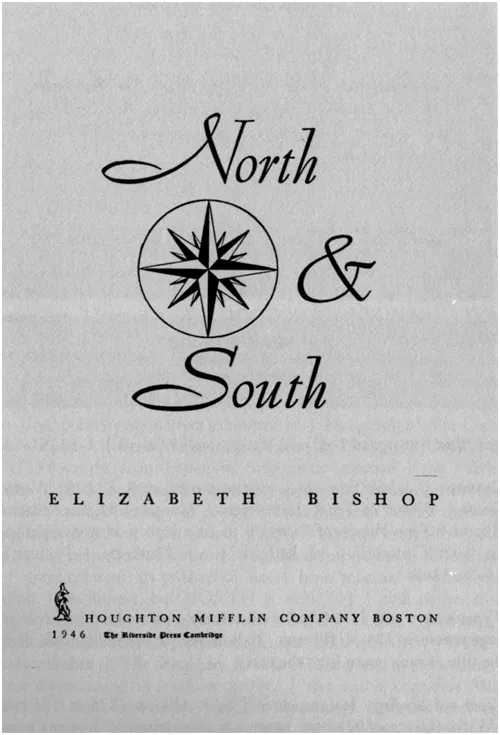
Title page of North & South, showing compass rose
Over a year later, there was another bit of serendipity. In my mail, there arrived an issue of the Elizabeth Bishop Society of Nova Scotia newsletter with a poem by Keith Ekiss about his trip to Vassar to read Bishop’s papers. When I read the last two lines, I once more sat up abruptly:
the compass rose painted on the library floorpredicted all the ways she would travel.
Within minutes, I was on e-mail to Dean Rogers at Vassar. What I needed to know was whether this was a figure of speech — very apt, if it was — or literal. Was there somewhere in Vassar’s library system a compass rose in the floor? I had not seen one. But in fact, I had stepped on that compass rose every time I descended the main stairs to the Archives and Special Collections. It is at the foot of the stairs but has been covered with carpeting since a fairly recent renovation. The architect and the Vassar authorities clearly had little notion that they were covering up an important device of one of their most famous graduates, a graduate who is the reason for many visitors to their library.7
I tried to imagine Bishop’s own reaction, coming to Vassar, descending the stairs, and finding at the bottom a navigational device very familiar to her. She was on her own far more than most of her fellow students. Her father had died when she was eight months old, and her mother had been confined to a mental hospital when she was five; she had not seen her mother since. Vassar became her home for four years in a special way. The compass rose on North & South harkens back not only to Bishop’s family but also to her time in college.
“The Map” was written in early 1935, within a year of Bishop’s graduation from Vassar and probably before her twenty-fourth birthday on February 8.8 In her hands, the poem becomes a little world. All her life, Bishop would write this kind of poem, focusing on one place or one area and quietly, slowly, indirectly showing us an entire world as surely as Vermeer shows us an entire world in some of his paintings. To continue Fairfield Porter’s tribute, “her relaxed line … allows each word enough space to be savored properly for what it is; and this comes from knowing when to change as well as when to repeat, how to keep such a distance that you pay attention and can go on, as you might go over the surface of a canvas.”9
Poems as Little Worlds
“The Map”Land lies in water; it is shadowed green.Shadows, or are they shallows, at its edges.
The first time that the singer Suzie Leblanc read these lines, she found that she had to stop and go out for a walk. She too is a Maritimer, and these words about land and water affected her intensely. Bishop, looking intently at a map, has translated some of her own intensity into her lines. A map with shaded areas along the coastline in a narrow strip causes the adjoining land to look as if it casts a shadow. The effect makes the map look three-dimensional, alive.
The question — shadows or shallows? — has sounded whimsical to some readers. It is not. In fact, it is crucial in one context. If you are a sailor, you need to know whether you are seeing shadows or shallows on a coastline. Otherwise you are in danger of foundering. That is why navigational charts that I’ve seen indicate the depth of the water along the shoreline up to six fathoms. If you are a writer, it is just as well to know about shallows too.
The perspective changes with lines 4 to 8.
Or does the land lean down to lift the sea from under,drawing it unperturbed around itself?Along the fine tan sandy shelfis the land tugging at the sea from under?
The sea is now a garment or covering, with the land pulling it up around itself. The two questions again sound fanciful or maybe touched with allegory and not descriptive. But in fact, they are descriptive, more obviously for a seacoast, descriptive in figurative terms.
The question to ask is much the same as for shadows and shallows in line 2. When might these lines be accurate or significant? Surely, during the flowing of the tide. Again, Bishop is drawing on a sailor’s knowledge and here childhood knowledge. Her Nova Scotia home was Great Village, which lies close to the innermost point of the Bay of Fundy, famous for its phenomenal tides, the highest in the world: “My aunt lives on an enormous (for that part of the country) farm … always described as the most beautiful farm on the Bay of Fundy. You know about the Bay of Fundy and its tides, I imagine, that go out for a hundred miles or so and then come in with a rise of 80 feet” (to Marianne Moore, 29 Aug. 1946, L 139). When the tide is flowing, the land gives the effect of lifting or drawing or “tugging at the sea from under.” It doesn’t, of course. But on the Bay of Fundy, as on other long tidal stretches, things can look different. (Bishop wants the verbs here for other reasons as well, I think, but reasons that emerge only gradually from the poem.) Even on some freshwater coasts, there is a similar effect — not from tides but from pressure. On the coastlines of any large body of water, rising pressure will cause the water to drop, while a low-pressure system will cause the water to rise, as in an old storm glass. Of course, the land does not literally lift or draw or tug the water; it is the atmosphere above that does so. But the effect can look that way.
Later, I came to realize that one test for some of Bishop’s lines or phrases is whether simple accuracy accounts for them. Sometimes there is not the slightest need to assume whimsy or fantasy or imaginary worlds.
An anecdote: I flew into Halifax in June 2011, and as the plane descended, I saw a very large riverbed, huge in fact. Then I saw that it was dry, then, further down, that it was damp and that the soil was reddish. And I suddenly exclaimed, partly aloud, “Heavens, I recognize the place. I know it!” I told my seat partner that it must be the Bay of Fundy, and she smiled indulgently, being a Haligonian. In fact, I had seen the bay but had not realized it, as Elizabeth Peabody said when she walked into a tree. Its shape on a map was very familiar, and I knew that Bishop said the tides went out about one hundred miles before returning. Why had I not imagined what this process looked like on the ground? I had not seen it that way since my teens, but still — a salutary lesson in realizing, imagining.
The word “unperturbed” in line 6 can modify “land” or “sea,” but why should either land or sea be perturbed or unperturbed? Once again, a sailor’s knowledge is in play. The word “unperturbed” is a benchmark for measuring the sea; calculations are made on the basis of “the unperturbed sea level” or “the unperturbed sea depth” or floor and the like. That is, measurements are taken “in the absence of ...
Table of contents
- Cover
- Title Page
- Copyright
- Dedication
- Contents
- Abbreviations
- Introduction
- 1. Land, Water, Fire, Air: Two Poems
- 2. Elizabeth Bishop’s Ordinary Diction — Yes, But …
- 3. On the Move: From New York to Key West, via France
- 4. Diction on the Move
- 5. Rhythms of A Cold Spring
- 6. Kinds of Travel, Kinds of Home, Kinds of Poem: Questions of Travel
- 7. Brief Interlude on Genre
- 8. Geography III
- 9. Late Poems
- Conclusion
- Notes
- Acknowledgments
- Illustration Credits
- Index to Bishop’s Poems, Stories, and Essays
- General Index
Trusted by 375,005 students
Access to over 1.5 million titles for a fair monthly price.
Study more efficiently using our study tools.
Frequently asked questions
Yes, you can cancel anytime from the Subscription tab in your account settings on the Perlego website. Your subscription will stay active until the end of your current billing period. Learn how to cancel your subscription
No, books cannot be downloaded as external files, such as PDFs, for use outside of Perlego. However, you can download books within the Perlego app for offline reading on mobile or tablet. Learn how to download books offline
Perlego offers two plans: Essential and Complete
- Essential is ideal for learners and professionals who enjoy exploring a wide range of subjects. Access the Essential Library with 800,000+ trusted titles and best-sellers across business, personal growth, and the humanities. Includes unlimited reading time and Standard Read Aloud voice.
- Complete: Perfect for advanced learners and researchers needing full, unrestricted access. Unlock 1.5M+ books across hundreds of subjects, including academic and specialized titles. The Complete Plan also includes advanced features like Premium Read Aloud and Research Assistant.
We are an online textbook subscription service, where you can get access to an entire online library for less than the price of a single book per month. With over 1.5 million books across 990+ topics, we’ve got you covered! Learn about our mission
Look out for the read-aloud symbol on your next book to see if you can listen to it. The read-aloud tool reads text aloud for you, highlighting the text as it is being read. You can pause it, speed it up and slow it down. Learn more about Read Aloud
Yes! You can use the Perlego app on both iOS and Android devices to read anytime, anywhere — even offline. Perfect for commutes or when you’re on the go.
Please note we cannot support devices running on iOS 13 and Android 7 or earlier. Learn more about using the app
Please note we cannot support devices running on iOS 13 and Android 7 or earlier. Learn more about using the app
Yes, you can access Elizabeth Bishop at Work by Eleanor Cook in PDF and/or ePUB format, as well as other popular books in Literature & Literary Criticism in Poetry. We have over 1.5 million books available in our catalogue for you to explore.