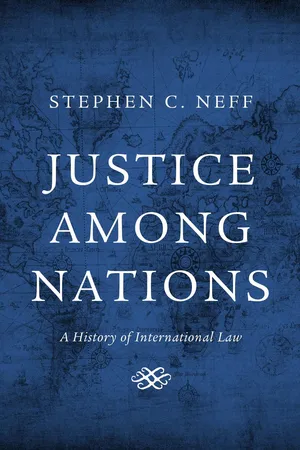
Justice among Nations tells the story of the rise of international law and how it has been formulated, debated, contested, and put into practice from ancient times to the present. Stephen Neff avoids technical jargon as he surveys doctrines from natural law to feminism, and practices from the Warring States of China to the international criminal courts of today.
Ancient China produced the first rudimentary set of doctrines. But the cornerstone of later international law was laid by the Romans, in the form of natural law—a universal law that was superior to early laws and governments. As medieval European states came into contact with non-Christian peoples, from East Asia to the New World, practical solutions had to be devised to the many legal quandaries that arose. In the wake of these experiences, international legal doctrine began to assume its modern form in the seventeenth and eighteenth centuries.
New challenges in the nineteenth century encompassed the advance of nationalism, the rise of free trade and European imperialism, the formation of international organizations, and the arbitration of disputes. Innovative doctrines included liberalism, the nationality school, and solidarism. The twentieth century witnessed the formation of the League of Nations and a World Court, but also the rise of socialist and fascist states and the advent of the Cold War. Yet the collapse of the Soviet Union brought little respite. As Neff makes clear, further threats to the rule of law today come from environmental pressures, genocide, and terrorism.
- 641 pages
- English
- PDF
- Available on iOS & Android
eBook - PDF
About this book
Information
Topic
DerechoSubtopic
Derecho internacionalTable of contents
- Contents
- Acknowledgments
- Introduction
- I. Law and Morality Abroad (to ca. ad 1550)
- II. Reason and Its Rivals (ca. 1550– 1815)
- III. Positive Century (1815–1914)
- IV. Between Yesterdayand Tomorrow (1914– )
- Conclusion
- Notes
- Bibliographic Essay
- Index
Trusted by 375,005 students
Access to over 1.5 million titles for a fair monthly price.
Study more efficiently using our study tools.
Frequently asked questions
Yes, you can cancel anytime from the Subscription tab in your account settings on the Perlego website. Your subscription will stay active until the end of your current billing period. Learn how to cancel your subscription
No, books cannot be downloaded as external files, such as PDFs, for use outside of Perlego. However, you can download books within the Perlego app for offline reading on mobile or tablet. Learn how to download books offline
Perlego offers two plans: Essential and Complete
- Essential is ideal for learners and professionals who enjoy exploring a wide range of subjects. Access the Essential Library with 800,000+ trusted titles and best-sellers across business, personal growth, and the humanities. Includes unlimited reading time and Standard Read Aloud voice.
- Complete: Perfect for advanced learners and researchers needing full, unrestricted access. Unlock 1.5M+ books across hundreds of subjects, including academic and specialized titles. The Complete Plan also includes advanced features like Premium Read Aloud and Research Assistant.
We are an online textbook subscription service, where you can get access to an entire online library for less than the price of a single book per month. With over 1.5 million books across 990+ topics, we’ve got you covered! Learn about our mission
Look out for the read-aloud symbol on your next book to see if you can listen to it. The read-aloud tool reads text aloud for you, highlighting the text as it is being read. You can pause it, speed it up and slow it down. Learn more about Read Aloud
Yes! You can use the Perlego app on both iOS and Android devices to read anytime, anywhere — even offline. Perfect for commutes or when you’re on the go.
Please note we cannot support devices running on iOS 13 and Android 7 or earlier. Learn more about using the app
Please note we cannot support devices running on iOS 13 and Android 7 or earlier. Learn more about using the app
Yes, you can access Justice among Nations by Stephen C. Neff in PDF and/or ePUB format, as well as other popular books in Derecho & Derecho internacional. We have over 1.5 million books available in our catalogue for you to explore.