A New York Times Book Review Editors' Choice
A Telegraph Editor's Choice
An Evening Standard "Best Books about London" Selection
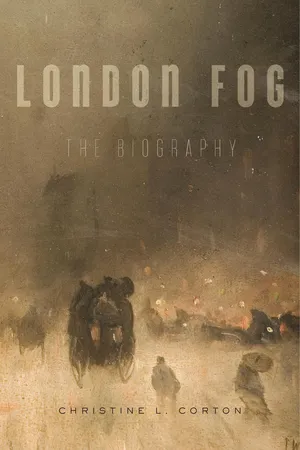
In popular imagination, London is a city of fog. The classic London fogs, the thick yellow "pea-soupers," were born in the industrial age of the early nineteenth century. Christine L. Corton tells the story of these epic London fogs, their dangers and beauty, and their lasting effects on our culture and imagination.
"Engrossing and magnificently researched…Corton's book combines meticulous social history with a wealth of eccentric detail. Thus we learn that London's ubiquitous plane trees were chosen for their shiny, fog-resistant foliage. And since Jack the Ripper actually went out to stalk his victims on fog-free nights, filmmakers had to fake the sort of dank, smoke-wreathed London scenes audiences craved. It's discoveries like these that make reading London Fog such an unusual, enthralling and enlightening experience."
—Miranda Seymour, New York Times Book Review
"Corton, clad in an overcoat, with a linklighter before her, takes us into the gloomier, long 19th century, where she revels in its Gothic grasp. Beautifully illustrated, London Fog delves fascinatingly into that swirling miasma."
—Philip Hoare, New Statesman
- 398 pages
- English
- ePUB (mobile friendly)
- Available on iOS & Android
eBook - ePub
About this book
Information
CHAPTER ONE
The Birth of London Fog
I
London has always been susceptible to mist and murk. True London fog, thick, yellow, and all-encompassing, was born in the 1840s, when the city’s rapid expansion multiplied the number of domestic coal fires and mingled their smoke as it poured out into the atmosphere with the noxious emissions of factory chimneys and workshops in the early stages of the industrial revolution in the capital. It reached maturity in the 1880s, when its repeated visitations during the winter months caused widespread social anxiety and nervous concern about crime and disorder and inspired many writers to treat it as a looming presence, alive and malignant. And it began a long decline already before the First World War, diminishing in frequency and density until legislators could no longer tolerate the dangers it posed to health and began to take decisive measures to control it. In 1962 it finally died, killed off by the Clean Air Act passed by Parliament a few years before.
In most parts of the world fog has always been a natural phenomenon, clouding the air with tiny water particles when the climatic conditions are right. The same has been true for centuries of Britain’s capital city. London has never enjoyed a particularly clear atmosphere. The Thames basin, hemmed in by low hills, has always been prone to lingering dampness and mist, and as the city grew slowly during medieval and Tudor times, complaints were voiced with increasing frequency about the pollution of the air by the smoke coming from wood fires, notably those used for the extraction of lime, and by the burning of “sea-coal” brought to London by boat from Newcastle and used for domestic and commercial fires alike. “Sea-coal” was originally a term for coal that could be found washed up on the beach from seams open beneath the sea. This could be collected easily from the seashore, but later the term seems to have been used for any coal brought to London by sea. Peter Brimblecombe notes that there was a street in London called Sacoles Lane as early as 1228, writing that “it does signify a very early beginning to the importation of coal into London.”1 No less a personage than Queen Elizabeth I confessed “herself greatly grieved and annoyed with the taste and smoke of sea-coales.”2 The problem grew more serious and led to attempts to legislate against the smoky atmosphere in the reign of her successor, James I. An Act to forbid the use of sea-coal in London breweries was passed by the House of Lords in 1623; but it was unenforceable, so in practice nothing happened.
The complaints continued. In 1676 the scientist Robert Hooke, approaching the city on horseback, estimated the cloud of smoke over London to be half a mile high and twenty miles long, while, earlier, in 1652, the Dutchman Lodewijk Huygens, looking over the capital from a similar vantage point (possibly Hampstead Heath or Highgate Hill), found the medieval cathedral of St. Paul’s “too much obscured by smoke” to see clearly. It was recognized instinctively that an atmosphere of this kind could not be good for the health of the city’s inhabitants. John Graunt, who analysed London’s Bills of Mortality in 1676, thought that “the smoak of London” was dangerous “for the suffocations which it causes,” while the merchant Thomas Tryon, whose book The Way to Health turned Benjamin Franklin into a vegetarian, wrote in 1700 that the “unwholesome airs” of London created “stinking, gross sulphurous Smoaks” that were “Pernicious to Mankind.”3
The most famous denunciation of London’s smoky atmosphere in the seventeenth century and indeed for a long time afterwards, however, was penned by the diarist John Evelyn (1620–1706). Entitled Fumifugium; or, The Inconvenience of the Aer and Smoake of London Dissipated, it was published in 1661. Already ten years earlier, in 1651, Evelyn had complained that London was obscured by “such a cloud of sea-coal, as if there be a resemblance of hell upon earth, it is in this volcano in a foggy day: This pestilent smoak.”4 In 1661 he was even more vociferous, denouncing the “Clowds of Smoake and Sulphur, so full of Stink and Darknesse” that enveloped the “Glorious and Antient City.”5 Evelyn followed the science of Kenelm Digby (1603–1665), who applied an atomic theory to air pollution in which the atoms of coal smoke were perceived as sharp and pointed:6 “This is that pernicious Smoake which sullyes all her [London’s] Glory, super-inducing a sooty Crust or Fur upon all that it lights, spoyling the moveables, tarnishing the Plate, Gildings and Furniture, and corroding the very Iron-bars and hardest Stones with these piercing and acrimonious Spirits which accompany its Sulphure; and executing more in one year, than exposed to the pure Aer of the Country it could effect in some hundreds.”7
Evelyn proposed to alleviate the evil of smoke by relocating smoke-producing industries outside London and providing a circle around London of sweet-smelling plants and hedges so that their delicious scents could waft into the city and dispel the fumes. According to Evelyn’s own diary he presented his tract to King Charles II: “[the King] was pleased I should publish it by his special Command; being much pleas’d with it.”8 Later in his diary Evelyn mentioned the drafting of a Bill by Sir Peter Ball against the smoke nuisance, though nothing more was heard of it.9 While some people, like Evelyn, were aware of the problem, nobody was seriously prepared to do anything about it.
Evelyn did not accept that the geographical situation of London was particularly unhealthy. It was, he claimed, “built upon a sweet and most agreeable Eminency of Ground.” He exonerated “the Fumes which exhale from the Waters and lower Grounds lying Southwards, by which means they are perpetually attracted, carried off or dissipated by the Sun, as soon as they are born, and ascend.”10 Evelyn thought smoke most unhealthy, declaring that it “causeth Consumptions, Phthisicks, and the Indisposition of the Lungs, not only by the suffocating aboundance of Smoake, but also by its Virulency; For all subterrany Fuell hath a kind of Virulent or Arsenical vapour rising from it.”11 Indeed, he charged, London’s “Inhabitants breathe nothing but an impure and thick Mist, accompanied with a fuliginous and filthy vapour.”12 Evelyn put the blame for the smoke problem firmly on industry. The objectionable smoke was emitted, he wrote, “not from the Culinary fires, which for being weak, and lesse often fed below, is with such ease dispelled and scattered above, as it is hardly at all discernible.”13 Lime kilns were worst of all, poisoning “the Aer with so dark and thick a Fog.”14
Fumifugium was reprinted in 1772, when the editor, Samuel Pegge the elder (1704–1796), reported on how conditions had worsened in his own time. He noted the increase of “glass-houses, foundries, and sugar-bakers, to add to the black catalogue” and singled out specific sources of pollution such as “the fire-engines of the water-works at London Bridge and York Buildings.”15 He conceded the impossibility of moving all smoke-producing works outside the city, as Evelyn had suggested, but he wondered if the law should forbid major polluters such as brewers and manufacturers of glass and sugar from building works in town. Their buildings, he recommended, should only be set up at a certain distance from the town. Pegge’s recommendations were not followed. His perception of worsening atmospheric conditions in the city was shared by many of the foreign visitors who came to London during the eighteenth century. Already in 1748 a Swedish traveller, Pehr Kalm (1716–1779), reported of the view from St. Paul’s that “the thick coal smoke, which on all sides hung over the town, cut off the view in several places.”16 In the 1760s the French visitor Pierre-Jean Grosley (1718–1785), a travel writer and man of letters, noted that “smoke … forms a cloud which envelops London like a mantle,… the smoke, which, being mixed with a constant fog, covers London, and wraps it up entirely.” A year’s sojourn in the city convinced him that the situation was getting worse: “the smoke,” he warned, “gains ground every day: if the increase of London proceeds as far as it may, the inhabitants must at last bid adieu to all hopes of ever seeing the sun.” Grosley tempered his criticism of the London atmosphere by his admiration of the English love of walking, even on foggy days, specifically April 26 in St. James’s Park, when objects could barely be distinguished at a distance of four steps but when the park was nonetheless filled with walkers who were, Grosley admits, “an object of musing and admiration to me during the whole day.”17 Grosley, it seems, was an early French admirer of British energy and pluck.
The German scientist Georg Christoph Lichtenberg, visiting the city in the 1770s, was so oppressed by a foggy day that he found himself “writing by the light of a candle (at half-past ten in the morning).” The Prussian pastor Karl Philipp Moritz, writing in 1782, reported that “everything in the streets … seemed dark even to blackness,” while the composer Joseph Haydn, living in Great Pulteney Street during his first triumphant musical visit to England, wrote on November 5, 1791: “There was a fog so thick that one might have spread it on bread. In order to write I had to light a candle as early as eleven o’clock.”18 The fog was responsible according to the fifty-nine-year-old Haydn for a severe attack of rheumatism that he described grumpily as “English.”19
A few years later, in 1809, Eric Gustaf Geijer (1783–1847), a Swedish historian and later Rector of Uppsala University, came to England as tutor to the son of a wealthy Stockholm merchant. He complained of “London’s miasma, a premonitory Deus Terminus of a world’s capital.… One penetrates ever deeper into an atmosphere of coal smoke in whose twilight moves an unending multitude of people.”20 London’s sky was, he claimed, “made of coal smoke”: “London is a foggy, smoky hole.”21 The following year Louis Simond (1767–1831), a Frenchman who had emigrated to America before the Revolution and who toured Great Britain in 1810–1811, complained, “It is difficult to form an idea of the kind of winter days in London; the smoke of fossil coals forms an atmosphere perceivable for many miles.”22
How could London’s air be improved from this desperate condition? Suggestions made by Pegge in his reissue of Evelyn’s Fumifugium included the charring of sea-coal, so it would yield less smoke, and the building of chimneys “much higher into the air … to convey the smoke away above the buildings, and in a great measure disperse it into distant parts, without its falling on the houses below.”23 This idea of high chimneys was taken up by William Frend (1757–1841) in the early nineteenth century in a pamphlet with the unwieldy title Is It Impossible to Free the Atmosphere of London in a Very Considerable Degree, from the Smoke and Deleterious Vapours with Which It Is Hourly Impregnated? (1819). It does not seem to have had much impact, however. Meanwhile, Evelyn’s influence continued into the early nineteenth century, inspiring in 1822 an article in the Quarterly Journal of Science, Literature, and the Arts on Fumifugium. The article linked Evelyn’s proposals to the establishment of a House of Commons select committee aiming “to inquire how far it may be practicable to compel persons using Steam-Engines to erect them in a Manner less prejudicial to public health and public comfort.”24 The article compared “the grievances occasioned by the smoake of London 160 years ago, when the metropolis was not one-sixth its present extent, with those which are now matter of complaint” and proposed to enquire “how far the evil was then, and is now, susceptible of diminution, or removal.”25 The writer questioned the efficacy of Parliament in such matters, for “as soon as Parliament is prorogued, and the smoke-burners out of town, we relapse into our pristine fuliginosity, and the pretty-behave...
Table of contents
- Cover
- Title Page
- Copyright
- Dedication
- Contents
- 1. The Birth of London Fog
- 2. Dickensian Gloom
- 3. King Fog
- 4. Women in Danger
- 5. The View from Abroad
- 6. London Apocalypse
- 7. Land of the Living Dead
- 8. The Last Gasp
- Conclusion: The Death of London Fog
- Notes
- Acknowledgements
- Index
Trusted by 375,005 students
Access to over 1.5 million titles for a fair monthly price.
Study more efficiently using our study tools.
Frequently asked questions
Yes, you can cancel anytime from the Subscription tab in your account settings on the Perlego website. Your subscription will stay active until the end of your current billing period. Learn how to cancel your subscription
No, books cannot be downloaded as external files, such as PDFs, for use outside of Perlego. However, you can download books within the Perlego app for offline reading on mobile or tablet. Learn how to download books offline
Perlego offers two plans: Essential and Complete
- Essential is ideal for learners and professionals who enjoy exploring a wide range of subjects. Access the Essential Library with 800,000+ trusted titles and best-sellers across business, personal growth, and the humanities. Includes unlimited reading time and Standard Read Aloud voice.
- Complete: Perfect for advanced learners and researchers needing full, unrestricted access. Unlock 1.5M+ books across hundreds of subjects, including academic and specialized titles. The Complete Plan also includes advanced features like Premium Read Aloud and Research Assistant.
We are an online textbook subscription service, where you can get access to an entire online library for less than the price of a single book per month. With over 1.5 million books across 990+ topics, we’ve got you covered! Learn about our mission
Look out for the read-aloud symbol on your next book to see if you can listen to it. The read-aloud tool reads text aloud for you, highlighting the text as it is being read. You can pause it, speed it up and slow it down. Learn more about Read Aloud
Yes! You can use the Perlego app on both iOS and Android devices to read anytime, anywhere — even offline. Perfect for commutes or when you’re on the go.
Please note we cannot support devices running on iOS 13 and Android 7 or earlier. Learn more about using the app
Please note we cannot support devices running on iOS 13 and Android 7 or earlier. Learn more about using the app
Yes, you can access London Fog by Christine L. Corton in PDF and/or ePUB format, as well as other popular books in Literature & 19th Century History. We have over 1.5 million books available in our catalogue for you to explore.