As a logical concept, identity refers to one and the same thing. So why, Vincent Descombes asks, do we routinely use "identity" to describe the feelings associated with membership in a number of different communities, as when we speak of our ethnic identity and religious identity? And how can we ascribe the same "identity" to more than one individual in a group? In Puzzling Identities, one of the leading figures in French philosophy seeks to bridge the abyss between the logical meaning of identity and the psychological sense of "being oneself."
Bringing together an analytic conception of identity derived from Gottlob Frege with a psychosocial understanding stemming from Erik Erikson, Descombes contrasts a rigorously philosophical notion of identity with ideas of collective identity that have become crucial in contemporary cultural and political discourse. He returns to an argument of ancient Greek philosophy about the impossibility of change for a material individual. Distinguishing between reflexive and expressive views of "being oneself," he shows the connections between subjective identity and one's life and achievements. We form profound attachments to the particular communities by which we define ourselves. At the same time, becoming oneself as a modern individual requires a process of disembedding oneself from one's social milieu. This is how undergoing a crisis of identity while coming of age has become for us a normal stage in human life.
Puzzling Identities demonstrates why a person has more than one answer to the essential question "Who am I?"
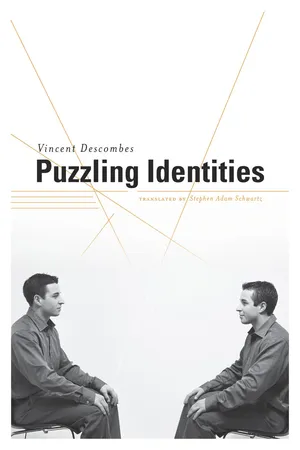
- 211 pages
- English
- ePUB (mobile friendly)
- Available on iOS & Android
eBook - ePub
Puzzling Identities
About this book
Information
Topic
PhilosophySubtopic
Mind & Body in PhilosophyPART I
“IDENTITY CAN BE A COMPLICATED MATTER”
1
LEARNING THE LANGUAGE OF IDENTITY
Identity Questions: A Lexical Puzzle
“Who am I?” “Who are we?” It might be said that these are the kinds of questions that we ask ourselves when reflecting upon our own identities. To ask, “Who am I?” is to ask what is sometimes called a “question of identity.” We know what it involves because we have a model for it: to know someone’s identity is to know what he is called. Yet can it be said, when I ask the first-person question of my own identity, that my intention is to be informed about my surname, forenames, and occupation, in much the same way as I might be expected to provide this information upon entering a public building and being subject to what is aptly called an “identity check”? Certainly not. My aim in this book will thus be to ask what the word “identity” means when it is used with the possessive (e.g., “my identity,” “our identity”) and where it does not simply refer to the statement of my surname, forenames, and occupation—i.e., my civil status.1
This use of the word “identity” (e.g., “my identity”) is of relatively recent coinage. In the past, a question of identity would have had the trivial sense expressed by the question “Who is he?”—i.e., an inquiry bearing on a person we can neither name nor place within our surroundings. Thus, when the nineteenth-century French Littré dictionary discusses “questions of identity” in the article on “identity,” it explains that the word, as used in this expression, is a “jurisprudential term” employed during investigations seeking to establish “whether an individual is who he claims to be” or whether a corpse is that of a particular person, “the presumed victim of a crime,” identified by the elements of his civil status. Understood in this way, questions of identity arise only in the third person. If someone were to raise such a question about herself, it could only be because she had become a stranger to herself, having been struck by amnesia or delirium and thus unable to state her name or identify her parents, etc.
When “identity” came to be understood as a matter of civil status, it entered into common parlance. But it retains the earlier meaning it had for philosophers who used it to formulate identity judgments. How does one move from this classical, philosophical sense to the new sense relating to civil status?
In its earliest editions, which date from the late seventeenth century, the Dictionnaire de l’Académie française makes clear that the word “identité” is a scholarly term that is rarely used: “It is only used in Didactics.” The definition offered in editions after 1794, by contrast, is philosophically perplexing: “That which makes it the case that two or more things are but a single thing.”
What is this quality or force called “identity” that is defined by its prodigious ability to make two things into a single thing? Perhaps we are to understand the definition as an elliptical one to be interpreted as follows: “That which makes it the case that what one (erroneously) took to be two or more things is (in reality) but a single, selfsame thing.” This definition would avoid falling into a dialectic of identity resulting from positing two things only so as to be able to claim that there is but one. The concept of identity thus defined is what one finds in statements of identity: to say that thing A is identical to thing B is to say that there is in reality but a single, selfsame thing that we sometimes call A and sometimes call B.
§§§ I came to understand that the word “identity” had ceased to be an exclusively scholarly or “didactic” word and had become part of the most ordinary sort of language when I came upon a passage in a tourist guide to Rome that stated of the San Lorenzo district that it was “one of the working-class neighborhoods whose identity has been best preserved.”2 Identity is now a quality that can be preserved, which means that it is also a quality that one can lose or that one can seek to defend against whatever threatens to destroy it.
Can we explain what is meant by the “identity” of a working-class neighborhood? An older guidebook might have referred to the character of the neighborhood, suggesting a charm or quaintness attaching to its originality and distinctiveness, all the more so if this character has been maintained when other neighborhoods have become uniform or gentrified. This might even have been referred to as a “personality” or a “soul” of the neighborhood thanks to an analogy between the feelings we have for people and those we have for places imbued with human presence.
Nevertheless, the word “identity” today says something more than this. In the example of a neighborhood that has retained its identity, it is clear that what is at issue is both a territory that could have been absorbed by the rest of the city that surrounds it and also the population that inhabits it. This allows the word “identity” to designate not just a quality of this part of the city, but also the inhabitants’ attachment to their way of life within it, their local customs, their surroundings. What would become of the neighborhood if, as is said, it “lost its identity”? It would never be the same, would be the response. But does this mean that it would have disappeared altogether or that it would still exist but in an indistinct way, blended as it would be with the city around it?
How can the word “identity” bear all of these meanings? How have we moved from the meaning given to the word in the Dictionnaire de l’Académie française to that given to it in the tourist guide? My aim in what follows is now set: departing from the idea that in times past the word “identity” exclusively meant (and still can mean) that there is only a single selfsame thing where one might have thought there to be two, I will seek to explain how in the past few decades it has come to sometimes mean something completely different—that there is a thing that has the virtue of being itself even though it might well have no longer been or not yet become itself.
§§§ One way of measuring the distance between these two meanings of the word “identity” is to consider its associated adjectives. We may say, for example, of two people that their behavior is identical. This means that they are doing the same thing—for example, they are both drinking coffee. By contrast, if we say that they are both engaged in “identity behavior” [un comportement identitaire], we mean that a certain way of acting provides them with a means for affirming their membership in a community or for claiming a social bond from which they derive their feeling of dignity or of their proper place in the world.3 In the latter case, the important point is that this characterization of their behavior is not simply something observed by us from outside—as it is for the tourists who admire the charm of San Lorenzo—but comes from the people involved themselves. In order for their conduct to be identitarian, they must be aware of it and be able to say, “It is not possible for me to give up acting as I do; it is a ‘question of identity’ for me in which the very conception that I have of myself is at stake.” Or, if they are speaking in the first-person plural, “The very conception that we have of ourselves is at stake.” It will be claimed, for example, that the linguistic conflict dividing a country—Belgium, for instance—is an identitarian conflict. To say this is to indicate that the conflict involves much more than opposing interests and that, in a sense, no compromise is possible. Indeed, the conflict will be said to be such that both sides would feel diminished and lose self-esteem if they were to give in on the matter in dispute.
For anyone not in thrall to a narrow utilitarian conception of human existence, there is nothing particularly enigmatic about the fact that people may come into conflict over questions that do not involve their material interests properly understood. Yet there remains a lexical enigma: why is it my “identity” that carries the burden of signifying the stakes and the object of such conflicts? My discussion in what follows will bear on this precise point: what do the word and the concept of “identity” have to do with all of this?
Declaring One’s Identity
Between identity in the sense of the identical and identity in the identitarian sense, there is an intermediary in the form of the juridical and administrative usage, which assigns to individuals an identity that makes them identifiable (and thus able to be recognized as identical to the person named by a given name) but at the same time also provides them with an identity proper to their person in the form of their names, forenames, and occupations (thereby also providing them with a potential source of identitarian feelings).
In his book Identity and Violence, Amartya Sen criticizes intellectuals who promote an “identity politics.”4 He reproaches these theorists for enclosing human beings within identities that are exclusive. In particular, he vigorously attacks a British proposal that sought to reconceive the country as a “federation of cultures.”5 With regard to diversity, he observes, what is proposed is more like a juxtaposition of what he calls “monoculturalisms.”6 Indeed, such a proposal would inevitably wind up confining everyone within his or her community of origin. In the name of celebrating diversity and respecting the customs of everyone, one would in reality end up giving official structure to the segmentation of the country into “communities” that could then remain oblivious to one another.
Sen raises a principled objection to this proposal, reminding us of the meaning we bestow on citizenship within a regime of popular sovereignty (i.e., a democratic regime). This objection is key: democratic citizenship assumes that the citizen is a member of his country directly, without the mediation of a community.
[The problem] concerns whether citizens of immigrant backgrounds should see themselves as members of particular communities and specific religious ethnicities first, and only through that membership see themselves as British, in a supposed federation of communities.7
Sen happens to begin his book with a personal anecdote meant to introduce his subject while stressing the way our use of the word “identity” can lead to difficulties—difficulties of communication that themselves lead to conceptual difficulties of a philosophical sort.
Here is the anecdote. The scene is Heathrow Airport. At the time, Amartya Sen was teaching at Cambridge, where he was Master of Trinity College. Passing through immigration after a trip abroad, he presents his immigration form to the immigration officer, who sees that his English address is Master’s Lodge, Trinity College, Cambridge. Taken aback, the officer seeks to find out how it is that the Indian traveler before him has come to live with the Master of the College. He asks whether Sen is a close friend of the Master. Clearly, it has never dawned on him that Trinity College might have appointed a professor of Indian nationality as its Master.
Mischievously, Sen points out that such a question when asked of him could be taken in a deeply philosophical sense. Since antiquity, philosophers have asked if an individual could be his own friend or have with himself a relation of friendship. If the officer’s question were asked in this sense, Sen would have to see whether the feelings he had for himself were friendly ones.
From this little incident at Heathrow, Sen draws the lesson that “identity can be a complica...
Table of contents
- Cover
- Series Page
- Title Page
- Copyright
- Epigraph
- Contents
- Part I: “Identity Can Be a Complicated Matter”
- Part II: “Who Am I?”
- Part III: “Who Are We?”
- Works Cited
- Index
Trusted by 375,005 students
Access to over 1.5 million titles for a fair monthly price.
Study more efficiently using our study tools.
Frequently asked questions
Yes, you can cancel anytime from the Subscription tab in your account settings on the Perlego website. Your subscription will stay active until the end of your current billing period. Learn how to cancel your subscription
No, books cannot be downloaded as external files, such as PDFs, for use outside of Perlego. However, you can download books within the Perlego app for offline reading on mobile or tablet. Learn how to download books offline
Perlego offers two plans: Essential and Complete
- Essential is ideal for learners and professionals who enjoy exploring a wide range of subjects. Access the Essential Library with 800,000+ trusted titles and best-sellers across business, personal growth, and the humanities. Includes unlimited reading time and Standard Read Aloud voice.
- Complete: Perfect for advanced learners and researchers needing full, unrestricted access. Unlock 1.5M+ books across hundreds of subjects, including academic and specialized titles. The Complete Plan also includes advanced features like Premium Read Aloud and Research Assistant.
We are an online textbook subscription service, where you can get access to an entire online library for less than the price of a single book per month. With over 1.5 million books across 990+ topics, we’ve got you covered! Learn about our mission
Look out for the read-aloud symbol on your next book to see if you can listen to it. The read-aloud tool reads text aloud for you, highlighting the text as it is being read. You can pause it, speed it up and slow it down. Learn more about Read Aloud
Yes! You can use the Perlego app on both iOS and Android devices to read anytime, anywhere — even offline. Perfect for commutes or when you’re on the go.
Please note we cannot support devices running on iOS 13 and Android 7 or earlier. Learn more about using the app
Please note we cannot support devices running on iOS 13 and Android 7 or earlier. Learn more about using the app
Yes, you can access Puzzling Identities by Vincent Descombes, Stephen Adam Schwartz in PDF and/or ePUB format, as well as other popular books in Philosophy & Mind & Body in Philosophy. We have over 1.5 million books available in our catalogue for you to explore.