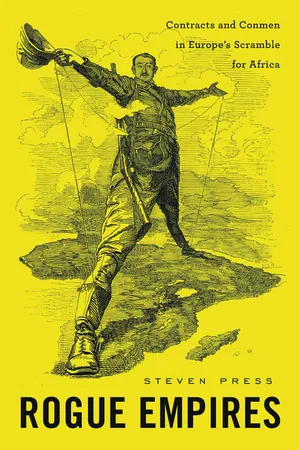
In the 1880s, Europeans descended on Africa and grabbed vast swaths of the continent, using documents, not guns, as their weapon of choice. Rogue Empires follows a paper trail of questionable contracts to discover the confidence men whose actions touched off the Scramble for Africa. Many of them were would-be kings who sought to establish their own autonomous empires across the African continent—often at odds with traditional European governments which competed for control.
From 1882 to 1885, independent European businessmen and firms (many of doubtful legitimacy) produced hundreds of deeds purporting to buy political rights from indigenous African leaders whose understanding of these agreements was usually deemed irrelevant. A system of privately governed empires, some spanning hundreds of thousands of square miles, promptly sprang up in the heart of Africa. Steven Press traces the notion of empire by purchase to an unlikely place: the Southeast Asian island of Borneo, where the English adventurer James Brooke bought his own kingdom in the 1840s. Brooke's example inspired imitators in Africa, as speculators exploited a loophole in international law in order to assert sovereignty and legal ownership of lands which they then plundered for profit.
The success of these experiments in governance attracted notice in European capitals. Press shows how the whole dubious enterprise came to a head at the Berlin Conference of 1884–1885, when King Leopold of Belgium and the German Chancellor Bismarck embraced rogue empires as legal precedents for new colonial agendas in the Congo, Namibia, and Cameroon.
- 371 pages
- English
- ePUB (mobile friendly)
- Available on iOS & Android
eBook - ePub
About this book
Information
1
The Man Who Bought a Country
THE MORNING OF SEPTEMBER 24, 1841, James Brooke woke up a stranger in a strange land. By the end of the day, he had been crowned a king.
Born in India, Brooke set foot on the island of Borneo for the first time in September 1839.1 Back in England, Brooke’s ancestral home, Borneo was terra incognita.2 Despite scant information owing to a ban on missionary travel through the late 1830s—imposed by Dutch colonial officials who had gradually taken over the island’s southern half since the seventeenth century—one commentator joked that less was known of Borneo than “of the North pole or of the headwaters of the Nile.”3 Nonetheless, this place had been attracting attention from international traders for more than a half-century.4 Britain’s empire was cementing a crucial period of expansion in Asia, and Borneo lay in the middle of a thriving maritime network between China, India, and Australia.5 Borneo’s location gave it great value, especially in view of the contemporaneous expansion of trade with China via the First Opium War. Many British ships started in India, passed through the Straits of Malacca, and then rounded the western and northern shore of Borneo before arriving in the South China Sea and moving on to Canton. Whoever controlled the Borneo coast could assist this China trade—say, by providing wood and supplies with which to refuel ship crews. They could also throttle it.
James Brooke admired the British colonization of Singapore, begun twenty years earlier by Stamford Raffles, and he wanted to extend what he saw as a superior civilization, as well as free trade, to areas even farther afield.6 Brooke grew interested in some large parcels of jungle in the northwestern section of Borneo, collectively known as Sarawak. This seemed a dangerous place, a hunting ground for pirates and the orangutan. The brush was so thick as to allow easy ambushes, and, among the most populous indigenous people, the Iban, marriage was conditional upon young men taking a head.7 Any European visitor would have to take this mystique into account, if tropical disease, leeches, or a crocodile did not overtake him first.
Sarawak was one of many polities then comprising the northern half of Borneo, which remained largely free of the sway Dutch colonists had established over the island’s southern half.8 At the time of Brooke’s arrival, the northern polities existed as dependencies under the rule of Omar Ali Saifuddin II, the sultan of Brunei. The sultan was the latest in a line of warriors who, several centuries earlier, had begun to Islamize a Brunei-based, Malay-speaking empire of Sumatran extraction. Primarily confined to the coast at first, the Islamized Bruneian power gradually became a paramount authority in Borneo’s interior, from whose subordinate kingdoms it exacted tribute.9 Its sultans commanded respect as far abroad as Manila and even earned the attention of Qing official Wei Yuan, who analyzed them in his landmark Illustrated Treatise on the Maritime Kingdoms.10 But by Brooke’s time Brunei’s imperial system teetered on the brink of dissolution, riven by civil wars, increasingly unable to defend against raiders based to the east, in the archipelago of Sulu, and struggling to adapt to European penetration of trade—much like Johor and Aceh, two neighboring Malay empires and competitors for regional supremacy. An uprising in Sarawak was the latest problem facing Brunei. Its cause was Mahkota, the sultan’s cousin and Dutch-educated provincial governor, who coerced local residents into mining antimony in an attempt to cash in on a booming export trade to Singapore.11 Mahkota’s tax regime proved so exacting as to make enemies out of Sarawak’s Ibans, as well as the Bidayuh, the area’s second-most numerous indigenous people.12 Most important, it also alienated the three leading datus, or aristocratic chiefs, whom Brunei had earlier placed in charge of administration, and with whom Mahkota and the sultan shared an ethnic heritage.13
By the late 1830s, Mahkota grew overwhelmed with his efforts to put down the revolt. Concerned about lost revenue, his cousin, the sultan, looked for outside help. One idea was to sell governing rights over Sarawak to the sultan of Sambas, a relative of Mahkota in southern Borneo with a vested interest in antimony mining and a formidable private army.14 The prevailing alternative, however, was to seek aid from a series of European adventurers who, at that time, cruised the ports of Southeast Asia looking to use their guns to make a fortune. James Brooke was such a man. A veteran of the Bengal army of the East India Company (EIC), he had retired from active duty after an injury in the First Anglo-Burmese War, then inherited a small fortune from his father. Eventually a wandering Brooke outfitted a yacht, the Royalist, and sailed to Kuching, the administrative center of Sarawak, with a crew of a dozen or so men, aiming to deliver a desultory message from the governor of Singapore to the sultan’s uncle and designated heir, Muda Hassim, but also interested in prospecting for minerals.
The plan to seek minerals stemmed in part from reports made by a missionary, George Lay, but also from a general atmosphere of permissiveness, including pleas from the navigator George Windsor Earl for Britons to extend their influence in Southeast Asia.15 Lay did not yet know the word “Sarawak” literally meant “antimony” in the sultan’s official language, Malay. But he nonetheless wrote favorably of Brunei’s antimony ore, as well as its coal deposits—certain to catch the eye of the British navy’s steamship captains—and the likelihood that Brunei could soon entice its northern provinces, including Sarawak, to join a kind of confederacy. Brooke’s arrival in Sarawak led to the desired meeting with Muda Hassim, who was then visiting in order to assist Governor Mahkota. Hassim hoped Brooke, his yacht outfitted with heavy guns, could bring Western firepower to bear on Brunei’s enemies. “Could” was the operative word. Mere money did not sufficiently tempt Brooke, and besides, Brunei was, like its Dutch neighbors to the south, suffering from a major recession.16 However, after multiple interviews and the ouster of Mahkota, Hassim allegedly proposed a more palatable trade: Brooke would help crush the insurgents in exchange for the rights and title of a rajah (Malay for “king”) in the province of Sarawak. This offer, Brooke later recalled, included the country’s trade and government rights, provided Brooke made annual tribute payments to the sultan.17
If taken at face value, the offer was not quite so novel as it may appear today. When one looks into the Malay tradition that gave rise to the Brunei Empire, one encounters numerous cases of bartered political control and, at least among aristocrats, a lack of differentiation between trade and governance. The Sejarah Melayu, a series of sixteenth-century annals whose most reliable iteration was published in English in 1821, tell how Malay rulers, whether local or imperial, consistently put a price on governmental powers, without ethical scruples. One such case took place around 1700, when Brunei sold control over the Kimanis River to Sulu; another saw Brunei acquire control over five districts, including Sarawak, from the sultan of Johor.18 Sovereignty, the annals say, is thus a cash register.19 Add to this that the Sultanate of Brunei had begun, several centuries before 1839, with what the anthropologist Marshall Sahlins has called a series of stranger-kings.20 Even outside Brunei, the hundreds of Dayak peoples comprising the indigenous population of Borneo—among them the Ibans and Bidayuh—had a long history of such dynasties. Some of them had even come about through transactions made in part by non-Dayaks and non-Malays: men like Sharif Abd-al Rahman, who in the 1770s acquired the Sultanate of Pontianak in an area that later, by the 1800s, fell under Dutch control.21
Brooke, of course, was European. Thus it would not be unreasonable to assume that at least this aspect of his deal was something new in 1840. But here, too, the reality looks otherwise, for he was merely the latest in a series of Europeans in receipt of a virtual kingdom in Southeast Asia.22 From the early eighteenth century on, certain English traders working for the East India Company around the Malay Peninsula had made similar arrangements, though sometimes without a formal transfer of title. In 1713, for instance, Joseph Collet reported that, thanks to his negotiations with the indigenous rulers on Sumatra, he had become a king, with the inhabitants of Bengkulu obeying his commands as if they came from a sovereign ruler.23 In 1812 Raffles’s colleague Alexander Hare went one step further, convincing a ruler in southern Borneo, the sultan of Banjarmasin, to give him a title to govern 1,400 square miles at Moluko.24 Banjarmasin was uninviting: English colonists had already failed there in 1707.25 But a crucial precedent was that Hare acted on his own initiative.26 True, he used his license to cultivate a large harem of women. True, his efforts at pepper cultivation failed, despite the importation of some 3,200 workers from Java, and he surrendered his country after a few years, leaving behind only a few copper coins he had minted as a new currency.27 But Hare’s story became known to British and Dutch traders in the area, many of whom went on to engage with Bruneian officials. The sultan and his uncle, the familiar Hassim, were two such figures.
When Hassim offered control of Sarawak to James Brooke, the latter was only thirty-eight years old. Brooke’s diary, accordingly, revealed plenty of self-doubt about governing.28 As regarded battle, though, he owned six heavy guns, which might allow him to do the improbable in a society whose firepower did not extend beyond darts. It took little time to end the revolt; not long after accepting Hassim’s offer, Brooke hired a diverse team of mercenaries, blew up the main opposition base, and initiated a rapprochement with the local Malay elites. Following a sojourn to Singapore, where he received encouragement from British officials, Brooke returned to the island of Borneo in 1841 intending to take formal control of Sarawak and its population: 45,000 souls, according to one contemporary estimate, with perhaps 1,500 of these living in Kuching.29
Such an ascent became the stuff of colonial fiction; Joseph Conrad used it, one of his childhood fixations, as material for the novels Lord Jim and The Rescue; less cerebrally, the popular Italian writer Emilio Salgari cast Brooke in his serialized adventure stories.30 In 1841, however, questions abounded about whether Brunei would honor the agreement Muda Hassim made. Not long after Brooke returned from Singapore, Hassim—who did not enjoy a reputation for honesty—denied any arrangement to transfer Sarawak’s government. That same day, Brooke’s interpreter died after eating rice laced with arsenic, probably at the behest of the sidelined Mahkota.31 Eventu...
Table of contents
- Cover
- Title Page
- Copyright
- Dedication
- Contents
- Introduction
- 1. The Man Who Bought a Country
- 2. The Emergence of an Idea
- 3. King Leopold’s Borneo
- 4. Bismarck’s Borneo
- 5. The Berlin Conference
- Epilogue: Afterlives
- Notes
- Acknowledgments
- Index
Trusted by 375,005 students
Access to over 1.5 million titles for a fair monthly price.
Study more efficiently using our study tools.
Frequently asked questions
Yes, you can cancel anytime from the Subscription tab in your account settings on the Perlego website. Your subscription will stay active until the end of your current billing period. Learn how to cancel your subscription
No, books cannot be downloaded as external files, such as PDFs, for use outside of Perlego. However, you can download books within the Perlego app for offline reading on mobile or tablet. Learn how to download books offline
Perlego offers two plans: Essential and Complete
- Essential is ideal for learners and professionals who enjoy exploring a wide range of subjects. Access the Essential Library with 800,000+ trusted titles and best-sellers across business, personal growth, and the humanities. Includes unlimited reading time and Standard Read Aloud voice.
- Complete: Perfect for advanced learners and researchers needing full, unrestricted access. Unlock 1.5M+ books across hundreds of subjects, including academic and specialized titles. The Complete Plan also includes advanced features like Premium Read Aloud and Research Assistant.
We are an online textbook subscription service, where you can get access to an entire online library for less than the price of a single book per month. With over 1.5 million books across 990+ topics, we’ve got you covered! Learn about our mission
Look out for the read-aloud symbol on your next book to see if you can listen to it. The read-aloud tool reads text aloud for you, highlighting the text as it is being read. You can pause it, speed it up and slow it down. Learn more about Read Aloud
Yes! You can use the Perlego app on both iOS and Android devices to read anytime, anywhere — even offline. Perfect for commutes or when you’re on the go.
Please note we cannot support devices running on iOS 13 and Android 7 or earlier. Learn more about using the app
Please note we cannot support devices running on iOS 13 and Android 7 or earlier. Learn more about using the app
Yes, you can access Rogue Empires by Steven Press in PDF and/or ePUB format, as well as other popular books in History & 19th Century History. We have over 1.5 million books available in our catalogue for you to explore.