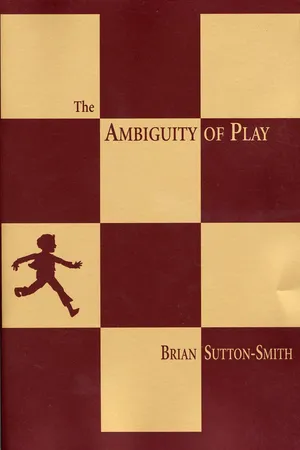
Every child knows what it means to play, but the rest of us can merely speculate. Is it a kind of adaptation, teaching us skills, inducting us into certain communities? Is it power, pursued in games of prowess? Fate, deployed in games of chance? Daydreaming, enacted in art? Or is it just frivolity? Brian Sutton-Smith, a leading proponent of play theory, considers each possibility as it has been proposed, elaborated, and debated in disciplines from biology, psychology, and education to metaphysics, mathematics, and sociology.
Sutton-Smith focuses on play theories rooted in seven distinct "rhetorics"—the ancient discourses of Fate, Power, Communal Identity, and Frivolity and the modern discourses of Progress, the Imaginary, and the Self. In a sweeping analysis that moves from the question of play in child development to the implications of play for the Western work ethic, he explores the values, historical sources, and interests that have dictated the terms and forms of play put forth in each discourse's "objective" theory.
This work reveals more distinctions and disjunctions than affinities, with one striking exception: however different their descriptions and interpretations of play, each rhetoric reveals a quirkiness, redundancy, and flexibility. In light of this, Sutton-Smith suggests that play might provide a model of the variability that allows for "natural" selection. As a form of mental feedback, play might nullify the rigidity that sets in after successful adaption, thus reinforcing animal and human variability. Further, he shows how these discourses, despite their differences, might offer the components for a new social science of play.
eBook - PDF
The Ambiguity of Play
About this book
Information
Publisher
Harvard University PressYear
2009Print ISBN
9780674005815
9780674017337
eBook ISBN
9780674044180
Table of contents
- Contents
- Preface
- Acknowledgments
- 1. Play and Ambiguity
- 2. Rhetorics of Animal Progress
- 3. Rhetorics of Child Play
- 4. Rhetorics of Fate
- 5. Rhetorics of Power
- 6. Rhetorics of Identity
- 7. Child Power and Identity
- 8. Rhetorics of the Imaginary
- 9. Child Phantasmagoria
- 10. Rhetorics of Self
- 11. Rhetorics of Frivolity
- 12. Conclusion
- Bibliography
- Index
Trusted by 375,005 students
Access to over 1.5 million titles for a fair monthly price.
Study more efficiently using our study tools.
Frequently asked questions
Yes, you can cancel anytime from the Subscription tab in your account settings on the Perlego website. Your subscription will stay active until the end of your current billing period. Learn how to cancel your subscription
No, books cannot be downloaded as external files, such as PDFs, for use outside of Perlego. However, you can download books within the Perlego app for offline reading on mobile or tablet. Learn how to download books offline
Perlego offers two plans: Essential and Complete
- Essential is ideal for learners and professionals who enjoy exploring a wide range of subjects. Access the Essential Library with 800,000+ trusted titles and best-sellers across business, personal growth, and the humanities. Includes unlimited reading time and Standard Read Aloud voice.
- Complete: Perfect for advanced learners and researchers needing full, unrestricted access. Unlock 1.5M+ books across hundreds of subjects, including academic and specialized titles. The Complete Plan also includes advanced features like Premium Read Aloud and Research Assistant.
We are an online textbook subscription service, where you can get access to an entire online library for less than the price of a single book per month. With over 1.5 million books across 990+ topics, we’ve got you covered! Learn about our mission
Look out for the read-aloud symbol on your next book to see if you can listen to it. The read-aloud tool reads text aloud for you, highlighting the text as it is being read. You can pause it, speed it up and slow it down. Learn more about Read Aloud
Yes! You can use the Perlego app on both iOS and Android devices to read anytime, anywhere — even offline. Perfect for commutes or when you’re on the go.
Please note we cannot support devices running on iOS 13 and Android 7 or earlier. Learn more about using the app
Please note we cannot support devices running on iOS 13 and Android 7 or earlier. Learn more about using the app
Yes, you can access The Ambiguity of Play by Brian Sutton-Smith in PDF and/or ePUB format, as well as other popular books in History & Religious Biographies. We have over 1.5 million books available in our catalogue for you to explore.