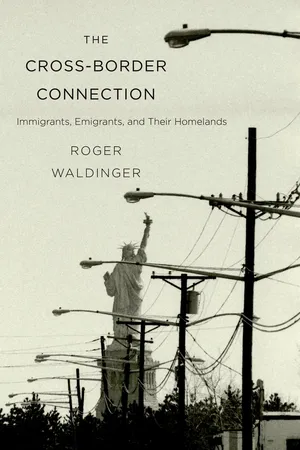
International migration presents the human face of globalization, with consequences that make headlines throughout the world. The Cross-Border Connection addresses a paradox at the core of this phenomenon: emigrants departing one society become immigrants in another, tying those two societies together in a variety of ways. In nontechnical language, Roger Waldinger explains how interconnections between place of origin and destination are built and maintained and why they eventually fall apart.
"When are immigrants 'us'? When are they 'them'? Waldinger implores readers to reframe the debate from a before-after dichotomy to a new transnational approach, revealing migrants to be here, there, and in-between at all stages of their migration tenure…The book's real strength is in the elegance of the author's argument, supported by evidence that transnationalism itself is not static but an ongoing dialectic."
—R. A. Harper, Choice
"The Cross-Border Connection is to be commended for putting substance into the black box of transnationalism, offering scholars a dynamic model to account for the ebb and flow of transnationalism in the real world and yielding testable propositions about the circumstances under which cross-border connections can be expected to expand or contract."
—Douglas S. Massey, American Journal of Sociology
- English
- ePUB (mobile friendly)
- Available on iOS & Android
eBook - ePub
About this book
Trusted by 375,005 students
Access to over 1.5 million titles for a fair monthly price.
Study more efficiently using our study tools.
Information
Publisher
Harvard University PressYear
2015Print ISBN
9780674975507
9780674736733
eBook ISBN
9780674967243
CHAPTER ONE
Immigrants, Emigrants, and Their Homelands
IMMIGRANTS ARE the people who leave one country behind to settle down somewhere else. Or so the dictionary contends. While citizens and sometimes even the scholars see the phenomenon in just this way, close observers of the immigrant experience in the United States have long known better. Though the huge transatlantic movements of the last century of migration generated millions of settlers, they also produced a continuous flow of people moving in the other direction. As discovered more than a century ago by the team that the US Immigration Commission sent to Europe, the results of the homeward bound flow were difficult to miss:
The investigators . . . were impressed by the number of men in Italy and various Slavic communities who speak English and who exhibit a distinct affection for the United States. The unwillingness of such men to work in the fields at 25 to 30 cents a day; their tendency to acquire property; their general initiative; and most concretely, the money they can show, make a vivid impression. They are dispensers of information and inspiration, and are often willing to follow up the inspiration by loans to prospective migrants. (Wyman 1993: 6)
As the commissioners unintentionally pointed out, the very same migrations that peopled America was a way of knitting old and new worlds together. Return migration belonged to a broader complex of social ties, facilitating migration while also channeling ideas, information, experiences, and capital back to the places from which the immigrants had originally come. Though separated by thousands of miles and an ocean that took days, not hours, to cross, the migrants and stay-at-homes maintained the connection. Millions of letters crossed the Atlantic to be read, sometimes by the individual recipients, sometimes by one of the literate villagers, in a public event that disseminated the news to a far wider audience. While the letters were designed to keep relatives and friends informed of the latest developments in the migrant’s life, they had other, deeper effects—namely, that of reporting on the advantages to be gained from life in the new world, thereby encouraging even greater numbers to engage in the migrant flow. The envelopes didn’t contain news only: looking inside, one found cash. That money should flow from one side of the Atlantic to another was no accident; rather, this was the very idea that impelled migrants to leave home. Earning money in places where wages were high but spending money where the cost of living was low, the poor exploited the rich, using their access to the resources of a wealthier country to make life better back home. Migration didn’t just generate social change back home; it was also often the lever for political transformation. Nationalist movements found fertile soil in the United States. With agitators freely plying their trade without fear of government repression, and a population base doing well enough to provide material assistance, the immigrants provided valuable support for the movements seeking to take apart the multiethnic empires that prevailed during the last era of mass migration.1
One never wants to say that the more things change, the more they stay the same. But the careful student of contemporary immigration to the United States can’t help but notice the similarities. Yes, America’s foreign-born population has grown rapidly over the past four decades: ever since 1970, when the foreign-born population fell to its historic nadir of 4.7 percent, the foreign-born presence has been continuously rising. The forty million foreign-born persons now living in the United States make up 13 percent of the population; numbers are growing so rapidly that the immigration rate—measured as the annual flow of persons as a percentage of total population—is approaching levels seen during the last century of migration, when the country’s population was less than one-third its current size.
If there is plenty of migration for settlement, evidence of connections linking “here” and “there” is no less striking than it was a hundred years ago. Of course, the places of origin are no longer the same. Although there is a continuing flow of migrants from Eastern Europe, transatlantic migration now takes on very modest proportions. Instead, the new immigrants come mainly from elsewhere in the Western Hemisphere, with sizable and growing numbers arriving from Asia and still small but expanding populations coming from Africa.
Regardless of origins, the immigrants of the current era of mass migration are maintaining home country connections, doing so in ways that remind one of the past but also look quite different, as changes in technology, communication, as well as the social environment would lead one to expect. Yesterday, the simple letter did an excellent job of bridging here and there, even though the passage from one side to another was far from speedy. Today communication between migrants and their relatives and friends can be instantaneous. A huge, near-constant flow of telephone traffic moves between the United States and the countries from which its immigrants come. While telephone lines might not extend to some of the small, isolated villages from which the immigrants come, the rapid diffusion of cell phones allows almost everyone, everywhere, to be connected. Telecommunication may not be free, but it’s not terribly expensive: competition within the telecommunications industry is constantly driving prices down. While the best prices are to be found on the Internet, cheap telephone cards are sold in just about every other store in the immigrant neighborhoods of Los Angeles, New York, Miami, and increasingly every other major US city. Access is also growing at the other end: the migrants’ friends and relatives at home may be too poor to own a phone, in which case the purchase can be made by the migrant abroad.
As in the past, people and money are moving back and forth. At Christmastime, airplanes headed for El Salvador or Jamaica or Port-au-Prince are packed with immigrants, many equipped with US passports, on the way to spend the holidays with relatives still living at home. As with communication, the ethnic tourism of immigrants and those of their relatives lucky enough to enter the United States with a visa is a good business, attracting investors eager to serve this market and help it grow. Even more attractive, perhaps, is the business of sending the dollars earned by the immigrants in the United States back to the countries from which they have come. The flow of remittances has burgeoned to impressive proportions. Remittances received by developing countries are large (the second largest source of development finance after direct foreign investment); rising (up by almost fivefold between 1989 and 2011); stable (with less volatility than other sources, such as capital market flows or development assistance, and much less severely hit by the financial crisis that began in 2008); and free, requiring neither interest nor repayment of capital (Sirkeci, Cohen, and Ratha 2012). With so much money leaving a rich country and heading toward a wide variety of poor countries, there is no shortage of actors seeking to facilitate what the immigrants want to do on their own accord. Remittances rank as a top priority for the World Bank, the International Monetary Fund, and the American Development Bank, to name just a few. For the private sector, the remittance business is an opportunity to be exploited, which is why large American banks are taking over Mexican chains, Central American banks are opening branches in Los Angeles’s immigrant neighborhoods, and all of the banks, whether US or foreign, are opening their doors for undocumented immigrants.
In the past, the emigrants’ efforts to get ahead on their own won them the contempt of the compatriots and states that they left behind. As depicted by the famous Mexican writer and former diplomat Octavio Paz, in his book The Labyrinth of Solitude, written in the middle of the last century, the emigrants who looked for fortune across the border did so at the price of their souls:
[The pachuco’s] whole being is sheer negative impulse . . . he has lost his whole inheritance: language, religion, customs, beliefs. He is left without a body and a soul with which to confront the elements, defenseless against the stares of everyone. (1950 [1994 ed.]: 14–15)
While Paz looked down from Olympian heights, popular culture spread the same view, with most Mexican movies, for example, portraying migration to the United States and Mexican American life in el norte in a negative light (Maciel 2000).
But that was then, and this is now. Yesterday’s traitors have become today’s heroes, as today’s sending countries realize that emigration of so many nationals is a stroke of good luck, provided that the emigrants don’t cut their ties to their old homes. Consequently, sending countries are reaching out to their expatriates, providing them with services, trying to solve the problems encountered in the United States, intervening with US authorities and policy makers, doing what they can to ensure that the flow of remittances doesn’t stop, and converting the migrants and their descendants into ethnic lobbyists. The very same Mexican government that long ignored the nationals living north of the Rio Grande now embraces them. Mexico’s consular infrastructure mirrors the size and dispersion of its emigrants: from Alaska to Arkansas and from Minnesota to Florida, Mexico’s fifty-one consulates are spread across the United States, with mobile units regularly connecting with emigrants in more far-flung locations. While the consuls’ job description includes resolution of everyday problems, the Institute for Mexicans in the Exterior focuses on the longer term, providing programs designed to build diasporic awareness and loyalty, while also providing an institutional framework linking migrant leaders and Mexican officials (González Gutierrez 2006a; Laglagaron 2010). The Salvadoran government has done the same on a smaller scale, making special efforts to ensure that the many Salvadorans living in the United States without full legal status take advantage of opportunities to gain permission that will allow them to live legally in the United States on a temporary basis, without any guarantee of long-term, permanent residence (Popkin 2003; Nosthas 2006).
Although immigrants’ “here-there” connections are the subject of burgeoning scholarly interest, the results are disappointing. Committed to theories of globalization, proof of which they find in immigrants’ extensive cross-border ties, most researchers have ignored the ways in which contemporary nation-states (especially the most powerful among them) circumscribe the immigrants’ social connections while transforming their identities. Methodologically, too much of the research has focused on concerted cross-border activities rather than on the more common and routine sort, and paid little attention to the processes that bind the immigrants to their new homes. Remittances and their consequences have been the subject of extensive, sophisticated quantitative research, telling us much about this one side of a multifaceted phenomenon, but little, if anything, about other myriad connections extending from receiving to sending state and then back again.
This book seeks to do better. Rather than restricting the focus to either the sending or the receiving side, it encompasses both. By analyzing the factors that both promote and supplant cross-border involvements, this book goes beyond the usual polarities, highlighting the impact of globalization while showing how it stands in tension with the continuing force of the nation-state. The book uses multiple methodologies, intersecting with the full range of relevant disciplines: anthropology, history, political science, and sociology. I draw on an abundance of sources: fieldwork; documents; newspaper accounts from the US mainstream and ethnic media, as well as the foreign press; a broad range of large-scale, representative surveys conducted in the United States and the countries from which today’s migrants come; as well as a vast secondary literature.
The next chapter will set the intellectual context, explaining how scholars have sought to understand the connections between immigrants and their homelands. This chapter critically assesses the sprawling and ever-expanding scholarship on the phenomenon known as “immigrant transnationalism.” As I will show, this literature has produced a new way of looking at migration, demonstrating that connections between place of reception and place of origin are an inherent, enduring component of the long-distance migrations of the modern world. The problem, however, is that connectivity between sending and receiving societies is cause and effect of international migration. Hence, discovering that migrants engage in cross-border activities begs the question, sidestepping the challenge of understanding the sources and types of variations in these connections that migration almost always produces: Why might these linkages persist, attenuate, or simply fade away? What different patterns characterize the many forms of cross-border involvement—whether occurring in political, economic, or cultural spheres, or involving concerted action or everyday, uncoordinated activities of ordinary immigrants? And what happens as the experiences and resources acquired through migration filter back to the home country?
Chapter 3 begins the job of answering these questions. I start with the premise that the people opting for life in another state are not just immigrants but also emigrants, retaining ties to people and places left behind. Few international migrants come as lonely adventurers; instead, they move by making use of the one resource on which they can almost always count—namely, support from one another—which is why social connections between veterans and newcomers lubricate the migration process. But the chains of mutual help extend across borders as well since the cross-border progression of families takes place at a much slower rate, in more erratic, incomplete fashion, with both migrants and stay-at-homes depending on one another for survival. Thus, in moving to another country, the migrants pull one society onto the territory of another state, creating a zone of intersocietal convergence, linking “here” and “there.” Still of the sending state, even though no longer in it, the immigrants transplant the home country society onto the receiving-state ground. In the process, alien territory becomes a familiar environment, yielding the infrastructure needed to keep up here–there connections and providing the means by which migrants can sustain identities as home community members while living on foreign soil.
The migrants cross borders in order to access resources that do not spill out from the territories of the rich states where they are contained. As the newcomers settle down and acquire competencies that the new environment values and rewards, the migrants gain ever-greater capacity to help out relatives and communities left behind. But then, the paradox of international migration kicks in: the migrants find that their own lives, just like the resources that lured them to a foreign land, get confined to the territory on which they have converged. Physical distance proves a hard constraint on continuing cross-border interchanges, leading almost inevitably to social separation. The new society that they have entered simultaneously transforms and absorbs the migrants, making them increasingly different from the people left behind and reducing the needs and motivation to keep the ties. Over time, an increasingly large share of the core familial network changes location; as the center of social gravity moves from “there” to “here,” the costs and benefits of maintaining the cross-border connection prove increasingly unfavorable. Hence, the migrants increasingly find themselves not just in the receiving state but increasingly of it, leading intersocietal convergence to give way to intersocietal divergence.
Moreover, the fact that international migration is not just a social but a political phenomenon structures the ties between “here” and “there.” Though territorial boundaries have become more heavily guarded, they prove to be protective once they are traversed, insulating migrants from the pressures of the home state and providing them with political freedoms previously unavailable. The material and the political combine: the receiving country’s wealth generates resources used for leverage back home; further weight comes from the skills, allies, ideas, and experiences acquired in a new political system. Consequently, some migrants maintain long-term engagements across borders, presenting themselves as members of the community they left behind, though they often advance interests distinct from those that have remained in place. These many cross-border migrant involvements—whether short- or long-term, whether maintained by individuals calling home or traveling or by organized groups seeking to influence policy—galvanize responses from sending states that seek to influence and embrace emigrants and a diaspora found in the territory of another state. In the process, the boundaries of the homeland polity become the object of conflict. The migrants, wanting full citizenship rights, seek a cross-border extension of the polity, one that corresponds to the intersocietal convergence produced by migration. Government elites and many of the stay-at-homes prove resistant, opposed to the costs imposed by extending political entitlements to those who voted with their feet for life in a foreign state and who increasingly behave like the foreigners among whom they live. But neither homeland, grassroots politics, nor state efforts at diaspora engagement interests the mass of the migrant rank and file. Intersocietal divergence becomes the dominant trend because most immigrants and immigrant offspring become progressively disconnected, reorienting concerns and commitments to the place where they actually live. Starting out as strangers, the migrants are turned into nationals—a process that also estranges them from the people and places where their journey started.
Chapter 4 shows how migration generates cross-border connections of all types. The typical migrant doesn’t turn her back on the place left behind: travel, communication, and material exchanges all bridge kin and communities separated by space, effectively allowing emigrants to be immigrants at the same time. Only an elite group of “transnationals” seems able to live their lives across borders; however, that option proves impractical for almost all. Access to the technology that might shrink distance is highly uneven, with significant disparities among immigrants but even greater disparities between immigrants and stay-at-homes. And while long-distance communication is easier and cheaper than ever, the brute fact of physical separation still matters. Keeping things moving between “here” and “there” requires scarce resources that are unequally shared, of which money and the capacity to move back and forth freely across borders are the most important. Consequently, relatively few migrants succeed in maintaining high-intensity cross-border contacts of all types. Moreover, the incentives to connect and the resources needed to do so follow opposing tracks: years of residence in the country of reception increase the material capacity to engage in the cross-border circuit, but they paradoxically reduce the motivation to do so.
Cross-border social ties may be dense and relatively persistent, but, as Chapter 5 will show, they don’t suffice to maintain immigrants’ engagement in the politics of their homelands. Political detachment occurs for a variety of reasons: Prior experience told the migrants that their state could do little to help, which is precisely why they voted with their feet. Homeland political matters also lose salience once the migrants have transitioned to a new polity, where homeland political activity generates only symbolic rewards and the environment lacks the features—namely, party mobilization and the example and influence of politically oriented neighbors and friends—that would spur attention to homeland matters. Hence, while most migrants maintain extensive social ties to the places left behind, political attention starts low and quickly flags. ...
Table of contents
- Cover
- Title Page
- Copyright
- Contents
- 1. Immigrants, Emigrants, and Their Homelands
- 2. Beyond Transnationalism
- 3. The Dialectic of Emigration and Immigration
- 4. Cross-Border Ties: Keeping and Losing the Connection
- 5. Engaging at Home from Abroad: The Paradox of Homeland Politics
- 6. Emigrants and Emigration States
- 7. Politics across Borders: Mexico and Its Emigrants
- 8. Hometown Blues: Migrants’ Long-Distance Pursuit of Development
- 9. Conclusion: Foreign Detachment
- Notes
- References
- Acknowledgments
- Index
Frequently asked questions
Yes, you can cancel anytime from the Subscription tab in your account settings on the Perlego website. Your subscription will stay active until the end of your current billing period. Learn how to cancel your subscription
No, books cannot be downloaded as external files, such as PDFs, for use outside of Perlego. However, you can download books within the Perlego app for offline reading on mobile or tablet. Learn how to download books offline
Perlego offers two plans: Essential and Complete
- Essential is ideal for learners and professionals who enjoy exploring a wide range of subjects. Access the Essential Library with 800,000+ trusted titles and best-sellers across business, personal growth, and the humanities. Includes unlimited reading time and Standard Read Aloud voice.
- Complete: Perfect for advanced learners and researchers needing full, unrestricted access. Unlock 1.5M+ books across hundreds of subjects, including academic and specialized titles. The Complete Plan also includes advanced features like Premium Read Aloud and Research Assistant.
We are an online textbook subscription service, where you can get access to an entire online library for less than the price of a single book per month. With over 1.5 million books across 990+ topics, we’ve got you covered! Learn about our mission
Look out for the read-aloud symbol on your next book to see if you can listen to it. The read-aloud tool reads text aloud for you, highlighting the text as it is being read. You can pause it, speed it up and slow it down. Learn more about Read Aloud
Yes! You can use the Perlego app on both iOS and Android devices to read anytime, anywhere — even offline. Perfect for commutes or when you’re on the go.
Please note we cannot support devices running on iOS 13 and Android 7 or earlier. Learn more about using the app
Please note we cannot support devices running on iOS 13 and Android 7 or earlier. Learn more about using the app
Yes, you can access The Cross-Border Connection by Roger Waldinger in PDF and/or ePUB format, as well as other popular books in Social Sciences & Discrimination & Race Relations. We have over 1.5 million books available in our catalogue for you to explore.