China's labor landscape is changing, and it is transforming the global economy in ways that we cannot afford to ignore. Once-silent workers have found their voice, organizing momentous protests, such as the 2010 Honda strikes, and demanding a better deal. China's leaders have responded not only with repression but with reforms. Are China's workers on the verge of a breakthrough in industrial relations and labor law reminiscent of the American New Deal?
In A New Deal for China's Workers? Cynthia Estlund views this changing landscape through the comparative lens of America's twentieth-century experience with industrial unrest. China's leaders hope to replicate the widely shared prosperity, political legitimacy, and stability that flowed from America's New Deal, but they are irrevocably opposed to the independent trade unions and mass mobilization that were central to bringing it about. Estlund argues that the specter of an independent labor movement, seen as an existential threat to China's one-party regime, is both driving and constraining every facet of its response to restless workers.
China's leaders draw on an increasingly sophisticated toolkit in their effort to contain worker activism. The result is a surprising mix of repression and concession, confrontation and cooptation, flaws and functionality, rigidity and pragmatism. If China's laborers achieve a New Deal, it will be a New Deal with Chinese characteristics, very unlike what workers in the West achieved in the last century. Estlund's sharp observations and crisp comparative analysis make China's labor unrest and reform legible to Western readers.
- 285 pages
- English
- ePUB (mobile friendly)
- Available on iOS & Android
eBook - ePub
A New Deal for China’s Workers?
About this book
Information
Topic
DirittoSubtopic
Diritto comparatoCHAPTER ONE
Introduction
IF THE WORKERS of the world are united in anything, it may be in the degree to which their working lives and their futures are being shaped by China. This is no surprise to American workers and the politicians who court them. China’s deep pool of “cheap labor” has been a recurring motif in modern American politics, most recently in the 2016 presidential campaign. But China’s workers are increasingly speaking up for themselves, and we should all be listening.
In the first decade or two after China opened its doors to the world and began to churn out much of the clothing, shoes, toys, and other mass consumer goods sold in Western stores, the prevailing Western image of Chinese workers—if there was one—was of an endless, faceless, voiceless mass. The millions of poor rural migrants flowing into the grim factories in China’s coastal areas seemed to tolerate the intolerable—working for pennies an hour at a brutal pace for unimaginably long days and weeks. Behind them, and ready to replace those who were chewed up and spit out, were the hundreds of millions who remained in the impoverished rural villages of the interior. That seemingly bottomless supply of cheap labor gave a geographic location if not a human face to the “race to the bottom” that for many Western observers was shaping the bleak future of workers, their unions, and their families in the developed economies of the world.
One does not have to be a close China watcher to know that things have changed. To begin with, China has become an economic powerhouse—the world’s second-largest national economy, home to a sizable share of global manufacturing and to a large and growing fraction of the world’s middle-income consumers. Since 1981, as many as six hundred million people in China have climbed out of poverty, partly through the wrenching process of migration out of destitute rural areas and into China’s vast and countless factories.1 That process has transformed product markets, labor markets, and workers’ lives both within and beyond its borders.
The rise from destitution has brought rising expectations. China’s workers may still be a faceless mass to many Westerners, but they are no longer voiceless, and they are increasingly unwilling to tolerate the intolerable. That is most vividly true in the factories of the newly-industrialized coastal areas, with their mostly migrant workforces, which churn out much of the world’s consumer goods. After years of widespread submission to miserable wages and working conditions, punctuated by occasional outbursts of wrath, Chinese workers are increasingly resorting to both “exit” and “voice” in response to their discontentment.2 They are exercising their market freedom to quit and seek better conditions elsewhere, and they are protesting, loudly and in larger numbers, against abuse and low wages.
An important spur to both “exit” and “voice” lies in the surprising appearance of labor shortages starting in the mid-2000s.3 The supply of new migrant workers, and especially of the skilled workers needed in the more advanced product sectors now growing up in China, began to slow as the smaller “one-child generation,” born starting in 1980, entered the industrial workforce.4 In the meantime, enough capital had trickled into the interior to create factory jobs closer to home, so that a teenager’s decision to leave home for a brutally demanding, poorly paid, and faraway factory job became more of a choice and less of a dire necessity.5 A tighter labor market changed the labor market calculus in the more developed coastal regions, and it emboldened many of China’s workers to join together to protest against injustice, to demand a bigger share of the growing economic pie and a greater voice in their working lives. More recently, an economic slump has brought layoffs and factory closings in some areas; but those events, too, have triggered strikes, for China’s migrant workers have become increasingly willing and able to mount a collective response to their grievances.
The rise of labor unrest, and especially the rise of strikes, has unsettled Chinese officialdom. For two decades after the opening of its economy, China’s Communist Party leaders pursued rapid economic growth above all else, paying little heed to the social and environmental costs of growth or to the increasingly unequal distribution of its benefits. But China’s restive workers have helped to push those problems up to the top of the policy agenda, and to underscore the need for reform and redistribution (and not only repression) in order to build a “harmonious society.”
An American observer might imagine (as I did upon first learning of these developments) that China’s workers had arrived at the cusp of their own “New Deal moment”—a moment when workers’ political and economic power and mobilization converge to produce major industrial relations reforms and redistributive policies. Even without the ability to vote for candidates promising labor reform, labor protest and the threat of serious unrest undoubtedly put political pressure on an authoritarian regime, and China’s leaders had already responded with some pro-worker reforms. Indeed, those leaders might well take note that it is not only workers who might have something to gain from a “New Deal with Chinese characteristics,” for the American New Deal was both transformative and conservative. It dramatically enhanced some workers’ ability to shape their own working lives and livelihoods through unionization and collective bargaining, and at the same time it helped to deflect and defuse demands for more radical political and economic change and to bolster the political legitimacy of the established order among the working classes.
In short, China is both changing the world, and is itself changing, in ways that we cannot afford to ignore. It is worth watching closely as the most populous nation in the history of the world grapples before our twenty-first-century eyes (albeit often behind closed doors) with the question of how to redefine the rights and entitlements of workers and the governance of labor relations in an increasingly advanced industrial economy. That big question may seem remote from a bigger question that has gripped many Western observers since the 1970s: is economic liberalization and growth leading, inevitably or otherwise, to political liberalization and democratization? But the two questions are linked. China’s workers are demanding not only higher wages but a greater voice in their working lives. China’s response to those demands will both reflect and potentially reshape the structure of governance and the prospects for broader political reform in China.
China’s Rise and the “Race to the Rising Bottom”?
China’s economic past and future—its unprecedented growth in recent decades and its hotly disputed capacity to sustain future growth—are inextricably intertwined with its unfolding labor relations story and with the welfare of workers elsewhere. For one thing, the sheer magnitude of future labor unrest in China may both affect and be affected by its ability to keep its now-troubled economy afloat and growing, and to avoid massive factory closings and layoffs.6 The stability of China’s economy preoccupies policy makers and others in China and across the world, and it is a matter of vigorous debate among economists; but it is not my topic here. Suffice it to say that the economic turmoil of the past few years does not encourage those who might have hoped that a steadily and vigorously growing economy would by itself solve the problem of labor unrest and avert the need for reform by meeting the rising material expectations of China’s workers.
China’s economic performance in recent decades does, however, raise another question that warrants brief attention here. Scholars and activists have debated for many decades whether the globalization of the economy has generated more of a “race to the bottom” or a “rising tide that lifts all boats.”7 But the rise of China, along with the wages and labor standards of its workers, suggests a better metaphor: a “race to the rising bottom.” And China’s increasingly restive workers are helping to raise that bottom.
Some industries and firms do chase cheap, unorganized labor and weakly regulated labor markets. The migration of much of the American textile and apparel industry to China in the 1990s, for example, was largely a quest for cheap labor, facilitated by falling trade barriers and transportation costs.8 The rise of labor shortages and of wages in China, in turn, has sent shudders through the ranks of foreign corporations that have profited so handsomely from China’s “cheap labor” model of development. Some industries and firms, especially in footwear, apparel, and other light mass manufacturing industries, have gravitated to even cheaper labor markets in Bangladesh, Vietnam, and elsewhere. That dynamic may encourage some poor countries’ leaders to make suppression of unions and lack of regulation part of a national development strategy. That is, of course, the “race to the bottom” story, and there is clearly something to it.
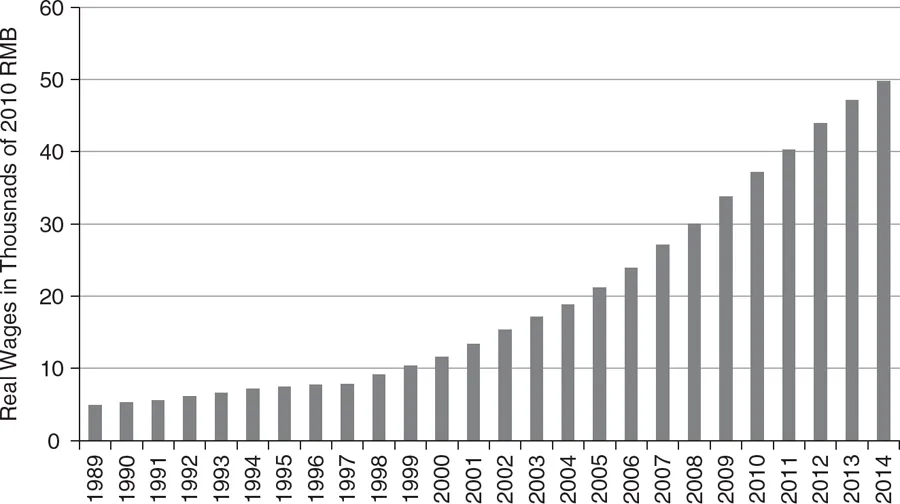
But China (among other developing economies) has complicated the story line. The “race to the bottom” was once seemingly embodied by China, with its apparently bottomless supply of poor farmers who could be drawn into its burgeoning factories. But the flow of capital to China has also helped to bring about the most dramatic reduction in poverty the world has ever seen: The percentage of China’s population living in “extreme poverty” fell from 84 percent in 1981 to 12 percent in 2010.9 Moreover, it is because labor is not so cheap in China anymore (not just because cheaper labor can be found elsewhere) that some firms are moving manufacturing jobs to lower-wage countries.10 Real wage levels have increased during the whole post-opening period by an average of nearly ten percent per year, as shown in Figure 1.1; and real minimum-wage levels have increased by an average of 8 percent per year from 2010 to 2014, and by as much as 20 percent in some provinces.11 That is partly because China’s workers have loudly demanded wage hikes; their struggle is at the heart of this book. But it underscores the fact that, at least in recent years, China’s rulers have not sought to suppress wages to keep bottom-tier manufacturing jobs in China. On the contrary, up to a point the loss of those jobs is in keeping with China’s development strategy, which is to move up the value chain and into more lucrative sectors and phases of production. Whether China can do so, and thus avoid the so-called “middle-income trap,” is a subject of anxious speculation in China and elsewhere.12 But these developments obviously do not reflect a simple “race to the bottom.”
The “race to the bottom” story gives short shrift to the fact that many industries and firms—especially those that drive a prosperous economy, and that China now aims to cultivate—depend on a more productive and stable workforce than may be found in a “cheap labor” locale. China’s continued growth thus requires developing the skills of its labor force, its gargantuan domestic consumer market, and its relatively sophisticated infrastructure and supplier networks; those are advantages that lower-wage jurisdictions cannot offer.13 Moreover, the flow of capital to “cheap labor” countries, even when it is attracted by their less demanding, less organized workers and weak or compliant regulators, tends to both enable and stimulate worker organizing, regulatory development, and rising wage levels.14 That is what has happened in China. Those dynamics might evoke the “rising tide” story.
Yet the rising tide is not quite lifting all boats. In particular, many blue-collar workers of the world’s richest industrial countries have seen their jobs disappear, and their hard-won wage gains and generous benefit packages erode, under competitive pressure from lower-cost workers in China and elsewhere.15 That is the kernel of truth that underlies recurring populist appeals in the United States, most recently in the 2016 presidential campaign, to reconstruct trade barriers and punish China for “stealing our jobs.” Many former steelworkers and autoworkers, and especially their children and grandchildren, have drifted into service-sector jobs that are much worse paid and less secure.16 And their fate might foreshadow that of many others. Much of the work that is currently done in the developed world—including skilled service work in technical, medical, legal, and financial fields—will be exportable to lower-wage countries as technology enhances firms’ ability to divide up work and transport its inputs and outputs across borders. Predictions vary as to how much of that work will be exported (or simply replaced by software and smart machines).17
The amalgam of the two stories that I mean to capture in the phrase “race to the rising bottom” offers little solace to workers at the top of the global economic ladder, for it is a long way down to even a rising bottom. But a rising bottom would be good news for many of the world’s poorest workers, who may reap economic gains from globalization even if they work under conditions that are appalling to us (and even if global business and financial elites take an outsized share of the gains). A simplistic anti-globalization line is hard to square with the rising fortunes of China’s hundreds of millions of formerly impoverished rural citizens, not to mention the aspirations of hundreds of millions of still-destitute citizens in South and Southeast Asia and Africa who need capital investment (among other things) to climb up the economic ladder in China’s footsteps. (Of course, China’s own development casts a shadow—or rather a noxious layer of smog—over the question of whether and how continued economic development can be made compatible with the habitability of the planet.18 That is another enormous question that will be set aside here.)
One piece of good news is that the “bottom” may now be in sight, as both manufacturers and anti-sweatshop activists are recognizing. Auret van Heerden, a veteran of the campaign to compel corporations to take responsibility for ensuring decent labor standards in their supply chains, descri...
Table of contents
- Cover
- Title Page
- Copyright
- Dedication
- Contents
- Preface
- 1. Introduction
- 2. The Rise of China, and of Labor Protest, in the Reform Era
- 3. Who Speaks for China’s Workers? The ACFTU and Labor NGOs
- 4. How Did the New Deal Resolve the American “Labor Question”? Bringing a Comparative Lens into Focus
- 5. Can China Regulate Its Way out of Labor Unrest? Rising Labor Standards and the Enforcement Gap
- 6. Can China Secure Labor Peace without Independent Unions? Strikes and Collective Bargaining with Chinese Characteristics
- 7. What Does Democracy Look Like in China? Reforming Grassroots Union Elections
- 8. Will Workers Have a Voice in the “Socialist Market Economy”? The Curious Revival of the Worker Congress System
- 9. Conclusion
- Notes
- Index
Trusted by 375,005 students
Access to over 1.5 million titles for a fair monthly price.
Study more efficiently using our study tools.
Frequently asked questions
Yes, you can cancel anytime from the Subscription tab in your account settings on the Perlego website. Your subscription will stay active until the end of your current billing period. Learn how to cancel your subscription
No, books cannot be downloaded as external files, such as PDFs, for use outside of Perlego. However, you can download books within the Perlego app for offline reading on mobile or tablet. Learn how to download books offline
Perlego offers two plans: Essential and Complete
- Essential is ideal for learners and professionals who enjoy exploring a wide range of subjects. Access the Essential Library with 800,000+ trusted titles and best-sellers across business, personal growth, and the humanities. Includes unlimited reading time and Standard Read Aloud voice.
- Complete: Perfect for advanced learners and researchers needing full, unrestricted access. Unlock 1.5M+ books across hundreds of subjects, including academic and specialized titles. The Complete Plan also includes advanced features like Premium Read Aloud and Research Assistant.
We are an online textbook subscription service, where you can get access to an entire online library for less than the price of a single book per month. With over 1.5 million books across 990+ topics, we’ve got you covered! Learn about our mission
Look out for the read-aloud symbol on your next book to see if you can listen to it. The read-aloud tool reads text aloud for you, highlighting the text as it is being read. You can pause it, speed it up and slow it down. Learn more about Read Aloud
Yes! You can use the Perlego app on both iOS and Android devices to read anytime, anywhere — even offline. Perfect for commutes or when you’re on the go.
Please note we cannot support devices running on iOS 13 and Android 7 or earlier. Learn more about using the app
Please note we cannot support devices running on iOS 13 and Android 7 or earlier. Learn more about using the app
Yes, you can access A New Deal for China’s Workers? by Cynthia Estlund in PDF and/or ePUB format, as well as other popular books in Diritto & Diritto comparato. We have over 1.5 million books available in our catalogue for you to explore.