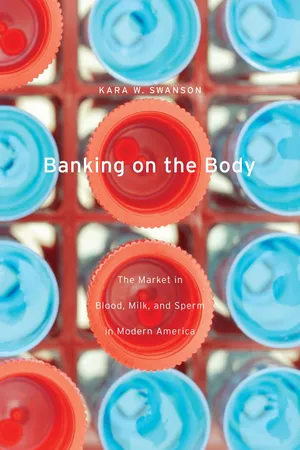
Scientific advances and economic forces have converged to create something unthinkable for much of human history: a robust market in human body products. Every year, countless Americans supply blood, sperm, and breast milk to "banks" that store these products for later use by strangers in routine medical procedures. These exchanges entail complicated questions. Which body products are donated and which sold? Who gives and who receives? And, in the end, who profits? In this eye-opening study, Kara Swanson traces the history of body banks from the nineteenth-century experiments that discovered therapeutic uses for body products to twenty-first-century websites that facilitate a thriving global exchange.
More than a metaphor, the "bank" has shaped ongoing controversies over body products as either marketable commodities or gifts donated to help others. A physician, Dr. Bernard Fantus, proposed a "bank" in 1937 to make blood available to all patients. Yet the bank metaphor labeled blood as something to be commercially bought and sold, not communally shared. As blood banks became a fixture of medicine after World War II, American doctors made them a front line in their war against socialized medicine. The profit-making connotations of the "bank" reinforced a market-based understanding of supply and distribution, with unexpected consequences for all body products, from human eggs to kidneys.
Ultimately, the bank metaphor straitjacketed legal codes and reinforced inequalities in medical care. By exploring its past, Banking on the Body charts the path to a more efficient and less exploitative distribution of the human body's life-giving potential.
eBook - ePub
Banking on the Body
The Market in Blood, Milk, and Sperm in Modern America
- English
- ePUB (mobile friendly)
- Available on iOS & Android
eBook - ePub
About this book
Information
Topic
MédecineSubtopic
Histoire de l'Amérique du Nord1
Bankable Bodies and the Professional Donor
A new calling has been evolved by modern medicine for healthy, full-blooded young men and women … the occupation of professional blood donor.
—Hygeia, 1930
In 1908 Dr. Fritz Talbot spent three days riding street cars around Boston in a discouraging search for a wet nurse. Talbot was a recent graduate of Harvard Medical School, anxious to establish himself as a pediatrician, a new medical specialty.1 One of his patients, a newborn baby, was not getting enough milk from his mother. The best hope for this baby’s survival was for his parents to hire a woman who would be willing to leave her own nursing baby and move into their home to feed their baby. Wet nursing was a long-established occupation, but finding a wet nurse in the early twentieth century was increasingly difficult.2 Doctors such as Talbot assumed this wearisome task as they sought to use their medical expertise to manage infant feeding as the best way of decreasing infant mortality. Talbot became discouraged as he crisscrossed the city in a time-consuming search. Doctors and parents found that wet nurse candidates often exhibited distressing signs of slovenliness, alcohol use, immorality, and lack of appropriate deference to the doctor and to their would-be employers, not to mention a reluctance to abandon their own child to an uncertain fate.3 After numerous disappointments in hunting down and interviewing such women, Talbot felt his time could be better spent.4 In order to care for his youngest patients, he needed a much more reliable and accessible source of breast milk.
In that same year another young doctor went on a frantic search through the streets of New York City. His quest too was motivated by a newborn hovering near death. Dr. Adrian Lambert’s daughter was four days old. She was feverish, steadily bleeding from her nose and umbilical cord stump, and becoming pale and lethargic. Her rare condition, melaena neonatorum, a poorly understood bleeding disorder, was often fatal.5 Based on recently published results from an Ohio surgeon, Dr. George Crile, the desperate father decided that a blood transfusion might save his daughter’s life. In 1907 Crile had described the amazing recoveries of patients he had treated using transfusion performed by vascular anastomosis. In this surgical operation, blood vessels from the supplier and the recipient were sutured together, uniting the circulatory systems to allow blood to pass from one to the other.6 Crile, Lambert knew, had learned the technique of vascular anastomosis by observing Dr. Alexis Carrel. Carrel, a French émigré, did not treat patients but worked as a medical researcher at the Rockefeller Institute in New York City. He had perfected the delicate technique of anastomosis as part of transplant experiments in dogs.7 Unlike Talbot, Lambert had no difficulty identifying a source for the body product he needed; both he and his brothers were ready to provide blood. What Lambert sought in his rush through the darkened streets of the city was the expertise to perform this risky and experimental procedure. If Carrel himself would operate on his daughter, perhaps she might live. In the early hours of the morning, he banged on Carrel’s door and implored the researcher to transfuse his daughter. Carrel heeded the call and performed the emergency surgery, attaching father to daughter in an operation that Lambert believed saved the baby’s life.8
Talbot and Lambert were two of the many doctors at the beginning of the twentieth century who were turning to healthy human bodies as a source of medical therapeutics. Their efforts succeeded in making the human body accessible and bankable. Patients dying of hemorrhage and babies suffering from inadequate nutrition were not new; the urgency of medical demand had long been apparent to doctors. What was new was the willingness of doctors to use other bodies as the source of cures for their desperate cases. Before there could be body banks, doctors needed both expertise in methods of harvesting body products and a cooperative source of supply.
The task of pediatricians seeking milk was easier than the task facing doctors fighting to save hemorrhaging patients. There was already an established, socially accepted method for providing nonmaternal milk to babies, the wet nurse. Talbot was able, therefore, to concentrate on the question of supply. His exasperating search led him to launch a two-pronged project to modernize wet nursing, using classic Progressive-era approaches. For the next three decades he worked to organize and rationalize the wet nurse and to transform the service of wet nursing into the job of producing bottles of breast milk. Breast milk in bottles offered significantly more medical control over when, how, and how much milk patients drank. Both aspects of his project, which was joined by doctors in cities across the United States, were designed to improve medical control over milk as a body product. Regimentation of the wet nurse herself was good, but transforming human milk into a commodity was better. Disembodied, milk could be standardized, anonymized, and controlled in ways that the producing women could never be. Doctors could replace intimate personal exchanges—putting a baby to the breast—with transactions between strangers who might never see or know each other. As a result of the efforts of Talbot and other pediatricians, human milk became the first body product to be institutionally organized in disembodied form.
Making blood into a body product was significantly trickier. The tale of Carrel’s successful operation on Lambert’s daughter has often been cited as the beginning of modern blood transfusion practice.9 The event received considerable press coverage at the time, both because Carrel, who later won the Nobel Prize, was already famous and because of the novelty of considering human blood to be like human milk, that is, a life-giving substance that could be transferred from supplier to recipient.10 The positive reports of Carrel’s feat prompted many doctors to attempt what Crile described as dramatic “resurrections” from blood transfusion, but they found that the procedure was much more complicated than feeding human milk to an infant, posing many problems in both harvesting and infusing blood.11 Only when doctors had mastered the technique of blood transfusion did the supply problem become pressing. While medical attempts to transfuse blood preceded Carrel’s exploit by centuries, there was no historical precedent like the wet nurse to use as a starting point to develop a source of supply.12 For both infant feeding and blood transfusion, the medical profession would come to rely on a new creature: the “professional donor.”
Regulating the Wet Nurse
Talbot’s search for a wet nurse was frustrating in part because lactating women were getting harder to find. During the same decades that pediatricians were seeking to supervise and control infant feeding, American women were abandoning breastfeeding in droves.13 Just as Talbot found wet nursing irritatingly old-fashioned and out of place in modern medicine, American mothers since the late nineteenth century had been finding maternal nursing old-fashioned and out of step with their lives. Women of all socioeconomic strata sought the ability to move freely outside their homes, unhampered by breastfeeding duties, out of either the necessity to earn wages or the desire to participate in social and civic life. As a result, not only did fewer women want to nurse their own infants, but women who could afford wet nurses were increasingly unable to find them.14
To replace human milk, mothers chose different forms of what was called “artificial feeding,” using cow’s milk–based concoctions. They might add milk to pap, a mixture of flour or bread cooked in water, or to panada, flour or bread cooked in broth.15 The emerging dairy industry made these homemade infant foods possible. Dairy companies were making fresh milk available in cities and also offering shelf-stable milk products, like condensed milk, evaporated milk, and powdered milk. Mothers mixed infant foods using these products. As the century advanced, they could also buy commercial additives advertised for use in artificial feeding, such as Horlick’s Malted Milk and Nestlé’s Infant Food, a more expensive alternative to homemade foods.16
Pediatricians were disturbed by the results of this maternal-led revolution in infant feeding. One told his colleagues in 1913 that any mother or doctor who relied on artificial feeding was operating under “a false sense of security,” because “a full one-third of all infant deaths [were due] to unnecessary bottle-feeding.”17 The culprit was often identified as “summer sickness,” also known as “cholera infantum,” a diarrheal disease leading rapidly to dehydration and death that could be caused by using unrefrigerated cow’s milk. In Boston by the late nineteenth century, three times as many children under the age of five years died in July and August as in any other month of the year.18 This death toll was repeated in cities across the United States and continued into the twentieth century.19 Faced with this level of mortality, pediatricians concluded that infant feeding choices should not be left to mothers. These pediatricians believed that motherhood, like medicine itself, should be based on science.
Not all doctors promoting “scientific motherhood” shared Talbot’s preference for human milk.20 Some doctors, accepting the reality that many women were relying on artificial feeding, joined “pure milk” campaigns focused on improving the safety of cow’s milk by improving the supply chain from farmer to distributor to corner store to kitchen to baby. Public health officials inserted themselves into this chain by creating “depots” or “stations” where they received supplies of milk and provided them to the urban poor at a subsidized price.21 In addition to supplies of subsidized milk for the poor, doctors created “certified milk.” This cow’s milk, supplied from inspected farms and certified by a medical board as clean and disease-free, was available at a high cost to those who could afford to pay. For the ultimate in scientific infant foods, the most privileged babies could get bottles of formulas mixed according to their doctor’s orders from commercial milk laboratories, combining pure milk with the latest research into the appropriate ingredients in infant foods.22
These artificial feeding options not only supported maternal preferences to avoid breastfeeding but also offered doctors much more scope to prescribe precise feeding regimens. Using their medical expertise, doctors could dictate the ingredients, volume, and timing of each feeding. In 1908, the year Talbot was searching for a wet nurse, he might have considered prescribing Nestlé’s Food to his patient, which was advertised to Boston doctors as a powdered additive “particularly well adapted to the needs of the nursling because it is based upon modern knowledge of the laws”—that is, the new scientific principles governing feeding.23 In his search for a wet nurse, Talbot was rejecting the tantalizing promise of infant formulas and pure milk campaigns, convinced that despite the advantages of artificial foods, breast milk was a superior infant food, especially for sick infants.
Despite the enthusiasm of some doctors for artificial feeding, Talbot was not alone in his dedication to promoting breast milk for his patients. Dr. Julius P. Sedgwick, chief of the Department of Pediatrics at the University of Minnesota School of Medicine, became chair of the American Pediatric Society in 1917. He used his chairman’s address to advocate for breast milk as the optimal infant food and continued to publish articles on the importance of breastfeeding for all babies.24 Breastfed babies tended to survive at higher rates as long as the cow’s milk supplies remained unpasteurized. Pasteurization of milk was not required in Boston, for example, until 1921.25 The medical preference for breastfed babies was expressed in public health campaigns promoting maternal nursing. One such campaign in Chicago in the 1910s aimed at immigrant mothers admonished, “Don’t kill your baby!”26 Middle-class mothers, as well as impoverished immigrants, were included in Sedgwick’s efforts in Minnesota. One of his nurses involved in his house-to-house breastfeeding campaign ...
Table of contents
- Cover
- Half Title
- Title Page
- Copyright
- Dedication
- Contents
- Introduction: Banking for Love and for Money
- 1. Bankable Bodies and the Professional Donor
- 2. Banks That Take Donations
- 3. Blood Battles in the Cold War
- 4. Market Backlash
- 5. Feminine Banks and the Milk of Human Kindness
- 6. Buying Dad from the Sperm Bank
- Conclusion: Beyond the Body Bank
- Notes
- Acknowledgments
- Index
Trusted by 375,005 students
Access to over 1.5 million titles for a fair monthly price.
Study more efficiently using our study tools.
Frequently asked questions
Yes, you can cancel anytime from the Subscription tab in your account settings on the Perlego website. Your subscription will stay active until the end of your current billing period. Learn how to cancel your subscription
No, books cannot be downloaded as external files, such as PDFs, for use outside of Perlego. However, you can download books within the Perlego app for offline reading on mobile or tablet. Learn how to download books offline
Perlego offers two plans: Essential and Complete
- Essential is ideal for learners and professionals who enjoy exploring a wide range of subjects. Access the Essential Library with 800,000+ trusted titles and best-sellers across business, personal growth, and the humanities. Includes unlimited reading time and Standard Read Aloud voice.
- Complete: Perfect for advanced learners and researchers needing full, unrestricted access. Unlock 1.5M+ books across hundreds of subjects, including academic and specialized titles. The Complete Plan also includes advanced features like Premium Read Aloud and Research Assistant.
We are an online textbook subscription service, where you can get access to an entire online library for less than the price of a single book per month. With over 1.5 million books across 990+ topics, we’ve got you covered! Learn about our mission
Look out for the read-aloud symbol on your next book to see if you can listen to it. The read-aloud tool reads text aloud for you, highlighting the text as it is being read. You can pause it, speed it up and slow it down. Learn more about Read Aloud
Yes! You can use the Perlego app on both iOS and Android devices to read anytime, anywhere — even offline. Perfect for commutes or when you’re on the go.
Please note we cannot support devices running on iOS 13 and Android 7 or earlier. Learn more about using the app
Please note we cannot support devices running on iOS 13 and Android 7 or earlier. Learn more about using the app
Yes, you can access Banking on the Body by Kara W. Swanson in PDF and/or ePUB format, as well as other popular books in Médecine & Histoire de l'Amérique du Nord. We have over 1.5 million books available in our catalogue for you to explore.