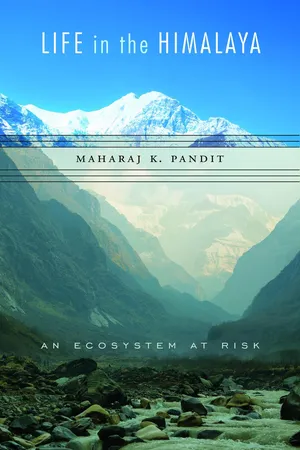
The collision of the Indian and Eurasian plates around fifty million years ago profoundly altered earth's geography and regional climates. The rise of the Himalaya led to intensification of the monsoon, the birth of massive glaciers and turbulent rivers, and an efflorescence of ecosystems along the most extreme elevational gradient on Earth. When the Ice Age ended, humans became part of this mix, and today nearly one quarter of the world's population inhabits its river basins, from Afghanistan to Myanmar. Life in the Himalaya examines the region's geophysical and biological systems and explores the past and future of human sustainability in the mountain's shadow.
Maharaj Pandit divides the Himalaya's history into four phases. During the first, the mountain and its ecosystems formed. In the second, humans altered the landscape, beginning with nomadic pastoralism, continuing to commercial deforestation, and culminating in pockets of resistance to forest exploitation. The third phase saw a human population explosion, accompanied by road and dam building and other large-scale infrastructure that degraded ecosystems and caused species extinctions. Pandit outlines a future networking phase which holds the promise of sustainable living within the mountain's carrying capacity.
Today, the Himalaya is threatened by recurrent natural disasters and is at risk of catastrophic loss of life. If humans are to have a sustainable future there, Pandit argues, they will need to better understand the region's geological vulnerability, ecological fragility, and sociocultural sensitivity. Life in the Himalaya outlines the mountain's past in order to map a way forward.
- 364 pages
- English
- ePUB (mobile friendly)
- Available on iOS & Android
eBook - ePub
About this book
Information
Index
- Abhinavagupta, 168
- Abhisara, 168
- Abor, 28, 29
- Adaptation, 10, 104, 111, 140, 208; physiological, 6; evolutionary, 11, 208; cultural, 44; ecological, 98
- Adaptive radiation, 6, 111, 113
- Adinath, 45
- Advaita, 185
- Aerosols, 178, 232; aerosol pollution, 234
- Afforestation, 158, 293, 299
- Afghanistan, 68, 223, 232, 233
- Africa, 48, 62; biotic exchange, 60, 78, 79, 80, 81, 82; breakup of Gondwana, 62; monsoon climate, 67; human migration, 124, 125, 127, 128, 129, 241
- Agriculture, 7, 8, 9, 13, 20, 31, 72; slash and burn, 129, 134, 140, 142; settled, 133, 136; productivity, 234, 248; sustainability, 240, 254, 268, 294
- Akbar, 53
- Aksai Chin, 165, 166, 171, 172
- Alien floras and faunas, 76, 246
- Alien invasives, 103, 245, 246, 247, 248, 249, 254
- Alien species, 102, 243, 244, 248, 249
- Alluvial environment, 85
- Alluvial plains, 73, 74
- Almora, 187, 290
- Alps, 3, 58, 94, 108, 109, 115; alpine vegetation, 116; alpine meadows, 130, 252, 253, 254, 267; alpine pastures, 240, 247
- Alter, Stephen, 1, 21
- Altitude, 24, 103, 140, 179, 205, 251
- Ananda, 41
- Andes, 3, 58, 109, 175
- Annapurna conservation area, 184
- Antarctica, 22, 61, 62, 65, 79, 179
- Anthropocene period, 271, 272, 273
- Aquatic ecosystems, 6, 76
- Aranya, 123
- Aravalli, 58, 72
- Arunachal Pradesh, 38, 167; Coptis teeta, 26; tribes, 27, 167; f...
Table of contents
- Cover
- Title Page
- Copyright
- Dedication
- Contents
- Foreword
- Introduction
- Prologue: Past as Precursor of Future
- I. Natural Phase
- II. Cultural Phase
- III. Mechanical Phase
- IV. Networking Phase
- References
- Acknowledgments
- Index
Trusted by 375,005 students
Access to over 1.5 million titles for a fair monthly price.
Study more efficiently using our study tools.
Frequently asked questions
Yes, you can cancel anytime from the Subscription tab in your account settings on the Perlego website. Your subscription will stay active until the end of your current billing period. Learn how to cancel your subscription
No, books cannot be downloaded as external files, such as PDFs, for use outside of Perlego. However, you can download books within the Perlego app for offline reading on mobile or tablet. Learn how to download books offline
Perlego offers two plans: Essential and Complete
- Essential is ideal for learners and professionals who enjoy exploring a wide range of subjects. Access the Essential Library with 800,000+ trusted titles and best-sellers across business, personal growth, and the humanities. Includes unlimited reading time and Standard Read Aloud voice.
- Complete: Perfect for advanced learners and researchers needing full, unrestricted access. Unlock 1.5M+ books across hundreds of subjects, including academic and specialized titles. The Complete Plan also includes advanced features like Premium Read Aloud and Research Assistant.
We are an online textbook subscription service, where you can get access to an entire online library for less than the price of a single book per month. With over 1.5 million books across 990+ topics, we’ve got you covered! Learn about our mission
Look out for the read-aloud symbol on your next book to see if you can listen to it. The read-aloud tool reads text aloud for you, highlighting the text as it is being read. You can pause it, speed it up and slow it down. Learn more about Read Aloud
Yes! You can use the Perlego app on both iOS and Android devices to read anytime, anywhere — even offline. Perfect for commutes or when you’re on the go.
Please note we cannot support devices running on iOS 13 and Android 7 or earlier. Learn more about using the app
Please note we cannot support devices running on iOS 13 and Android 7 or earlier. Learn more about using the app
Yes, you can access Life in the Himalaya by Maharaj K. Pandit in PDF and/or ePUB format, as well as other popular books in Biological Sciences & Asian History. We have over 1.5 million books available in our catalogue for you to explore.