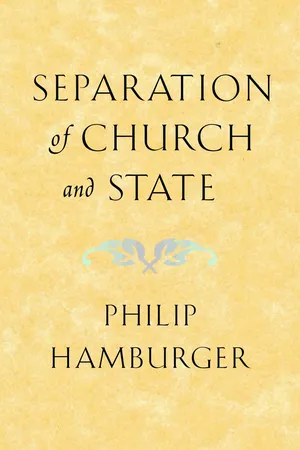
In a powerful challenge to conventional wisdom, Philip Hamburger argues that the separation of church and state has no historical foundation in the First Amendment. The detailed evidence assembled here shows that eighteenth-century Americans almost never invoked this principle. Although Thomas Jefferson and others retrospectively claimed that the First Amendment separated church and state, separation became part of American constitutional law only much later.
Hamburger shows that separation became a constitutional freedom largely through fear and prejudice. Jefferson supported separation out of hostility to the Federalist clergy of New England. Nativist Protestants (ranging from nineteenth-century Know Nothings to twentieth-century members of the K.K.K.) adopted the principle of separation to restrict the role of Catholics in public life. Gradually, these Protestants were joined by theologically liberal, anti-Christian secularists, who hoped that separation would limit Christianity and all other distinct religions. Eventually, a wide range of men and women called for separation. Almost all of these Americans feared ecclesiastical authority, particularly that of the Catholic Church, and, in response to their fears, they increasingly perceived religious liberty to require a separation of church from state. American religious liberty was thus redefined and even transformed. In the process, the First Amendment was often used as an instrument of intolerance and discrimination.
- 529 pages
- English
- PDF
- Available on iOS & Android
eBook - PDF
Separation of Church and State
About this book
Information
Publisher
Harvard University PressYear
2009Print ISBN
9780674013742
9780674007345
eBook ISBN
9780674038189
Table of contents
- CONTENTS
- Acknowledgments
- Introduction
- I LATE EIGHTEENTH-CENTURY RELIGIOUS LIBERTY
- II EARLY NINETEENTH-CENTURY REPUBLICANISM
- III MID-NINETEENTH-CENTURY AMERICANISM
- IV LATE NINETEENTH- AND TWENTIETH-CENTURY CONSTITUTIONAL LAW
- Conclusion
- Index
Trusted by 375,005 students
Access to over 1.5 million titles for a fair monthly price.
Study more efficiently using our study tools.
Frequently asked questions
Yes, you can cancel anytime from the Subscription tab in your account settings on the Perlego website. Your subscription will stay active until the end of your current billing period. Learn how to cancel your subscription
No, books cannot be downloaded as external files, such as PDFs, for use outside of Perlego. However, you can download books within the Perlego app for offline reading on mobile or tablet. Learn how to download books offline
Perlego offers two plans: Essential and Complete
- Essential is ideal for learners and professionals who enjoy exploring a wide range of subjects. Access the Essential Library with 800,000+ trusted titles and best-sellers across business, personal growth, and the humanities. Includes unlimited reading time and Standard Read Aloud voice.
- Complete: Perfect for advanced learners and researchers needing full, unrestricted access. Unlock 1.5M+ books across hundreds of subjects, including academic and specialized titles. The Complete Plan also includes advanced features like Premium Read Aloud and Research Assistant.
We are an online textbook subscription service, where you can get access to an entire online library for less than the price of a single book per month. With over 1.5 million books across 990+ topics, we’ve got you covered! Learn about our mission
Look out for the read-aloud symbol on your next book to see if you can listen to it. The read-aloud tool reads text aloud for you, highlighting the text as it is being read. You can pause it, speed it up and slow it down. Learn more about Read Aloud
Yes! You can use the Perlego app on both iOS and Android devices to read anytime, anywhere — even offline. Perfect for commutes or when you’re on the go.
Please note we cannot support devices running on iOS 13 and Android 7 or earlier. Learn more about using the app
Please note we cannot support devices running on iOS 13 and Android 7 or earlier. Learn more about using the app
Yes, you can access Separation of Church and State by Philip Hamburger,Philip HAMBURGER in PDF and/or ePUB format, as well as other popular books in Law & North American History. We have over 1.5 million books available in our catalogue for you to explore.