For much of the twentieth century, large companies employing many workers formed the bedrock of the U.S. economy. Today, as David Weil's groundbreaking analysis shows, large corporations have shed their role as direct employers of the people responsible for their products, in favor of outsourcing work to small companies that compete fiercely with one another. The result has been declining wages, eroding benefits, inadequate health and safety conditions, and ever-widening income inequality.
"Authoritative…[The Fissured Workplace] shed[s] important new light on the resurgence of the power of finance and its connection to the debasement of work and income distribution."
—Robert Kuttner, New York Review of Books
"The kinds of workplace fissuring discussed here—subcontracting, franchising, and global supply chains—have been the subjects of a number of studies detailing the employment effects that Weil describes. The Fissured Workplace is unusual in bringing this research together into an integrated, detailed, and decidedly policy-oriented analysis…It makes a convincing case that the better regulation of fissured workplaces is a first step towards reversing the erosion of pay and conditions at the bottom of the labor market."
—Virginia Doellgast, Times Higher Education
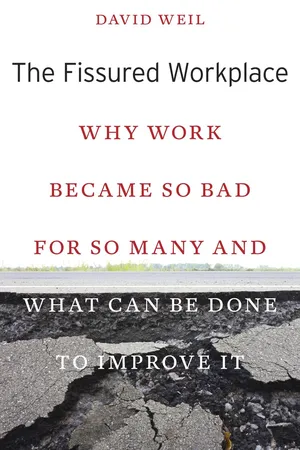
eBook - ePub
The Fissured Workplace
Why Work Became So Bad for So Many and What Can Be Done to Improve It
- English
- ePUB (mobile friendly)
- Available on iOS & Android
eBook - ePub
The Fissured Workplace
Why Work Became So Bad for So Many and What Can Be Done to Improve It
About this book
Information
Publisher
Harvard University PressYear
2014Print ISBN
9780674975446
9780674725447
eBook ISBN
9780674727090
PART I
Vignettes from the Modern Workplace
A maid works at the San Francisco Marriott on Fisherman’s Wharf. The hotel property is owned by Host Hotels and Resorts Inc., a lodging real estate company. The maid, however, is evaluated and supervised daily and her hours and payroll managed by Crestline Hotels and Resorts Inc., a national third-party hotel management company. Yet she follows daily procedures (and risks losing her job for failure to accomplish them) regarding cleaning, room set-up, overall pace, and quality standards established by Marriott, whose name the property bears.
A cable installer in Dayton, Ohio, works as an independent contractor (in essence a self-employed business provider), paid on a job-by-job basis by Cascom Inc., a cable installation company. Cascom’s primary client is the international media giant Time Warner, which owns cable systems across the United States. The cable installer is paid solely on the basis of the job completed and is entitled to no protections normally afforded employees. Yet all installation contracts are supplied solely by Cascom, which also sets the price for jobs and collects payment for them. The installer must wear a shirt with the Cascom logo and can be removed as a contractor at will for not meeting minimum quotas or quality standards, or at the will of the company.
A recent immigrant to the United States and an aspiring entrepreneur in Boston starts a commercial janitorial service by purchasing a franchise from Coverall, one of the largest U.S. companies in this business. He is owner of the Coverall franchise and works long hours, cleaning clients’ businesses, including a Bank of America branch. He receives his clients from Coverall, which sets the price and quality standards, defines the geographic boundaries of his franchise, and loaned him capital to purchase the franchise. The prevailing market rate for janitorial services set by Coverall barely covers the royalties, loan repayment, and other expenses to the franchisor, the gas and car costs for traveling between clients, and compensation for himself and the people who work with him.
A member of a loading dock crew working in Southern California is paid by Premier Warehousing Ventures LLC (PWV)—a company providing temporary workers to other businesses—based on the total time it takes him and members of his crew to load a truck. PWV, in turn, is compensated for the number of trucks loaded by Schneider Logistics, a national logistics and trucking company that manages distribution centers for Walmart. Walmart sets the price, time requirements, and performance standards that are followed by Schneider. Schneider, in turn, structures its contracts with PWV and other labor brokers it uses to provide workers based on those prices and standards and its own profit objectives.
A young Moldovan exchange student works in a Palmyra, Pennsylvania, shipping facility packing chocolates exclusively for the Hershey Company. The job was arranged via the J-1 visa program overseen by the State Department to provide international students with cultural opportunities in the United States via a nonprofit organization, the Council for Educational Travel, USA (CETUSA). CETUSA, in turn, set up summer employment for the student and four hundred others with Exel, a company contracted by Hershey to manage its packing facility. Exel in turn hires a labor contractor, SHS OnSite Solutions, to provide workers, including students holding J-1 visas. Students who paid $6,000 to participate in the exchange program are assigned the 10:00 p.m. to 6:00 a.m. shift in the refrigerated facility and are paid a wage of $8.00 an hour, from which rent and other expenses are deducted, leaving little extra for the “exchange” portion of their experience.
In an earlier era, Marriott, Time Warner, Bank of America, Walmart, and Hershey, as well as other large employers that produced well-known products and services, would likely have directly employed the workers in the above vignettes. Not so now. As major companies have consciously invested in building brands and devoted customers as the cornerstone of their business strategy, they have also shed their role as the direct employer of the people responsible for providing those products and services.
In all of the above cases, the jobs shifted away to be done by separate employers pay low wages; provide limited or often no health care, pension, or other benefits; and offer tenuous job security. Moreover, workers in each case received pay or faced workplace conditions that violated one or more workplace laws. Tudor Ureche, a Moldovan student working in the Hershey packing facility, sent an email to the State Department seeking “help [from] the miserable situation in which I’ve found myself cought [sic],” which included lifting 50–60-pound boxes in a refrigerated facility on the night shift. Pius Awuah, a resident of Lowell, Massachusetts, put his life savings into a Coverall franchise contract that in many respects was simply paying to be an employee (who was then compensated in violation of minimum wages and overtime standards). And Everardo Carrillo and coworkers at a facility operated by Schneider Logistics were paid in violation of the Fair Labor Standards Act and then fired for stepping forward to complain about those working conditions.
The cases are not exceptional, but rather indicative of practices found in the varied industries depicted above as well as in a growing number of other sectors and occupations. Yet these working conditions are not an inevitable result of the nature of those jobs or of amorphous forces like globalization. They result from a fundamental restructuring of employment in many parts of the economy.
The vignettes reveal a transformation in how business organizes work in ways that are invisible to most of us as consumers. We walk into a Marriott and assume that the people who greet us at the front desk or who clean our rooms each day are employees of that venerable brand (as their uniforms imply). We greet the technicians sent to our home to fix our cable, not even questioning whether they work for the media company to whom we pay our bills. In short, we assume that the companies who invest millions of dollars to convince us of the benefits of buying products under their retail nameplate or to purchase the unique services they offer also undertake the operations needed to produce them—including acting as the employer of all the interconnected people who make their businesses possible.
Those assumptions are increasingly wrong. In the late 1980s and early 1990s, many companies, facing increasingly restive capital markets, shed activities deemed peripheral to their core business models: out went janitors, security guards, payroll administrators, and information technology specialists. But then came activities many of us would assume were more central to these well-known businesses: the front desk staff at hotel check-in; the drivers for the package delivery companies who come to our homes or offices; the tower workers who help assure uninterrupted cell phone service promoted in the commercials (and for which we pay a premium). Even the lawyers who handle our business transactions and the consultants who work for well-known accounting companies may now have an arm’s-length relationship with those by whom we think they are employed.
By shedding direct employment, lead business enterprises select from among multiple providers of those activities and services formerly done inside the organization, thereby substantially reducing costs and dispatching the many responsibilities connected to being the employer of record. Information and communication technologies have enabled this hidden transformation of work, since they allow lead companies to promulgate and enforce product and quality standards key to their business strategies, thereby maintaining the carefully created reputation of their goods and services and reaping price premiums from their loyal customer base.
The new organization of the workplace also undermines the mechanisms that once led to the workforce sharing part of the value created by their large corporate employers. By shedding employment to other parties, lead companies change a wage-setting problem into a contracting decision. The result is stagnation of real wages for many of the jobs formerly done inside.
Laws originally intended to ensure basic labor standards and to protect workers from health and safety risks now enable these changes by focusing regulatory attention on the wrong parties. Core federal and state laws that regulate employment, often dating back to the first half of the twentieth century, often assume simple and direct employee/employer relationships. They make presumptions about responsibility and liability similar to those we make as customers, presumptions that ignore the transformation that has occurred under the hood of many business enterprises. Traditional approaches to enforcing those laws similarly ignore the myriad new relationships that lie below the surface of the workplace. As a result, the laws crafted to safeguard basic standards, to reduce health and safety risks, and to cushion displacement from injury or economic downturn often fail to do so.
In essence, private strategies and public policies allow major companies to simultaneously profit from the core activities that create value in the eyes of customers and the capital markets and shed the actual production of goods and services. In so doing, they have their cake and eat it too.
How did the workplace fissure? What are the wider impacts? Is continued shedding of employment the inevitable outcome of a modern, flexible economy? Are there ways to assure that workers are treated fairly and responsibly given the continued pressure to fissure employment? These are the central questions explored in this book.
1
The Fissured Workplace and Its Consequences
The modern workplace has been profoundly transformed. Employment is no longer the clear relationship between a well-defined employer and a worker. The basic terms of employment—hiring, evaluation, pay, supervision, training, coordination—are now the result of multiple organizations. Responsibility for conditions has become blurred. Like a rock with a fracture that deepens and spreads with time, the workplace over the past three decades has fissured. And fissuring has serious consequences for the bedrock that people depend upon from employment: the share of the economic pie available to workers and their families; their exposure to health and safety and other risks each day at work; and the likelihood that their workplaces comply with the standards set out by law.
The stories opening Part I are not unusual. In 1960 most hotel employees worked for the brand that appeared over the hotel entrance. Today, more than 80% of staff are employed by hotel franchisees and supervised by separate management companies that bear no relation to the brand name of the property where they work. Twenty years ago, workers in the distribution center of a major manufacturer or retailer would be hired, supervised, evaluated, and paid by that company. Today, workers might receive a paycheck from a labor supplier or be managed by the personnel of a logistics company, while their work is governed by the detailed operating standards of the nationally known retailer or consumer brand serviced by the facility. And whereas IBM in its ascendency directly employed workers from designers and engineers to the people on the factory floor producing its computers, Apple can be our economy’s most highly valued company while directly employing only 63,000 of the more than 750,000 workers globally responsible for designing, selling, manufacturing, and assembling its products.
A Seismic Shift in the Focus of Employment
During much of the twentieth century, the critical employment relationship was between large businesses and workers. Large businesses with national and international reputations operating at the top of their industries (which will be referred to as “lead businesses” throughout the book) continue to focus on delivering value to their customers and investors. However, most no longer directly employ legions of workers to make products or deliver services. Employment has been actively shed by these market leaders and transferred to a complicated network of smaller business units. Lower-level businesses operate in more highly competitive markets than those of the firms that shifted employment to them.
This creates downward pressure on wages and benefits, murkiness about who bears responsibility for work conditions, and increased likelihood that basic labor standards will be violated. In many cases, fissuring leads simultaneously to a rise in profitability for the lead companies who operate at the top of industries and increasingly precarious working conditions for workers at lower levels.
But the fissured workplace is not simply the result of employers seeking to reduce wages and cut benefits. It represents the intersection of three business strategies, one focused on revenues, one on costs, and one on providing the “glue” to make the overall strategy operate effectively. Its components begin not with employment, but with the demands by capital markets that lead companies focus on core competencies that produce value for investors and consumers. This means building brands, creating innovative products and services, capitalizing on true economies of scale and scope, or coordinating complex supply chains. But focusing on the core also has come to mean shifting activities once considered central to operations to other organizations in order to convert employer-employee relationships into arm’s-length market transactions. Finally, fissuring weds these potentially contradictory activities through the glue of the creation, monitoring, and enforcement of standards on product and service delivery, made available through new information and communication technologies and enabled by organizational models like franchising, labor brokers, and third-party management.
The result is businesses and industries wired in fundamentally new ways. Wage setting and supervi...
Table of contents
- Cover
- Half Title
- Title Page
- Copyright
- Dedication
- Contents
- Part I: Vignettes from the Modern Workplace
- Part II: The Forms and Consequences of the Fissured Workplace
- Part III: Mending the Fissured Workplace
- Notes
- References
- Acknowledgments
- Index
Trusted by 375,005 students
Access to over 1.5 million titles for a fair monthly price.
Study more efficiently using our study tools.
Frequently asked questions
Yes, you can cancel anytime from the Subscription tab in your account settings on the Perlego website. Your subscription will stay active until the end of your current billing period. Learn how to cancel your subscription
No, books cannot be downloaded as external files, such as PDFs, for use outside of Perlego. However, you can download books within the Perlego app for offline reading on mobile or tablet. Learn how to download books offline
Perlego offers two plans: Essential and Complete
- Essential is ideal for learners and professionals who enjoy exploring a wide range of subjects. Access the Essential Library with 800,000+ trusted titles and best-sellers across business, personal growth, and the humanities. Includes unlimited reading time and Standard Read Aloud voice.
- Complete: Perfect for advanced learners and researchers needing full, unrestricted access. Unlock 1.5M+ books across hundreds of subjects, including academic and specialized titles. The Complete Plan also includes advanced features like Premium Read Aloud and Research Assistant.
We are an online textbook subscription service, where you can get access to an entire online library for less than the price of a single book per month. With over 1.5 million books across 990+ topics, we’ve got you covered! Learn about our mission
Look out for the read-aloud symbol on your next book to see if you can listen to it. The read-aloud tool reads text aloud for you, highlighting the text as it is being read. You can pause it, speed it up and slow it down. Learn more about Read Aloud
Yes! You can use the Perlego app on both iOS and Android devices to read anytime, anywhere — even offline. Perfect for commutes or when you’re on the go.
Please note we cannot support devices running on iOS 13 and Android 7 or earlier. Learn more about using the app
Please note we cannot support devices running on iOS 13 and Android 7 or earlier. Learn more about using the app
Yes, you can access The Fissured Workplace by David Weil in PDF and/or ePUB format, as well as other popular books in Economics & Economic Theory. We have over 1.5 million books available in our catalogue for you to explore.