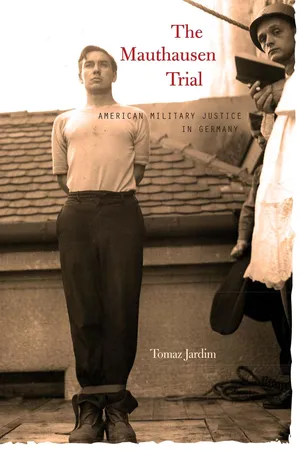
Shortly after 9:00 a.m. on May 27, 1947, the first of forty-nine men condemned to death for war crimes at Mauthausen concentration camp mounted the gallows at Landsberg prison near Munich. The mass execution that followed resulted from an American military trial conducted at Dachau in the spring of 1946—a trial that lasted only thirty-six days and yet produced more death sentences than any other in American history.
The Mauthausen trial was part of a massive series of proceedings designed to judge and punish Nazi war criminals in the most expedient manner the law would allow. There was no doubt that the crimes had been monstrous. Yet despite meting out punishment to a group of incontestably guilty men, the Mauthausen trial reveals a troubling and seldom-recognized face of American postwar justice—one characterized by rapid proceedings, lax rules of evidence, and questionable interrogations.
Although the better-known Nuremberg trials are often regarded as epitomizing American judicial ideals, these trials were in fact the exception to the rule. Instead, as Tomaz Jardim convincingly demonstrates, the rough justice of the Mauthausen trial remains indicative of the most common—and yet least understood—American approach to war crimes prosecution. The Mauthausen Trial forces reflection on the implications of compromising legal standards in order to guarantee that guilty people do not walk free.
- 301 pages
- English
- PDF
- Available on iOS & Android
eBook - PDF
About this book
Information
Table of contents
- Contents
- Introduction
- 1. War Crimes Trials and the U.S. Army
- 2. American Investigators at Mauthausen
- 3. The Prosecution Crafts Its Case
- 4. The Defendants in the Dock
- 5. Judgment at Dachau
- Conclusion
- Appendix: The Mauthausen Trial Charge Sheet
- Notes
- Bibliography of Primary Sources
- Acknowledgments
- Index
Trusted by 375,005 students
Access to over 1.5 million titles for a fair monthly price.
Study more efficiently using our study tools.
Frequently asked questions
Yes, you can cancel anytime from the Subscription tab in your account settings on the Perlego website. Your subscription will stay active until the end of your current billing period. Learn how to cancel your subscription
No, books cannot be downloaded as external files, such as PDFs, for use outside of Perlego. However, you can download books within the Perlego app for offline reading on mobile or tablet. Learn how to download books offline
Perlego offers two plans: Essential and Complete
- Essential is ideal for learners and professionals who enjoy exploring a wide range of subjects. Access the Essential Library with 800,000+ trusted titles and best-sellers across business, personal growth, and the humanities. Includes unlimited reading time and Standard Read Aloud voice.
- Complete: Perfect for advanced learners and researchers needing full, unrestricted access. Unlock 1.5M+ books across hundreds of subjects, including academic and specialized titles. The Complete Plan also includes advanced features like Premium Read Aloud and Research Assistant.
We are an online textbook subscription service, where you can get access to an entire online library for less than the price of a single book per month. With over 1.5 million books across 990+ topics, we’ve got you covered! Learn about our mission
Look out for the read-aloud symbol on your next book to see if you can listen to it. The read-aloud tool reads text aloud for you, highlighting the text as it is being read. You can pause it, speed it up and slow it down. Learn more about Read Aloud
Yes! You can use the Perlego app on both iOS and Android devices to read anytime, anywhere — even offline. Perfect for commutes or when you’re on the go.
Please note we cannot support devices running on iOS 13 and Android 7 or earlier. Learn more about using the app
Please note we cannot support devices running on iOS 13 and Android 7 or earlier. Learn more about using the app
Yes, you can access The Mauthausen Trial by Tomaz Jardim in PDF and/or ePUB format, as well as other popular books in History & German History. We have over 1.5 million books available in our catalogue for you to explore.