At the height of its power around 1800, the English East India Company controlled half of the world's trade and deployed a vast network of political influencers at home and abroad. Yet the story of the Company's beginnings in the early seventeenth century has remained largely untold. Rupali Mishra's account of the East India Company's formative years sheds new light on one of the most powerful corporations in the history of the world.
From its birth in 1600, the East India Company lay at the heart of English political and economic life. The Company's fortunes were determined by the leading figures of the Stuart era, from the monarch and his privy counselors to an extended cast of eminent courtiers and powerful merchants. Drawing on a host of overlooked and underutilized sources, Mishra reconstructs the inner life of the Company, laying bare the era's fierce struggles to define the difference between public and private interests and the use and abuse of power. Unlike traditional accounts, which portray the Company as a private entity that came to assume the powers of a state, Mishra's history makes clear that, from its inception, the East India Company was embedded within—and inseparable from—the state.
A Business of State illuminates how the East India Company quickly came to inhabit such a unique role in England's commercial and political ambitions. It also offers critical insights into the rise of the early modern English state and the expansion and development of its nascent empire.
eBook - ePub
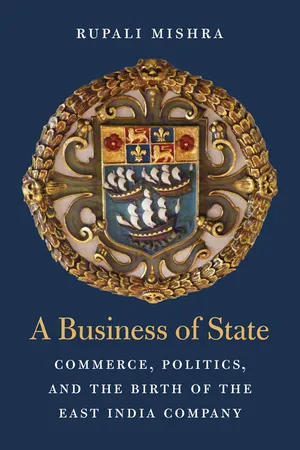
A Business of State
Commerce, Politics, and the Birth of the East India Company
- 412 pages
- English
- ePUB (mobile friendly)
- Available on iOS & Android
eBook - ePub
A Business of State
Commerce, Politics, and the Birth of the East India Company
About this book
Information
Part One
GOVERNING THE COMPANY
This part of the book investigates the internal life of the East India Company by examining topics that reveal the institution’s political culture. Ranging from issues that took place wholly within the Company to ones that involved people unconnected to the body, the Company’s political life involved not only its full membership but also the regime and members of the public.
Every opportunity, complication, and power in the East India Company’s experience had roots in the Company’s patent. Both the Company’s internal government and its place in the wider Stuart state drew upon and tested the powers and privileges granted in the Company’s patent. Chapter 1 explores the Company’s patent, the privileges conferred in it, and the negotiations involved in securing that patent.
The Company’s patent granted the right of self-government but gave limited direction for how it should work. Chapter 2 examines how the elected leaders of the Company constituted and exercised their authority over the Company’s general membership. Establishing and maintaining authority required constant effort, and members excluded from leadership positions sometimes resented that authority. Chapter 3 traces how the membership of the Company changed during the early seventeenth century, as Company leaders sought to recruit influential figures as members. The result was that the Company’s membership came to overlap extensively with those of the royal court and other prominent state institutions. Courtiers and aristocrats brought special skills and connections to the Company, and Company leaders purposefully cultivated these men for membership.
Chapters 4 and 5 look at the form and meaning of challenges to the Company’s leadership and style of government. Company members debated at length their own government as a representative body, and how power should be organized within it. Chapter 4 follows the types of opposition by members to the elected leaders of the Company, focusing on election-day disputes and proposals for procedural changes. Some Company leaders traced opposition in the Company, which they often labeled faction, to the increased presence of courtiers and gentlemen in the membership and the outsize demands they made, though the challengers frequently cited the lack of transparency and infrequent turnover of leadership as the cause of their concerns. Chapter 5 investigates the debates about the Company and its government that took place in print. The Company became the target of public suspicion as printed pamphlets appeared that alleged the Company had mismanaged the trade and harmed the commonwealth. Critics charged that the East Indies trade benefited the private interests of Company members rather than serving the public good. To defend against these accusations, Company writers reconceptualized private interest, developing new arguments about how the pursuit of private interest actually served the commonwealth. Answering the external critics led Company leaders to grapple with questions of public appeal and to begin experimenting with new tools as they entered the public arena to defend themselves and their trade.
This part of the book shows how central these questions of power and authority were to the East India Company, and how the Company became the site of contests about the proper use of power not only within the corporation but also in the wider commonwealth. These chapters demonstrate how the business of state prompted debate and new answers to questions about the nature and purpose of self-government, private interest and public benefit, and the aim of overseas ventures.

1
The Patent and the Formation of the Company

IN THE EARLY seventeenth century, trading with the East Indies was a significant challenge—and not solely because of distance. That a body such as the East India Company should exist and develop a trade such as the East India trade, in a place such as the East Indies, was the fruit of concerted work by a varied group of people. The prospective adventurers had to answer a number of possible objections to show that the trade was viable, would not infringe on Spanish or Portuguese claims in the East Indies, and would provide a real benefit to the commonwealth—all with the object of securing a letter patent from Elizabeth I for the trade. Only through a letter patent could a group of merchants be transformed into an incorporated body with powerful privileges. The trade they sought to develop would have enforceable legal protections, and they would have authority to govern themselves in both London and the East Indies.
Without a patent, merchants could still have organized a trade, but they would have had no guarantees or special legal powers. They could still have banded together to send a ship, but they would have had no way of preventing anyone else from also sending ships. Competition might mean infighting, which would have prevented a strong English presence in the East Indies. The death or disinterest of a particular merchant active in the trade might mean the end of the trade altogether. They would have no authority to govern themselves or, arguably, even to assemble. At the other extreme and most important, without the imprimatur of the state, a group of merchants in the East Indies might be at the mercy of the power of rival European powers in the East Indies, unable to rely on official support for their venture.
An early modern patent, therefore, was a powerful thing. It was powerful symbolically and politically. A patent represented the moment when the private interest of individuals and the interest of the commonwealth were bound together. It signified how the monarch, through an act of the royal prerogative, could harness the endeavors of a group of individuals for the benefit for the whole nation. It transformed what could be a problem—the exercise of self-interest—into a method of growing the power and reach of the state. In the case of the East India Company, the patent gave a group of merchants the means of developing a new trade through the delegation of powers and privileges that they saw as necessary for that trade to succeed.
Yet a patent represented not only the moment of creation, but also the ongoing relationship between the parties named in it. The connection between the monarch and the individuals named in the patent did not end with the granting of powers. As with any relationship, the meaning of the patent changed over time—both in formal terms, as new powers or privileges were delegated, and in informal terms, with changes in the named parties’ interpretation of the powers and privileges granted. For the East India Company, that meant that the patent was and continued to be a guide for both the regime and Company members for how the Company should function within the state, even as the grantor and grantee of a patent could and often did have very different understandings of what the patent promised.
The early years of the Company’s existence (and the years before its existence) witnessed frequent and sometimes tense negotiations between crown and Company (or its future members) over the meaning of the patent and the privileges it granted. The patent was the cornerstone of the Company’s relationship with the crown. How faithfully the monarch respected the patent provided a gauge of the state of the relationship between the Company and crown. Without the patent (or charter, as it was sometimes called), the East India Company would not exist, and Company leaders generally sought to protect and enlarge its existing privileges. Meanwhile the crown sought to compel Company leaders to use those privileges granted by the monarch in ways that were most useful or convenient to the regime. Despite the appearance of permanence and transparent meaning that a written patent gave, the patent and exactly what its grant encompassed were always fluid, with different parties’ understandings shaped by changing circumstances.
Patents and Trading Companies
When the East India Company was founded in 1600, as an incorporated company engaging in a long-distance trade, it was an institution at the cutting edge of both the English state and private enterprise. The world of English trade in the early seventeenth century was much more regional than global. In 1600, England’s biggest export crop was wool, which was exported primarily to the Low Countries. That commodity accounted for the vast majority of English trade and had been traded since at least the fourteenth century.1 However, English overseas horizons were expanding. Since the mid-1500s, English merchants had engaged in trades in the Baltic and to Muscovy. Since 1581, England had had a formal trade in the Mediterranean, through the Turkey or Levant Company. By 1600, there had been a few unsustained ventures to North America, and the Virginia Company was founded a few years later, in 1606. Other companies, such as the Somers Island Company and the Royal Africa Company (founded in 1615 and 1618, respectively), were formed in the following years. In addition to these formal trades—meaning organized trades run by merchants—English privateers operated in the Atlantic and Indian Oceans and the Mediterranean Sea. The East India Company was part of this flowering of English overseas endeavors and was responsible for English activities east of the Cape of Good Hope.
The legal mechanism that undergirded English overseas expansion—that helped make the risks and expense bearable—was the letter patent. Increasingly in the sixteenth and seventeenth centuries, groups of investors, often merchants, turned to patents to establish new overseas trades. Crown-chartered trading companies were a relatively new feature of the economic landscape, compared to the much older trading guilds of the Merchant Adventurers (founded in 1407) and the Merchant Staplers (founded sometime in the fourteenth century), which together ran much of England’s cloth trade. In comparison, the first joint-stock trading company, the Russia or Muscovy Company, was created by letter patent in 1555. The overseas trading companies of the late sixteenth and early seventeenth centuries were almost all constituted by letters patent.2
Prospective adventurers were open about the value and use of a letter patent and the privileges it conferred. A proposal for a trade to “lands beyond the equinoctial” presented to Lord Burghley in 1573 directly requested a letter patent. It asked that the queen give a patent “to the authors and fellowship of this voyage in nature of a corporation.” The patent should “add such franchise and privilege as in this case is requisite.” The proposal explicitly noted the need for the patent to grant the company the ability to form a government for itself: “to stablish some form of governance and authority in some persons of the company of this adventure, so as by some regiment obedience, quiet unity, and order may be preserved.”3 A separate proposal in 1580 for a company (also to trade “beyond the equinoctial line”) directly asked Elizabeth to “grant like privileges as have been granted by her and her progenitors unto her subjects trading into the dominions of the emperor of Russia.”4 Neither of these patents was granted, but they testify to the perceived value of a patent and what prospective adventurers wanted from one.
The letters patent that groups of adventurers sought and were granted shared several key features: they granted exclusive rights to something (an activity, a trade, or presence in a particular geographic area); they incorporated the prospective adventurers; and they granted that incorporated body the right of self-government.5 The specifics of each of those grants could vary considerably, but the essence of the grants was the same. There were other types of early modern letters patent, granting other types of powers and privileges. Patents could grant land and powers related to land, office, and commissions and had a variety of other functions. They could even grant the power to claim and possess new lands, as did the patents given to individuals (and companies) in the Americas.6 However, the letters patent that created trading companies formed an unofficial subset, defined by their shared and distinctive powers that granted exclusivity, incorporation, and self-government.
The grant of exclusivity made patents essentially grants of monopoly. The scope of the exclusivity thus granted could range from the importation or manufacture of a specific commodity (like soap, playing cards, or particular types of woven goods) to the development and conduct of a trade to a particular place. The exclusivity ceded to the trading companies usually reflected geographical locations. This could mean a specific place, like Spain, or more general regions, like Muscovy, the Eastlands, the Levant, and the East Indies. Sometimes the grant of a particular place effectively meant a grant of exclusive access to particular commodities. The Levant Company brought in the nation’s supply of currants, for example, just as the East India Company was the source of indigo.7 The fundamental characteristic of the patent was that it gave the sole right to something, though that “something” varied considerably.
The grants of incorporation and self-government were no more standard in their meaning than the exclusivity grant. What exactly incorporation meant was not always clear. Though corporate institutions had existed for centuries, the idea that merchant trading bodies should be incorporated was not standard before Elizabeth’s reign. Grants of privileges to the Merchant Adventurers residing in Calais in 1505 by Henry VII and to the merchants trading to Andalusia in 1530 by Henry VIII did not explicitly grant incorporation, though they granted the right of self-government.8 The Muscovy Company was directly incorporated in its letter patent in 1555, however, and subsequent patents for other companies generally followed suit. The 1606 patent for the Virginia Company did not explicitly mention incorporation, but that omission was remedied in the 1609 patent. By the late sixteenth century, groups of adventurers regularly sought and were granted incorporation.
Yet the legal rights and privileges associated with incorporation were very much in flux. Where the meaning of incorporation was mentioned or alluded to in patents, it generally referred to the legal perpetuity of the body and its ability to buy land, resort to law, and conduct other business as a unit.9 However, the first book on corporate law, for example, was not published until 1659, and Sir Edward Coke’s famous assertion that corporations had no souls, could own land, and had rights that extended beyond the lifetime of their founders was given as a commentary on a case that took place in 1612 (the Case of Sutton’s Hospital). In sum, the legal certainties that the patents suggested were not actually certainties. Thus, though corporate bodies were common, and the corporate structure something adventurers desired, the rights attendant on them were not standard.10 Indeed, a number of companies—not solely the East India Company—struggled to demarcate the p...
Table of contents
- Cover
- Series Page
- Title Page
- Copyright
- Contents
- Note on Spelling, Dates, and Sources
- Introduction
- Part One: Governing the Company
- Part Two: The Company and the State
- Conclusion
- Abbreviations
- Notes
- Manuscript and Archival Sources
- Acknowledgments
- Index
Trusted by 375,005 students
Access to over 1.5 million titles for a fair monthly price.
Study more efficiently using our study tools.
Frequently asked questions
Yes, you can cancel anytime from the Subscription tab in your account settings on the Perlego website. Your subscription will stay active until the end of your current billing period. Learn how to cancel your subscription
No, books cannot be downloaded as external files, such as PDFs, for use outside of Perlego. However, you can download books within the Perlego app for offline reading on mobile or tablet. Learn how to download books offline
Perlego offers two plans: Essential and Complete
- Essential is ideal for learners and professionals who enjoy exploring a wide range of subjects. Access the Essential Library with 800,000+ trusted titles and best-sellers across business, personal growth, and the humanities. Includes unlimited reading time and Standard Read Aloud voice.
- Complete: Perfect for advanced learners and researchers needing full, unrestricted access. Unlock 1.5M+ books across hundreds of subjects, including academic and specialized titles. The Complete Plan also includes advanced features like Premium Read Aloud and Research Assistant.
We are an online textbook subscription service, where you can get access to an entire online library for less than the price of a single book per month. With over 1.5 million books across 990+ topics, we’ve got you covered! Learn about our mission
Look out for the read-aloud symbol on your next book to see if you can listen to it. The read-aloud tool reads text aloud for you, highlighting the text as it is being read. You can pause it, speed it up and slow it down. Learn more about Read Aloud
Yes! You can use the Perlego app on both iOS and Android devices to read anytime, anywhere — even offline. Perfect for commutes or when you’re on the go.
Please note we cannot support devices running on iOS 13 and Android 7 or earlier. Learn more about using the app
Please note we cannot support devices running on iOS 13 and Android 7 or earlier. Learn more about using the app
Yes, you can access A Business of State by Rupali Mishra,Rupali Mishra Mishra in PDF and/or ePUB format, as well as other popular books in History & Business History. We have over 1.5 million books available in our catalogue for you to explore.