A Times Literary Supplement Book of the Year
A Marginal Revolution Best Non-Fiction Book of the Year
A Seminary Co-op Notable Book of the Year
A Times Higher Education Book of the Week
A Choice Outstanding Academic Title of the Year
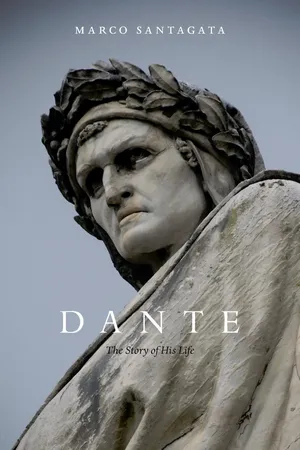
Marco Santagata's Dante: The Story of His Life illuminates one of the world's supreme poets from many angles—writer, philosopher, father, courtier, political partisan. Santagata brings together a vast body of Italian scholarship on Dante's medieval world, untangles a complex web of family and political relationships for English readers, and shows how the composition of the Commedia was influenced by local and regional politics.
"Reading Marco Santagata's fascinating new biography, the reader is soon forced to acknowledge that one of the cornerstones of Western literature [The Divine Comedy], a poem considered sublime and universal, is the product of vicious factionalism and packed with local scandal."
—Tim Parks, London Review of Books
"This is a wonderful book. Even if you have not read Dante you will be gripped by its account of one of the most extraordinary figures in the history of literature, and one of the most dramatic periods of European history. If you are a Dantean, it will be your invaluable companion forever."
—A. N. Wilson, The Spectator
- 486 pages
- English
- ePUB (mobile friendly)
- Available on iOS & Android
eBook - ePub
About this book
Information
Part One
FLORENCE
1
Childhood
1265–1283
I was born and raised
in the great city on the lovely River Arno
I’ fui nato e cresciuto
sovra ’l bel fiume d’Arno a la gran villa
—Inf. XXIII 94–95
The “glorious stars”
DANTE ALIGHIERI was born in Florence in May 1265 under the sign of Gemini.1 At the baptismal font he was given the name Durante.2 It was a name he would never use: in his writings he called himself and always signed himself just Dante; the poets with whom he corresponded called him Dante; Dante is the only name to appear in private and public documents written during his lifetime; and Dante is the form on which all “interpretations” of his name have been built. In the Middle Ages there was a widely held belief that the name of a person, if properly interpreted (interpretatio nominis), would reveal the destiny of its bearer, or rather, that the actions carried out by the person bearing it would reveal the inner meaning of the name itself. This interpretation was not at all influenced by the actual etymology of the name. In the same way that the name Beatrice tells us this woman is “blessed” and “a source of beatitude” for others, so the name Dante indicates that its holder, through his works, generously “gives” (dà) to others his great intellectual gifts received from God.3
Dante tells us himself in Paradiso that he was born under Gemini. During his ascent to the Empyrean, finding himself in that very constellation, he asks the Twins to help him on the final difficult stretch of his journey and recalls how the sun had reached them at the moment when he had “first breathed the Tuscan air” (Para. XXII 117; “quand’ io senti’ di prima l’aere tosco”). At the very moment of his first breath, when the influence of the stars operates with greater force, those “glorious stars” had infused in him all the talent, “whatever it might be,” with which he felt endowed. But though he considers astrological problems on many occasions, and though he insists on the “virtue” of the stars that had presided over his birth, Dante never specifies what particular influence they had on him. The astrologers of the time claimed that if Mercury and Saturn were present in the “house” of Gemini (a conjunction that had actually taken place in 1265), those born under the sign were endowed with excellent intellectual qualities and special abilities in writing. Dante may also have thought this. Certainly, apart from (infrequent) assertions of modesty, he was convinced that the twins of Gemini had provided him with a remarkable talent.4
We can be sure, however, that if he had been born under another sign, he would have claimed to have been greatly blessed all the same. The most remarkable aspect of Dante’s personality is, in fact, his feeling of being different and predestined. In whatever he saw, did or said—the first feeling of love, the death of the woman he had loved, political defeat or exile—he glimpsed some sign of destiny, the shadow of an unavoidable fate, the mark of a higher will. It was an idea he first cultivated in his youth, and one that would grow stronger until it became a conviction that he had been invested by God with the prophetic mission of saving humanity. How can we avoid asking, then, what kind of self-image such an egocentric man, so sure of his exceptional nature, must have possessed in daily life? Above all, how did his self-opinion influence how others saw him?
The popular portrait of Dante as scornful, proud, haughty, a man of rock-solid convictions who, for love of truth, challenges those in power and pays for it personally, obviously originates from the Commedia: both from what he says there about himself—“be like a solid tower, that never crumbles from the battering of winds” (Purg. V 14–15; “sta come torre ferma, che non crolla / già mai la cima per soffiar di venti”) and “foursquare against the blows of destiny” (Para. XVII 24; “ben tetragono ai colpi di ventura”)—and from the poet’s asserted role as judge of humanity. Indeed, you need an uncommon degree of self-confidence to hand out scathing judgments, to hurl ferocious jibes and utter slanderous accusations against people of rank, many of whom, moreover, were still alive or had direct descendants who were still living. Such a portrait, however, does not altogether correspond with the human and psychological reality of a man obliged to steer his way between conflicting political factions, to temper the wills of patrons who were often themselves divided and hostile, nor with the reality of an exile without material resources, endlessly and fruitlessly searching for a replacement for his lost home.
His contemporaries offer little help to anyone wishing to reconstruct the true Dante. Almost none of those who knew him wrote about him; only a few of the next generation had anything reliable to say about him.
Giovanni Villani, about ten years younger, was an acquaintance, if not a friend of Dante. In his history of Florence (1321), he dedicates a whole paragraph to him in which he draws a brief, caustic profile of his character. Villani acknowledges that Dante had honored the city with his works but insinuates that in the Commedia, perhaps exasperated by his exile, he “took delight” in “grumbling and complaining” more than he ought. He then says Dante’s learning had made him “presumptuous, contemptuous, and disdainful,” and ends by noting that, like an “ungracious” scholar, he was unable to talk easily to uneducated people. In short, he portrays Dante as impatient and ill-tempered. Giovanni Boccaccio, who didn’t know Dante but spoke to many who did, was an unreserved admirer, so that the portrait he paints is one entirely of praise, if not out-and-out glorification. Certain features, however, are similar to those drawn by Villani, except that Boccaccio puts a positive light on the less endearing qualities. Dante’s peculiarities, such as talking little and only when asked, his love of solitude, losing himself in thought and fancy to the point of being unconscious of what was happening around him, being “proud and very disdainful,” are the very aspects of the sage and the philosopher, of someone who is aware of his own greatness. So far as his pride, even though Dante accuses himself of this sin, Boccaccio, like a scrupulous historian, requires the supporting evidence of “contemporaries,” namely of those who knew him in life. And he also cites oral testimony providing evidence of a negative side of Dante’s personality, that of “animosity,” which he is indeed ashamed to have to reveal. Boccaccio concludes that, if moved on points of politics, Dante would get angry until he lost his self-control, just like a “furious” madman—and sometimes for futile reasons. It seems that in the Romagna region (where Dante spent the final years of his life and where Boccaccio had also lived) it was commonly said that Dante worked himself into such a state of anger if he heard a young woman or even a small boy speak ill of the Ghibellines that he’d throw stones at them if they didn’t stop. This hardly seems likely. What is believable, however, is that in Romagna a picture was passed down of Dante being irascible and fiercely partisan. These outbursts, according to Boccaccio, were triggered by hatred of the Guelfs, who had thrown him out of Florence, a hatred which in response had turned him into a “proud Ghibelline.” Dante never was a Ghibelline, but it is clear from all he did that tolerance was never one of his strengths.5
Boccaccio also sketches a physical portrait: long face, aquiline nose, large eyes, and jaws that protruded in a pronounced, jutting lower jaw. These would become classic features in later portraits, especially during the fifteenth century. But where did Boccaccio get this information? It is striking that certain of these features are to be found in the frescoed figure (apparently earlier than 1337) in the chapel of the Palazzo del Podestà (the Bargello) in Florence: there is no documentary evidence to confirm that the portrait, once attributed to Giotto, is of Dante, but its partial resemblance to a later, confirmed one (1375–1406) that has recently come to light in the old audience hall in the Palazzo dell’Arte dei Giudici e Notai (the Palace of the Guild of Judges and Notaries), also in Florence, suggests that the earlier portrait really does depict Dante.6 Boccaccio would have been able to view that fresco, but also perhaps others now lost. He adds further details, such as his low stature, dark complexion, and the fact that in later years he was “rather hunched,” which he couldn’t have deduced (particularly the last of these) from any paintings, but about which he must have been told by people who had known Dante. And in fact he names Andrea Poggi, “an illiterate man, but of natural good sense,” with whom he spoke several times “about Dante’s habits and ways.” Andrea, who came of age in 1304, not only knew Dante but was a nephew (the son of a sister of Dante whose name we don’t know) and, moreover, a nephew who bore an extraordinary similarity to him in mien, “in personal stature,” and even in bearing, given that he too “was somewhat hunched, as Dante was said to have been.” This suggests that something of the original figure of Dante must have remained in Boccaccio’s description, in the same way that something of his facial features must, in the light of certain similarities, have remained in the picture at the Palazzo del Podestà. Which means, therefore, that despite the inevitable tendency to produce a uniform image (the fourteenth-century graffito picture on a ground floor wall of the Florentine convent of SS. Annunziata, formerly Santa Maria di Cafaggio, if it was of him, was almost a caricature), we have at least a rough idea of how Dante looked.7
The “ancient circle” and the “new folk”
Dante was born in the family home on the piazza behind the church of San Martino al Vescovo, in the sestiere of San Pier Maggiore, almost opposite the Torre della Castagna, which still stands, a few steps away from the abbey and church still known as the Badia Fiorentina, and the Palazzo del Podestà. The Alighieri house was therefore about halfway between the Duomo and the present-day Piazza della Signoria, to the east of what is now Via dei Calzaiuoli. When Dante was sentenced to exile and to the confiscation and destruction of his property in 1302, his house was not razed to the ground: its destruction was prevented by the fact that he jointly owned the property with his half-brother Francesco.8 It was still there in the early decades of the fifteenth century.
Leonardo Bruni tells of a great-grandson of Dante called Leonardo, a descendant of his eldest child Pietro, who, having come to Florence “with other young men” from Verona, where the family had then been living for two generations, had visited Bruni to find out about his illustrious great-grandfather: on that occasion, Bruni had shown him “the properties belonging to Dante and his forebears” and had given him information “about many things unknown to him.” The house—“very respectable,” according to Bruni—would have been of modest size. Yet in the Vita Nova, the autobiographical account of his love for Beatrice, Dante refers several times to a “room” of his own where he could go alone to think, to weep, and also to sleep. His insistence on a space exclusively for his use is quite striking—not only were there no separate areas for single members of a family in medieval houses, but those living in the small Alighieri house at the time when the Vita Nova is set included (apart from Dante) his wife, his stepmother, and his half-brother. It is hard to believe, therefore, that he had a room of his own. Only very rich people could afford spaces set aside for study, or as a bed chamber, which others couldn’t enter. If the availability of his own domestic space denoted the status of a gentleman, it is more than likely that, by emphasizing the room, Dante wanted to suggest his own aristocratic tenor of life: this too would be one of the many signs of distinction by which he was seeking to hide his lowly origins and give himself a higher social rank.9
Though the house was modest, San Pier Maggiore was what, today, we would call a good neighborhood. Living there were magnate families—some aristocrats, others awarded the dignity of knights—as well as ordinary folk with no noble coats of arms, indeed most of humble origin but well-to-do. Magnates or not, they were influential families. Some, like the Portinari, Beatrice’s family, were to have an important part in Dante’s life; others, like the Cerchi and Donati, would indeed play a decisive role: the disastrous conflict between the factions led by these two families would lead to his banishment. San Pier Maggiore, like all sestieri, was divided by economic interests, especially those of banking and commerce, as well as political interests: at an early stage it was pro-papal Guelfs against pro-imperial Ghibellines; later Black (Donati) Guelfs against White (Cerchi) Guelfs. And yet the rival families lived shoulder-to-shoulder in fortified houses with towers, each abutting the other, and were for this very reason always anxious to keep control over their own residential area and ready to exploit every opportunity to expand it. Ideally, marriages were contracted between those living in nearby houses so as to gradually extend ownership of land. The greater the portion under direct control, the stronger the influence over the whole district. The greatest risk was that other families would move into someone’s territory. One of the causes of the struggle between the Donati and Cerchi mentioned above—which only ended at the close of the century, and with disastrous results—was this very problem of invasion of territory. The Cerchi, extremely rich but of humble origin, had managed to take over a large part of the area. In 1280 they had also bought up properties owned by the Guidi (Palatine counts, appointed by the Holy Roman emperor, who were among the most distinguished feudal dynasties in the territories between Tuscany and Romagna). They had rebuilt the area and were living a life of luxury. The Donati, ancient aristocrats with less wealth, regarded themselves as the leading figures in the sestiere and, seeing their supremacy under threat, began to hate and disdain their upstart neighbors who were brazenly flaunting their economic power.10
Florence, the city where Dante would live until he was thirty-six, was nothing like the city that later became famous worldwide for its architectural monuments.11 Obviously, there was no bell tower by Giotto, no Brunelleschi dome, no Medici palaces, nor even the churches of Santa Maria Novella or Santa Maria del Fiore. Dante’s Florence was a medieval city: a tangle of narrow streets, of buildings in stone and wood, one against the other, a jumble of houses, factories, workshops, and storehouses interspersed here and there with vegetable plots, vineyards, and gardens. The churches were many but small; the towers numerous, and sometimes remarkably tall. The great family clans built them partly as a sign of their power, but above all to defend the houses and the workshops beneath them, and as high lookout posts from which they could control a vast area around them. Defense and intimidation were both necessary operations in a city where quarrels between individual citizens and factions degenerated almost daily into violence and unrest.12 In short, the city was shaped by its towers and campaniles, not by civic or religious monuments. Only by the end of the century would work begin on some of the great building projects that still shape modern-day Florence. In May 1279, the Dominicans in the monastery of Santa Maria Novella solemnly laid the first stone of a church they intended to become one of the greatest in Italy; in 1284 the old Badia was modernized (perhaps by the great architect Arnolfo di Cambio); in October 1295 the Franciscans began to build Santa Cr...
Table of contents
- Cover
- Title Page
- Copyright
- Contents
- Translator’s Note
- Abbreviations of Dante’s Works
- Part One: Florence
- Part Two: Exile
- Appendix: Genealogical Tables
- Abbreviations in Notes
- Notes
- Acknowledgments
- Index
Trusted by 375,005 students
Access to over 1.5 million titles for a fair monthly price.
Study more efficiently using our study tools.
Frequently asked questions
Yes, you can cancel anytime from the Subscription tab in your account settings on the Perlego website. Your subscription will stay active until the end of your current billing period. Learn how to cancel your subscription
No, books cannot be downloaded as external files, such as PDFs, for use outside of Perlego. However, you can download books within the Perlego app for offline reading on mobile or tablet. Learn how to download books offline
Perlego offers two plans: Essential and Complete
- Essential is ideal for learners and professionals who enjoy exploring a wide range of subjects. Access the Essential Library with 800,000+ trusted titles and best-sellers across business, personal growth, and the humanities. Includes unlimited reading time and Standard Read Aloud voice.
- Complete: Perfect for advanced learners and researchers needing full, unrestricted access. Unlock 1.5M+ books across hundreds of subjects, including academic and specialized titles. The Complete Plan also includes advanced features like Premium Read Aloud and Research Assistant.
We are an online textbook subscription service, where you can get access to an entire online library for less than the price of a single book per month. With over 1.5 million books across 990+ topics, we’ve got you covered! Learn about our mission
Look out for the read-aloud symbol on your next book to see if you can listen to it. The read-aloud tool reads text aloud for you, highlighting the text as it is being read. You can pause it, speed it up and slow it down. Learn more about Read Aloud
Yes! You can use the Perlego app on both iOS and Android devices to read anytime, anywhere — even offline. Perfect for commutes or when you’re on the go.
Please note we cannot support devices running on iOS 13 and Android 7 or earlier. Learn more about using the app
Please note we cannot support devices running on iOS 13 and Android 7 or earlier. Learn more about using the app
Yes, you can access Dante by Marco Santagata, Richard Dixon in PDF and/or ePUB format, as well as other popular books in Literature & Literary Biographies. We have over 1.5 million books available in our catalogue for you to explore.