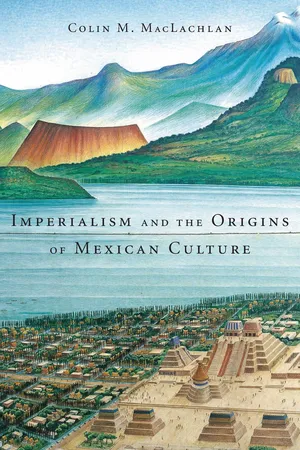
With an empire stretching across central Mexico, unmatched in military and cultural might, the Aztecs seemed poised on the brink of a golden age in the early sixteenth century. But the arrival of the Spanish changed everything. Imperialism and the Origins of Mexican Culture chronicles this violent clash of two empires and shows how modern Mestizo culture evolved over the centuries as a synthesis of Old and New World civilizations.
Colin MacLachlan begins by tracing Spain and Mesoamerica's parallel trajectories from tribal enclaves to complex feudal societies. When the Spanish laid siege to Tenochtitlán and destroyed it in 1521, the Aztecs could only interpret this catastrophe in cosmic terms. With their gods discredited and their population ravaged by epidemics, they succumbed quickly to Spanish control—which meant submitting to Christianity. Spain had just emerged from its centuries-long struggle against the Moors, and zealous Christianity was central to its imperial vision. But Spain's conquistadors far outnumbered its missionaries, and the Church's decision to exclude Indian converts from priesthood proved shortsighted. Native religious practices persisted, and a richly blended culture—part Indian, part Christian—began to emerge.
The religious void left in the wake of Spain's conquests had enduring consequences. MacLachlan's careful analysis explains why Mexico is culturally a Mestizo country while ethnically Indian, and why modern Mexicans remain largely orphaned from their indigenous heritage—the adopted children of European history.
- 342 pages
- English
- ePUB (mobile friendly)
- Available on iOS & Android
eBook - ePub
Imperialism and the Origins of Mexican Culture
About this book
Information
1
MESOAMERICAN CIVILIZATIONS
The Evolution of Mesoamerica
INDO-MEXICO PROVIDED the canvas on which imperial Spain superimposed its historical experience. Consequently, in order to understand the process of the creation of a hybrid Mestizo culture, one must begin with an examination of the important elements of pre-Columbian Mexico that existed prior to the European intrusion. All organized human existence appears to follow a similar path from small groups huddled in caves or under rock formations to more complex conglomerations over time. Early groups were migratory in both Europe and Indo-America. Humans likely began as gatherers before becoming hunters as well as gatherers, followed by settled agriculture and interaction, hostile or otherwise, with others. The elaboration of religion is the key element that makes civilized progress possible. Seeking to explain and control one’s environment is the first step in the elaboration of culture in a collective sense. The intent of spiritual practices in a universe created by gods is the same in spite of the different forms those practices take among others. No human group is unique; consequently, we should not be surprised that the path toward civilization is similar and, on occasion, virtually the same. The encounter in 1519 was not one of Martians with Earthlings, in spite of the initial shock and confusion.
The roots of early Mesoamerican civilizations are lost in prehistory and can only be partially and painstakingly uncovered by archeologists. Their discoveries tend to indicate that early humans were not as primitive as modern society prefers to imagine. Nevertheless, in the absence of recorded histories, one can only speculate broadly. The origin of these early migrants to the Americas is the subject of debate. Many specialists believe that the Western Hemisphere’s early populations crossed a Bering Sea land bridge from Asia, perhaps following migrating herds. Others suggest that there was more than one migration route, including those who argue that Polynesian navigators from the Asia Pacific region, perhaps observing migratory birds, reached the coast of what is now South America.1 Just how long ago such a population movement occurred is another unresolved question. Most geneticists and archeologists agree that Native Americans are descended from Siberians who crossed into America 26,000 to 18,000 years ago via a land bridge over the Bering Strait. But although genetic analysis of modern Native Americans lends support to this idea, strong fossil evidence has been lacking. Now a nearly complete skeleton of a prehistoric teenage girl, with an intact cranium and preserved DNA, newly discovered in an underwater cave in the Yucatán Peninsula, establishes a clear link between the ancient and modern people. Writing in the journal Science, the researchers report that they analyzed mitochondrial-DNA genetic material passed down through the mother that was extracted from the skeleton’s wisdom tooth by divers. Their analysis reveals that the girl, who lived at least 12,000 years ago, belonged to an Asian-derived genetic lineage seen only in Native Americans.2 Older sites with evidence of human habitation, which point to a much longer time frame for the presence of humans in Meso- and South America, are being excavated by teams of archeologists and other specialists. At the same time, material from sites excavated in the twentieth century is being reevaluated to determine if new and previous claims of habitation ranging from 25,000 to 50,000 years ago can be substantiated.3 If the northern land bridge served as the principal population conduit, experts in migration studies estimate that it would have required some 18,000 years to spread the population throughout the Americas as successive waves of migrants crossed into the Western Hemisphere. Similarly, linguistic evidence from the Americas suggests that the older dates are credible; some 140 different languages and 1,200 dialects are spoken, more than anywhere else in the world.4 If these experts are correct, the Yucatan excavations indicate that migrations into the Western Hemisphere began some 40,000 years ago. Although the debate remains unresolved, new dating techniques and comparative analysis is broadening our understanding of the peopling of North and South America.5
Skeletal remains indicate that these hunters and gathers were well nourished, tall, and generally healthy. Given a plentiful supply of game, they must have enjoyed leisure time, a prerequisite for the development of civilizations. Indigenous peoples of Mexico began to breed maize plants selectively around 8000 BC. In 7200 BC, climate change resulted in drier conditions that, coupled with population increases, set the stage for the development of fixed agriculture and pottery. The transition from hunting and gathering supplemented by root agriculture to settled agricultural villages with the ability to support artisanal production took some time.6 Evidence shows a marked increase in pottery working by 2300 BC and the beginning of intensive maize farming between 1800 BC and 1500 BC.
Between 1800 BC and 300 BC, complex cultures began to form. Many matured into advanced pre-Columbian Mesoamerican civilizations such as the Olmec, Zapotec, Maya, Izapa, Teotihuacán, Mixtec, Huastec, Purepecha, Totonac, Tarascan, Toltec, and Mexica (also called Aztec), which flourished for nearly 4,000 years before the first contact with Europeans. According to postconquest accounts gathered from native informants by the Franciscan friar Bernardino de Sahagún, three foundational civilizations preceded that of the Mexica-Aztecs who dominated central Mexico when the Spaniards arrived in the Western Hemisphere. The three dominant civilizations were the Tamoanchán, perhaps the Gulf Coast Olmec, followed by Teotihuacán and the Toltec: a transmission chain of civilized complexity from the Olmecs to the ultimate beneficiary—the Aztec and other contemporary groups.7 We know the cultural development of present-day Mexico was far more complex.
The Olmecs were an ancient pre-Columbian people living in the tropical lowlands of south-central Mexico, roughly in what are the modern-day states of Veracruz and Tabasco on the Isthmus of Tehuantepec. Their immediate cultural influence, however, extended far beyond this region as a result of trade and conquest. The Olmecs flourished during the Formative (or Preclassic) Period, dating from 1600 BC to about 400 BC. Olmec peoples continued to inhabit the region, however, until 100 BC. This Olmec culture is currently considered the prototype civilization of Mesoamerica. The Olmecs may have been the first Mesoamericans to build ceremonial centers. Three ceremonial sites dominated Olmec culture during various periods: San Lorenzo (1600–900 BC), La Venta (900–600 BC), and Tres Zapotes (500–100 BC). These centers originally had only a few permanent residents, including priests and rulers and their staffs. Most of the population continued to live in disbursed settlements and came to these protocities to participate in religious ceremonies, public works projects, trade, and public events. Gradually, ceremonial centers evolved into cities with temples, elite housing, large plazas, housing blocks to accommodate other urban residents, and markets and artisan production sites.
Discoveries in the early twenty-first century, though, have persuaded experts that the Olmecs were the originators of some of the most important aspects of Mesoamerican civilization. Olmec artifacts provide the first evidence of many of the Mesoamerican religious themes and architectural, social, and political structures central to later civilizations. What we know about the Olmec political and social system is based on archeological remains and informed conjecture. That they were a politically organized chieftaincy seems clear: only a highly organized group could have built cities and produced the large stone sculptures that distinguish them; the stones had to be transported from sixty miles away by hand, perhaps utilizing rafts to reach their destination. From very recent evidence, it seems possible that Mesoamerican ball games, calendars, mathematics, astronomy, and even written script had their origins in Olmec times.8
Other regions of southern Mexico, including Oaxaca in southeastern Mexico and the Yucatan Peninsula, developed in a similar trajectory during the Formative Period. In contrast to the Olmec culture, however, in the Classic Period (1200 BC–AD 100), militarism and belligerent domination of distant groups became a central feature of Mesoamerican political dynamics. By the early Classic Period, around 200 BC, the Zapotecs, who inhabited the highland valleys of Oaxaca, attained military and political control of the region. They established their capital at Monte Albán, which dominated the area from 250 BC to AD 700. The city developed extensive trade and cultural relationships with the Olmecs, the Mayans, and the city of Teotihuacán in the Valley of Mexico. Whereas Olmec writing has been verified by symbols found in 2002 and 2006, dating from 650 BC and 900 BC, respectively, Zapotec writing dates from about 400 BC. The earliest known writing in the Mayan script dates from about 250 BC, but the script is thought to have developed at an earlier date.9 Other Mesoamerican cultures began to demonstrate significant advances and borrowings from other cultures,10 although debate continues about the role of the Olmecs, Zapotecs, and Mayans in the development of the concept of the zero and the calendar. Three calendars utilizing an overlapping system were important elements of a number of Mesoamerican cultures by AD 100: the Long Count, a chronological system that began on a specific date in the distant past, which probably commemorated some important actual or mystical event; a 360-day calendar divided into eighteen periods of twenty days with five days added at the end of the year to align it to the solar year; and a 260-day ritual calendar divided into twenty periods of thirteen days. These are but two examples of the intellectual vibrancy that typified Mesoamerican societies.11
The remarkable city of Teotihuacán in central Mexico (ca. 100 BC–AD 750) became the largest city in the Americas during the Classic Period, with an estimated population of 120,000 to 200,000 spread over eight square miles. It was a thriving center of religion and culture, as well as manufacturing, trade, and commerce. The city eventually controlled the trade routes in Mesoamerica. Impressive civil and religious structures dominated the city; their remains continue to awe modern visitors. The priest-rulers who governed the city also carried out grand religious pageants and ceremonies that often involved human sacrifices. Two pyramids dedicated to the sun and the moon, some 200 feet high and covered with frescos, were placed on the wide street of the dead that cut through the city, complemented by another broad east-west thoroughfare, which provided the urban axis. Residents lived in apartment-like structures; the city must have resembled a human anthill. The economy, built on trade and a tribute system, attracted merchants, craft workers, porters, and religious pilgrims. Goods produced in Teotihuacán made their way to virtually every corner of Mesoamerica and perhaps beyond. As was characteristic of Mesoamerican religion, a pantheon of gods was venerated. The cult of Quetzalcóatl (plumed serpent) appears to have reached its distinct form in the city. Although Teotihuacán’s influence waned over time and the city was abandoned, its religious and secular accomplishments continued to influence subsequent Mesoamerican development.12
The successor group, the Toltecs, arrived in the central valley in the ninth century AD, conquered the Otomies of Culhuacán, and subsequently established the Toltec city of Tollan (Tula) in 698. The Toltecs adopted important elements of Teotihuacán’s civilization, including the cult of Quetzalcóatl, while adding aspects of their own. The Toltecs were a militarized chieftaincy, as evidenced by the architecture of Tula’s Temple of the Warriors. Military orders such as those of the Coyotes, the Eagles, and the Jaguar knights provided the professional core of Toltec armies. Their conquest empire extended across a large swath of Mesoamerica, including south to Oaxaca, a colony in Mayan territory at Chichén Itzá, and a northern ring of settlements to protect the central valley from barbarians (Chichimecas) moving southward from the arid north. Toltec traders traveled into what is now the American Southwest for turquoise and into Central America for quetzal feathers.13
Somewhere along the way, the cult of Quetzalcóatl was transformed into a moral death struggle personified by the plumed serpent as virtue and with evil in the form of Tezcatlipoca, the feared smoking mirror, who supported human sacrifice and warfare. According to one of several myths, Quetzalcóatl was seduced at the instigation of Tezcatlipoca, resulting in a gross violation of his priestly status. A disgraced Quetzalcóatl left Tula and traveled to the Gulf Coast, where he sailed away on a serpent raft, vowing to return and destroy his enemies. Another version is that he set himself on fire. The notion of an avenging return appears to have had the most currency. The myth has aspects of expulsion similar to that of Adam and Eve, as well as a threatened apocalyptic ending.14
The Toltec empire experienced the same fate as Teotihuacán before it. Drought in the north propelled desperate waves of Chichimecas against the city of Tula, relentlessly crippling its economy, physically demolishing its grandeur, and forcing the survivors to become refugees. The last paramount Toltec chief, Huémac, abandoned the city, moving deep into the Valley of Mexico, where he committed suicide. Toltec remnants gradually mixed with other groups and exited history. Violence once again had served to disperse cultural fragments widely across Mesoamerica.15
An idealized characterization of the Toltecs emerged that presented them as a people who excelled in the arts and fine crafts, as well as in commerce, architecture, and agricultural sciences. Indo-Mexicans had a valid claim to being their heirs. For the Aztecs, the Toltec mantle served as a means of legitimizing their imperial ambitions. In the great Templo Mayor, the Mexica kept objects, some 7,000 gifts offered to the gods, including many from tributaries. Of more significance were masks from Teotihuacán and the Olmecs who preceded the Toltecs, but not one item from the Mayans or the Tarascans. The Mexica used the sacred compound to integrate an imagined past and into a religiopolitical imperial culture.16
The Mexica Road to Empire
The progression of the seminomadic Mexica from a difficult existence in the arid north to central Mexico represented a pattern previously followed by many others. The great basin of central Mexico, which today includes the Federal District, the Mexican states of Mexico, Morelos, Hidalgo, Puebla, and Tlaxcala, is an area of 2,500 square miles, bounded by low hills in the north and high mountains to the east, west, and south. Most of it is at an elevation of over 7,000 feet with a corresponding temperate climate. Reasonably well-watered valleys with alluvial soils subdivide the central region. It functioned as one of the world’s cradles of civilizations along the lines of the lower Tigris-Euphrates river valley.
How long ago the Mexica started their journey and from where and why is a mystery. We know that Nahuatl is a Uto-Aztecan language related to indigenous groups in what is now the American Southwest. T...
Table of contents
- Cover
- Title Page
- Copyright
- Dedication
- Contents
- Prologue
- Introduction
- 1. Mesoamerican Civilizations: The Evolution of Mesoamerica
- 2. The Formation of Euro-Spanish Culture: Iberia Enters History
- 3. Moors and Christians: A Fateful Encounter
- 4. Creating Mestizo Mexico: The Philosophical Challenge of America
- Conclusion
- Notes
- Bibliography
- Acknowledgments
- Index
Trusted by 375,005 students
Access to over 1.5 million titles for a fair monthly price.
Study more efficiently using our study tools.
Frequently asked questions
Yes, you can cancel anytime from the Subscription tab in your account settings on the Perlego website. Your subscription will stay active until the end of your current billing period. Learn how to cancel your subscription
No, books cannot be downloaded as external files, such as PDFs, for use outside of Perlego. However, you can download books within the Perlego app for offline reading on mobile or tablet. Learn how to download books offline
Perlego offers two plans: Essential and Complete
- Essential is ideal for learners and professionals who enjoy exploring a wide range of subjects. Access the Essential Library with 800,000+ trusted titles and best-sellers across business, personal growth, and the humanities. Includes unlimited reading time and Standard Read Aloud voice.
- Complete: Perfect for advanced learners and researchers needing full, unrestricted access. Unlock 1.5M+ books across hundreds of subjects, including academic and specialized titles. The Complete Plan also includes advanced features like Premium Read Aloud and Research Assistant.
We are an online textbook subscription service, where you can get access to an entire online library for less than the price of a single book per month. With over 1.5 million books across 990+ topics, we’ve got you covered! Learn about our mission
Look out for the read-aloud symbol on your next book to see if you can listen to it. The read-aloud tool reads text aloud for you, highlighting the text as it is being read. You can pause it, speed it up and slow it down. Learn more about Read Aloud
Yes! You can use the Perlego app on both iOS and Android devices to read anytime, anywhere — even offline. Perfect for commutes or when you’re on the go.
Please note we cannot support devices running on iOS 13 and Android 7 or earlier. Learn more about using the app
Please note we cannot support devices running on iOS 13 and Android 7 or earlier. Learn more about using the app
Yes, you can access Imperialism and the Origins of Mexican Culture by Colin M. MacLachlan in PDF and/or ePUB format, as well as other popular books in History & European History. We have over 1.5 million books available in our catalogue for you to explore.