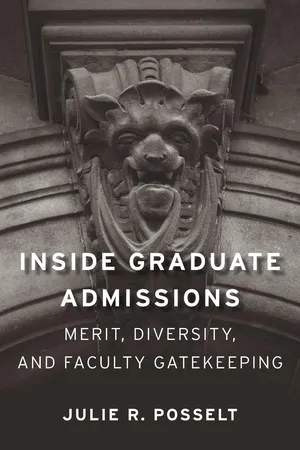
How does graduate admissions work? Who does the system work for, and who falls through its cracks? More people than ever seek graduate degrees, but little has been written about who gets in and why. Drawing on firsthand observations of admission committees and interviews with faculty in 10 top-ranked doctoral programs in the humanities, social sciences, and natural sciences, education professor Julie Posselt pulls back the curtain on a process usually conducted in secret.
"Politicians, judges, journalists, parents and prospective students subject the admissions policies of undergraduate colleges and professional schools to considerable scrutiny, with much public debate over appropriate criteria. But the question of who gets into Ph.D. programs has by comparison escaped much discussion. That may change with the publication of Inside Graduate Admissions…While the departments reviewed in the book remain secret, the general process used by elite departments would now appear to be more open as a result of Posselt's book."
—Scott Jaschik, Inside Higher Ed
"Revealing…Provide[s] clear, consistent insights into what admissions committees look for."
—Beryl Lieff Benderly, Science
- 258 pages
- English
- ePUB (mobile friendly)
- Available on iOS & Android
eBook - ePub
About this book
Information
Publisher
Harvard University PressYear
2016Print ISBN
9780674984042
9780674088696
eBook ISBN
9780674915664
Topic
EducationSubtopic
Education AdministrationIntroduction
Gatekeeping Reconsidered
FOR THREE HOURS the philosophy admissions committee had been working in a cramped storage room that doubled as their meeting space. They had been discussing applicants on their short list, one by one, but had reached a point of deadlock over who should ultimately receive offers. Breaking a long silence that betrayed the group’s exhaustion, their administrative assistant, Leon,1 spoke up for the first time. He noted that agreeing to admit everyone who received an average rating of 1.8 or higher would give them their desired cohort size: the lucky 13. Their work would be done. No one jumped at the idea, but the committee chair, Liana, and a senior professor, Olivia, expressed their support. Another senior professor, Gerald, wasn’t so sure.
“People seem to be very confident about the line where admissible leaves off and inadmissible picks up,” he said. “I have a hard time drawing lines because wherever we draw it, it’s going to look arbitrary.”
Olivia emphatically responded, “Well, it is an artificial line!”
Continuing to push, Leon noted that drawing the line at a rating of 2.4 would finish the job even more quickly by giving them the optimal number of admitted and wait-listed students. A long pause and a few sighs and shoulder shrugs later, they agreed to use this threshold and started packing up.2
There is a story behind every statistic—including the lucky 13, the 2.4 rating, and the 18 percent of applicants admitted to research doctoral programs nationally.3 This book tells the story of how faculty in ten top-ranked doctoral programs draw the almost imperceptibly fine line between those whom they admit and those whom they reject. Two years of observing and interviewing graduate admissions committees in core academic disciplines—astrophysics, biology, classics, economics, linguistics, philosophy, physics, political science, sociology—gave me a unique window into the evaluation and selection processes that go into graduate admissions. My research revealed faculty members’ nebulous, shifting ideals about student quality; how departmental, disciplinary, and personal priorities are woven into judgments of admissibility; and the implications of it all for equity and the health of the academy.
Changes in society, the applicant pool, and the labor market have fundamentally altered the markets for graduate education and for people with graduate degrees, yet the criteria associated with admission to degree programs have changed little. Of the three strongest determinants of access to graduate education—college grades, Graduate Record Examination (GRE) scores, and the reputation of a student’s undergraduate institution—the latter two are part of a conventional notion of student quality that fails on at least two counts.4 GRE scores and college prestige fail to reliably predict whether a student will complete the PhD, and disproportionately exclude some of the very groups whom our mission statements and websites claim we wish to attract. What is more, the structure of the academy in the twenty-first century will not sustain many of the positions that admissions decision makers themselves hold...
Table of contents
- Cover
- Title Page
- Copyright
- Dedication
- Contents
- Preface
- Introduction: Gatekeeping Reconsidered
- One. Decision Making as Deliberative Bureaucracy
- Two. Meanings of Merit and Diversity
- Three. Disciplinary Logics
- Four. Mirror, Mirror
- Five. The Search for Intelligent Life
- Six. International Students and Ambiguities of Holistic Review
- Conclusion: Merit beyond the Mirror
- Methodological Appendix
- Notes
- References
- Acknowledgments
- Index
Trusted by 375,005 students
Access to over 1.5 million titles for a fair monthly price.
Study more efficiently using our study tools.
Frequently asked questions
Yes, you can cancel anytime from the Subscription tab in your account settings on the Perlego website. Your subscription will stay active until the end of your current billing period. Learn how to cancel your subscription
No, books cannot be downloaded as external files, such as PDFs, for use outside of Perlego. However, you can download books within the Perlego app for offline reading on mobile or tablet. Learn how to download books offline
Perlego offers two plans: Essential and Complete
- Essential is ideal for learners and professionals who enjoy exploring a wide range of subjects. Access the Essential Library with 800,000+ trusted titles and best-sellers across business, personal growth, and the humanities. Includes unlimited reading time and Standard Read Aloud voice.
- Complete: Perfect for advanced learners and researchers needing full, unrestricted access. Unlock 1.5M+ books across hundreds of subjects, including academic and specialized titles. The Complete Plan also includes advanced features like Premium Read Aloud and Research Assistant.
We are an online textbook subscription service, where you can get access to an entire online library for less than the price of a single book per month. With over 1.5 million books across 990+ topics, we’ve got you covered! Learn about our mission
Look out for the read-aloud symbol on your next book to see if you can listen to it. The read-aloud tool reads text aloud for you, highlighting the text as it is being read. You can pause it, speed it up and slow it down. Learn more about Read Aloud
Yes! You can use the Perlego app on both iOS and Android devices to read anytime, anywhere — even offline. Perfect for commutes or when you’re on the go.
Please note we cannot support devices running on iOS 13 and Android 7 or earlier. Learn more about using the app
Please note we cannot support devices running on iOS 13 and Android 7 or earlier. Learn more about using the app
Yes, you can access Inside Graduate Admissions by Julie R. Posselt in PDF and/or ePUB format, as well as other popular books in Education & Education Administration. We have over 1.5 million books available in our catalogue for you to explore.