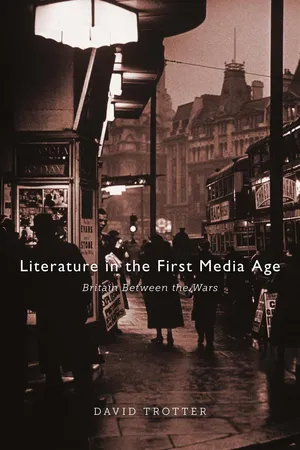
The period between the World Wars was one of the richest and most inventive in the long history of British literature. Interwar literature, David Trotter argues, stood apart by virtue of the sheer intelligence of the enquiries it undertook into the technological mediation of experience. After around 1925, literary works began to portray communication by telephone, television, radio, and sound cinema—and to examine the sorts of behavior made possible for the first time by virtual interaction. And they filled up, too, with the look, sound, smell, taste, and feel of the new synthetic and semi-synthetic materials that were reshaping everyday modern life.
New media and new materials gave writers a fresh opportunity to reimagine both how lives might be lived and how literature might be written. Today, Trotter observes, such material and immaterial mediations have become even more decisive. Communications technology is an attitude before it is a machine or a set of codes. It is an idea about the prosthetic enhancement of our capacity to communicate. The writers who first woke up to this fact were not postwar, postmodern, or post-anything else: some of the best of them lived and wrote in the British Isles in the period between the World Wars. In defining what they achieved, this book creates a new literary canon of works distinguished formally and thematically by their alertness to the implications of new media and new materials.
- English
- ePUB (mobile friendly)
- Available on iOS & Android
eBook - ePub
About this book
Information
Notes
Introduction
1. Ralph Waldo Emerson, Society and Solitude, Collected Works, vol. 7, ed. Douglas Emory Wilson and Ronald A. Bosco (Cambridge, MA: Belknap Press of Harvard University Press, 2007), 81.
2. William Uricchio, “Historicizing Media in Transition,” in Rethinking Media Change: The Aesthetics of Transition, ed. David Thorburn and Henry Jenkins (Cambridge, MA: MIT Press, 2004), 23–38, p. 24.
3. Lisa Gitelman, Always Already New: Media, History, and the Data of Culture (Cambridge, MA: MIT Press, 2006), 7. I am also indebted to Carolyn Marvin, When Old Technologies Were New: Thinking about Electric Communication in the Late 19th Century (New York: Oxford University Press, 1988); and Jonathan Sterne, The Audible Past: Cultural Origins of Sound Reproduction (Durham, NC: Duke University Press, 2006).
4. Uricchio, “Historicizing Media,” 26.
5. Ann L. Ardis and Patrick Collier, eds., Transatlantic Print Culture, 1880–1940: Emerging Media, Emerging Modernisms (Basingstoke: Palgrave Macmillan, 2008).
6. Garrett Stewart, Between Film and Screen: Modernism’s Photo Synthesis (Chicago: University of Chicago Press, 1999); Sara Danius, The Senses of Modernism: Technology, Perception, and Aesthetics (Ithaca, NY: Cornell University Press, 2002); David Trotter, Cinema and Modernism (Oxford: Wiley-Blackwell, 2007); Laura Marcus, The Tenth Muse: Writing about Cinema in the Modernist Period (Oxford: Oxford University Press, 2010); Andrew Shail, Cinema and the Origins of Literary Modernism (London: Routledge, 2012).
7. Todd Avery, Radio Modernism: Literature, Ethics, and the BBC, 1922–1938 (Aldershot: Ashgate, 2006); Debra Rae Cohen, Michael Coyle, and Jane Lewty, eds., Broadcasting Modernism (Gainesville: University Press of Florida, 2009).
8. Tim Armstrong, Modernism (Cambridge: Polity Press, 2005), 109–14; Melba Cuddy-Keane, “Virginia Woolf, Sound Technologies, and the New Aurality,” in Virginia Woolf in the Age of Mechanical Reproduction, ed. Pamela L. Caughie (New York: Garland, 2000), 69–96; Ivan Kreilkamp, “A Voice without a Body: The Phonographic Logic of Heart of Darkness,” Victorian Studies 40, no. 2 (1997): 211–43; John M. Picker, Victorian Soundscapes (Oxford: Oxford University Press, 2003), 110–45; Juan A. Suárez, Pop Modernism: Noise and the Reinvention of Everyday Life (Urbana: University of Illinois Press, 2007), 119–40.
9. John Brooks, Telephone: The First Hundred Years (New York: Harper & Row, 1976); Ithiel de Sola Pool, ed., The Social Impact of the Telephone (Cambridge, MA: MIT Press, 1977); Claude S. Fischer, America Calling: A Social History of the Telephone to 1940 (Berkeley: University of California Press, 1992). For a cogent revisionist approach, see Robert MacDougall, “Long Lines: AT&T’s Long-Distance Network as an Organizational and Political Strategy,” Business History Review 80 (2006): 297–327; and Richard R. John, Network Nation: Inventing American Telecommunications (Cambridge, MA: Harvard University Press, 2010).
10. Donald Crafton, The Talkies: American Cinema’s Transition to Sound, 1926–1931 (Berkeley: University of California Press, 1997), 34. See also Paul Starr, The Creation of the Media: Political Origins of Modern Communications (New York: Basic Books, 2004), ch. 6.
11. Roland Marchand, Creating the Corporate Soul: The Rise of Public Relations and Corporate Strategy in American Big Business (Berkeley: University of California Press, 1998), ch. 3.
12. Facts from “A History of the British Post Office,” http://web.online.co.uk/freshwater/bpo.htm.
13. F. G. C. Baldwin, The History of the Telephone in the United Kingdom (London: Chapman & Hall, 1925), 615–18.
14. Asa Briggs and Peter Burke, A Social History of the Media: From Gutenberg to the Internet (Cambridge: Polity Press, 2002), 152.
15. Raymond Williams, Television: Ideology and Cultural Form, 2nd ed. (London: Routledge, 1990), 26.
16. Avital Ronell, The Telephone Book: Technology—Schizophrenia—Electric Speech (Lincoln: University of Nebraska Press, 1989); Jacques Derrida, “Ulysses Gramophone: Hear say yes in Joyce,” in Acts of Literature, trans. Tina Kendall, ed. Derek Attridge (New York: Routledge, 1992), 253–309, pp. 266, 269; Laurence A. Rickels, Aberrations of Mourning: Writing on German Crypts (Detroit: Wayne State University Press, 1988), 279–93.
17. Eileen Bowser, “Le coup de téléphone dans le primitif du cinéma,” in Les premiers ans du cinéma français, ed. Pierre Guibbert (Perpignan: Institute Jean Vigo, 1985), 218–24; Tom Gunning, “Heard over the Phone: The Lonely Villa and the de Lorde Tradition of the Terrors of Technology,” Screen 32, no. 2 (1991): 184–96; Jan Olsson, “Framing Silent Calls: Coming to Cinematographic Terms with Telephony,” in Allegories of Communication: Intermedial Concerns from Cinema to the Digital, ed. John Fullerton and Jan Olsson (Rome: John Libbey Publishing, 2004), 157–92.
18. Richard Menke, Telegraphic Realism: Victorian Fiction and Other Information Systems (Stanford, CA: Stanford University Press, 2008), 10–11, 3. Mark Goble, starting where Menke leaves off, with Henry James, has taken this story up in compelling fashion. For Goble, American literary Modernism’s desire for communication provoked an avid interest in, precisely, photography, cinema, the telephone, and the gramophone. The writers he investigates, from James through Gertrude Stein, William Carlos Williams, F. Scott Fitzgerald, and James Weldon Johnson to George Oppen and James Agee, “manifest a sha...
Table of contents
- Cover
- Half Title
- Title Page
- Copyright
- Contents
- Introduction
- One: Telephony
- Two: Techno-Primitivism
- Three: Thermoplastic
- Four: Talkativeness
- Five: Transit Writing
- Conclusion
- Notes
- Index
Trusted by 375,005 students
Access to over 1.5 million titles for a fair monthly price.
Study more efficiently using our study tools.
Frequently asked questions
Yes, you can cancel anytime from the Subscription tab in your account settings on the Perlego website. Your subscription will stay active until the end of your current billing period. Learn how to cancel your subscription
No, books cannot be downloaded as external files, such as PDFs, for use outside of Perlego. However, you can download books within the Perlego app for offline reading on mobile or tablet. Learn how to download books offline
Perlego offers two plans: Essential and Complete
- Essential is ideal for learners and professionals who enjoy exploring a wide range of subjects. Access the Essential Library with 800,000+ trusted titles and best-sellers across business, personal growth, and the humanities. Includes unlimited reading time and Standard Read Aloud voice.
- Complete: Perfect for advanced learners and researchers needing full, unrestricted access. Unlock 1.5M+ books across hundreds of subjects, including academic and specialized titles. The Complete Plan also includes advanced features like Premium Read Aloud and Research Assistant.
We are an online textbook subscription service, where you can get access to an entire online library for less than the price of a single book per month. With over 1.5 million books across 990+ topics, we’ve got you covered! Learn about our mission
Look out for the read-aloud symbol on your next book to see if you can listen to it. The read-aloud tool reads text aloud for you, highlighting the text as it is being read. You can pause it, speed it up and slow it down. Learn more about Read Aloud
Yes! You can use the Perlego app on both iOS and Android devices to read anytime, anywhere — even offline. Perfect for commutes or when you’re on the go.
Please note we cannot support devices running on iOS 13 and Android 7 or earlier. Learn more about using the app
Please note we cannot support devices running on iOS 13 and Android 7 or earlier. Learn more about using the app
Yes, you can access Literature in the First Media Age by David Trotter in PDF and/or ePUB format, as well as other popular books in Literature & 20th Century History. We have over 1.5 million books available in our catalogue for you to explore.