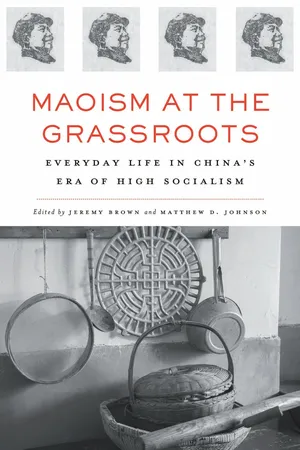
The Maoist state's dominance over Chinese society, achieved through such watersheds as the Great Leap Forward and the Cultural Revolution, is well known. Maoism at the Grassroots reexamines this period of transformation and upheaval from a new perspective, one that challenges the standard state-centered view. Bringing together scholars from China, Europe, North America, and Taiwan, this volume marshals new research to reveal a stunning diversity of individual viewpoints and local experiences during China's years of high socialism.
Focusing on the period from the mid-1950s to 1980, the authors provide insights into the everyday lives of citizens across social strata, ethnicities, and regions. They explore how ordinary men and women risked persecution and imprisonment in order to assert personal beliefs and identities. Many displayed a shrewd knack for negotiating the maze-like power structures of everyday Maoism, appropriating regime ideology in their daily lives while finding ways to express discontent and challenge the state's pervasive control.
Heterogeneity, limited pluralism, and tensions between official and popular culture were persistent features of Maoism at the grassroots. Men had gay relationships in factory dormitories, teenagers penned searing complaints in diaries, mentally ill individuals cursed Mao, farmers formed secret societies and worshipped forbidden spirits. These diverse undercurrents were as representative of ordinary people's lives as the ideals promulgated in state propaganda.
eBook - ePub
Maoism at the Grassroots
Everyday Life in China’s Era of High Socialism
- 468 pages
- English
- ePUB (mobile friendly)
- Available on iOS & Android
eBook - ePub
Maoism at the Grassroots
Everyday Life in China’s Era of High Socialism
About this book
Information
Part I
Crimes, Labels, and Punishment
1
How a “Bad Element” Was Made
The Discovery, Accusation, and Punishment of Zang Qiren
YANG KUISONG
The term “bad element” (huaifenzi) has a history of use by both the Nationalist and Communist Parties. Initially, it was a general reference to all corrupt, degenerate, and opportunistic “elements.” Later, it became a specific term in Communist Party documents, referring to all people whose actions were vile and thoughts impure, and who had a damaging effect on the Party’s work.
Party Center issued an official document defining the differences between “counterrevolutionary elements” and “other bad elements” on March 10, 1956. The document noted, however, that “all counterrevolutionary elements are bad elements.” Based on this definition, the “other bad elements” referred to those outside the group of people who had been investigated and proven to be “counterrevolutionaries”—“political imposters,” “traitorous elements,” “hooligan elements,” and “degenerate elements of extremely vile character.”1
In 1957 Mao Zedong categorized huaifenzi as criminals. In Mao’s words, dictatorship was to be imposed on all “thieves, swindlers, murderers and arsonists, hooligans’ organizations, and elements that cause serious harm to socialism.”2 But because most huaifenzi “harmed socialism” indirectly, they were different from “counterrevolutionaries,” who stood in direct opposition to the Party. Therefore, the conviction and sentencing rates of huaifenzi were usually lighter than the punishments meted out to counterrevolutionaries. But because huaifenzi still “cause[d] serious harm to socialism” from a class struggle standpoint, the regime treated these people and class enemies as birds of a feather. As a result, policies toward huaifenzi were similar to those governing counterrevolutionaries. The authorities usually deprived these people of their political rights and personal freedoms, handing them over to local governments through which they would undergo reform through labor or supervised reeducation.
Even by the standards of the time, however, the definition of huaifenzi was broad, and the factors leading to conviction were numerous and complex. Many criminals did not necessarily oppose socialism, and many of them fell afoul of the political system and its policies without necessarily committing “bad” acts. It is therefore worthwhile for historians to question just how bad convicted “bad elements” actually were and to what extent they may have opposed socialism. This chapter tells the story of a “bad element” whose badness was ambiguous and contested.
A Bright Future
Zang Qiren was born on August 26, 1925, in Lishui County, Jiangsu Province. His family belonged to the class of urban poor, and his father, Zang Nansheng, was a low-ranking clerk in charge of grain receipts in the county government’s land tax office. After the junior Zang’s mother died in the wartime chaos of 1937, the senior Zang remarried, after which time the entire Zang family, which included younger brothers and sisters, subsisted on Zang Nansheng’s tiny income. With his schooling cut short by financial difficulties, Zang Qiren worked for a living from age fifteen onward—as an apprentice in a cigarette factory and a sock factory, an intermittent hawker, an intern at the Kunshan Public Roads Bureau, and finally as a bus conductor. When Nanjing was occupied by Communist Party forces in 1949, Zang had already lived a difficult life. Recruited on the day of his twenty-fourth birthday into the Lishui County Grain Bureau as a tax collector, Zang soon became an enthusiastic supporter of the new society and its politics and applied on his own volition to join the New Democracy Youth Corps.3
Zang’s fortunes changed again in April 1951, when arrangements were made for him to be transferred to a factory in Nanjing as a temporary worker. He was soon promoted to a permanent position. Zang’s new job coincided with the Campaign to Suppress Counterrevolutionaries. Responding to the campaign’s emphasis on placing loyalty to the Party above all, Zang reported to the authorities that the landlord relatives of the very person who had secured him a new job in Nanjing were then hiding in Nanjing. Zang also reported his mother’s cousin for possessing firearms.4 While the campaign raged on, Zang devoted his own spare time to studying and to improving his coworkers’ literacy. The factory named Zang “Excellent Anti-Illiteracy Teacher” for three consecutive years from 1954 to 1956, and he was elected to the organizing committee of the factory Youth Corps.
In 1956 Zang’s factory was relocated from Nanjing to Xuchang in Henan Province. By this time Zang had married, but his new wife, who worked at the looms in a wool factory, was unable to make the trip with her husband because of her own family circumstances. Zang, now a Youth Corps cadre and confidante of the factory’s Communist Party secretary, responded enthusiastically to this impending assignment. Although his wife had given birth to their first child only a few months before, Zang did not exercise his right to request that he remain in Nanjing and instead worked hard with little outward complaint. Regularly exceeding both quotas and expectations, Zang’s good fortune continued after the factory finally moved to Xuchang. He was elected vice-chairman of the factory workers’ union and was a representative at Xuchang’s fourth union congress. In 1957 he received the Union Activist Award, Second Level.5
Zang had reached the apex of his political career. At the same time, however, a change in factory leadership and worker dissatisfaction brought about by the move to Xuchang had transformed the factory’s political atmosphere. When a new rectification campaign unfolded alongside the Hundred Flowers and Anti-Rightist Movements, mobilizing ordinary people to criticize bureaucratism within the upper ranks, Zang Qiren began to make his first series of mistakes—mistakes that, given Zang’s personality and experience, seem surprising.
A Guilty Conscience
Zang Qiren was short, with small, elongated eyes and a natural smile. His easygoing appearance allowed him to mix comfortably with his coworkers, even if Zang himself spoke infrequently. Although Zang had a strong sense of self-esteem, he was sensitive and became hesitant when he encountered problems. Documents that Zang wrote over the years confirm that he viewed this particular trait as his most significant shortcoming, noting that “I do not take setbacks well” and “I have the weakly cowardice of the petty bourgeoisie.” Zang’s superiors agreed. In their eyes, although Zang “sought to improve himself” and “had a positive work attitude” most of the time, he had a “weak capacity for struggle,” “could not take criticism,” and “possessed certain petty bourgeois thinking.”6
Zang’s personality had a lot to do with his past. When asked to write up his personal history during each of the political campaigns of the 1950s, Zang’s résumé always looked the same:
September 1938–June 1940: Stopped schooling because of the Japanese invasion.
September 1940–June 1942: Studied and completed education at Lishui Model Elementary School.
September 1942–June 1944: Studied at Lishui Normal Junior High School; schooling interrupted because of family difficulties.
October 1944–June 1945: Apprentice at XX Socks Factory in Nanjing; left because of bullying.
September 1945–August 1946: Medic trainee at Shaoxing Zhangzhen Civilians’ Hospital; dismissed.
January 1947–June 1948: Trainee at Kunshan bus station of the Public Roads Bureau; dismissed.
July 1948–March 1949: Unemployed; became a hawker.
August 1949–April 1951: Lishui Grain Bureau, municipal and district governments; drew up books and accounts; helped with tax collection during summer and fall harvests.
April 1951–present: Washer, Decorations Department [penhua bu, xiban] XX Factory, Nanjing.7
This matter-of-fact narrative concealed several details that Zang held back even when called on to confess and reconfess his personal history. Zang’s 1953 election to the factory’s Youth Corps Organization Committee had brought him good political standing and a sense of satisfaction. But it also made his superiors pay more attention to him, contributing to his unease. He was especially nervous about speaking to his superiors. The situation went on for several months before Zang submitted a resignation letter in May 1953:
Lacking sufficient knowledge of political theory and work experience, I cannot progress in my work and lack confidence. . . . I have little time to connect deeply with the masses, with the serious outcome that I have cut myself off from them. For this reason, I have had many criticisms directed at me from the Youth Corps. Some people say I am selfish because I am only concerned about my own education. In addition, after getting married last year I have had many family problems, and these have taken up part of my time. The above reasons have made me depressed, and my attitude toward work has become worse. For the sake of my other responsibilities, I wish to resign from my posts in the Youth Corps and to be replaced by another Organization Committee member chosen by the branch who will play a leading role in educating young workers, striving ahead with them and improving links with the masses.8
The letter’s fluency and cohesion (most workers in Zang’s factory were illiterate or had received only an elementary school education) drew the attention of factory Communist Party secretary Wan Shihong, who took time to counsel and encourage his distraught young subordinate. During his spare time, Secretary Wan would seek out Zang for conversation and a game of table tennis. With Wan as a mentor, Zang’s work in the Youth Corps once again began to progress, and he was promoted to the position of acting branch secretary. Zang’s resignation was postponed for less than a year, however, before his anxiety returned, and he abruptly quit the Youth Corps with the excuse that he had become too old to continue.
What Zang did not realize was that his experience and position as branch secretary would make it impossible for him to ever reclaim normal worker status. In January 1955 he was asked to complete a cadre résumé form, implying that the factory bureaucracy still considered him a political functionary. In the context of the ensuing Campaign to Eliminate Counterrevolutionaries—in full swing by summer that year—this meant that Zang was subject to investigation as a potential “bully, spy, and counterrevolutionary” and was a candidate for expulsion from the cadre ranks. For personnel in leading positions, every blemish in one’s personal history had to be checked. As an ordinary worker, Zang might have remained untouched by the movement. Yet coupled with his guilty conscience, the compulsory review soon forced him into a surprising confession. As more people from the factory, including some he knew well, became targets of the purge, Zang’s resolve broke down. In September 1956 he confessed to the Party branch that before 1949 he had been “forced by life’s circumstances to work on the other side” and that he had thereafter concealed this fact from the organization.9
Historical Problems
What specifically had Zang done wrong? According to his written confession he had (1) underreported his age by two years during the time of the Japanese occupation for fear of being conscripted and had never corrected the deception; (2) during the Anti-Japanese War, he had been forced by the Nationalist Army to become a medic, deserted, then returned when he was unable to survive without his military connections, and also worked as a tax collector; (3) also during this period, he had joined a secret organization called “Ten Sworn Brothers” and pledged loyalty to a leader called the “Old Man.” Zang’s revised personal history also reflected the new revelations:
August 1932–June 1937: Fifth Grade, Lishui Normal Affiliated Elementary School.
August 1937–June 1938: Took refuge from the war in Maoshixiang.
August 1938–June 1940: Completed elementary education at Lishui Model Elementary School; enrolled at Lishui Normal Junior High School.
June 1940–September 1940: Left school, remained at home.
September 1940–November 1940: Apprentice, XX Cigarette Factory, Nanjing.
November 1940–August 1941: Unemployed, at home.
August 1941–June 1942: Apprentice, XX Socks Factory, XX Road, Nanjing.
June 1942–April 1943: Medic, 89th Regiment Civilians’ Hospital, Zhangzhen, Shaoxing County.
May 1943–September 1943: Unemployed, at home.
September 1943–June 1944: Medic, 88th Regiment Rear Hospital, Tianjiashan, Shangyu County.
June 1944–August 1944: Unemployed, at home.
August 1944–January 1945: Revenue Department, 88th Regiment, Jinjishan, Xiaoshan County.
January 1945–May 1945: Unemployed, left home.
May 1945–April 1946: Unemployed, at home.
May 1946–January 1947: Hawker, Suzhou.
January 1947–June 1948: Trainee, Kunshan Public Roads Bureau.
July 1948–March 1949: Bus conductor, Kuntai Bus Station.
April 1949–August 1949: Cigarette stallholder, Lishui.
August 1949–April 1951: Assisted with tax collection, Lishui Grain Bureau.
April 1951–present: Joined factory.10
In his written confession, Zang Qiren reiterated several times that the Nationalist troops he had joined were engaged in combat with the Japanese behind enemy lines. His first encounter with the army was after he had left the XX Socks Factory in Nanjing and was traveling to Zhejiang in search of his relatives. While on a boat from Xiaoshan to Zhangzhen, Zang was captured by scouts of the 89th Regiment of the Nationalist Army’s 30th Brigade and was forcibly impressed into the regiment’s medical unit, where he became a medic. After a few months, Zang escaped home but could not get along with his stepmother or stand the scorn of his neighbors, so he left. Unable to find a new job, he then worked as a medic for a new unit, the 88th Regiment, for several months. Finding life in the military too arduous, Zang managed to secure a new job as a tax collector through his network of pers...
Table of contents
- Cover
- Title Page
- Copyright
- Contents
- Introduction
- Part I. Crimes, Labels, and Punishment
- Part II. Mobilization
- Part III. Culture and Communication
- Part IV. Discontent
- Epilogue: Mao’s China—Putting Politics in Perspective
- Notes
- Contributors
- Acknowledgments
- Index
Trusted by 375,005 students
Access to over 1.5 million titles for a fair monthly price.
Study more efficiently using our study tools.
Frequently asked questions
Yes, you can cancel anytime from the Subscription tab in your account settings on the Perlego website. Your subscription will stay active until the end of your current billing period. Learn how to cancel your subscription
No, books cannot be downloaded as external files, such as PDFs, for use outside of Perlego. However, you can download books within the Perlego app for offline reading on mobile or tablet. Learn how to download books offline
Perlego offers two plans: Essential and Complete
- Essential is ideal for learners and professionals who enjoy exploring a wide range of subjects. Access the Essential Library with 800,000+ trusted titles and best-sellers across business, personal growth, and the humanities. Includes unlimited reading time and Standard Read Aloud voice.
- Complete: Perfect for advanced learners and researchers needing full, unrestricted access. Unlock 1.5M+ books across hundreds of subjects, including academic and specialized titles. The Complete Plan also includes advanced features like Premium Read Aloud and Research Assistant.
We are an online textbook subscription service, where you can get access to an entire online library for less than the price of a single book per month. With over 1.5 million books across 990+ topics, we’ve got you covered! Learn about our mission
Look out for the read-aloud symbol on your next book to see if you can listen to it. The read-aloud tool reads text aloud for you, highlighting the text as it is being read. You can pause it, speed it up and slow it down. Learn more about Read Aloud
Yes! You can use the Perlego app on both iOS and Android devices to read anytime, anywhere — even offline. Perfect for commutes or when you’re on the go.
Please note we cannot support devices running on iOS 13 and Android 7 or earlier. Learn more about using the app
Please note we cannot support devices running on iOS 13 and Android 7 or earlier. Learn more about using the app
Yes, you can access Maoism at the Grassroots by Jeremy Brown, Jeremy Brown,Matthew D. Johnson in PDF and/or ePUB format, as well as other popular books in History & Chinese History. We have over 1.5 million books available in our catalogue for you to explore.