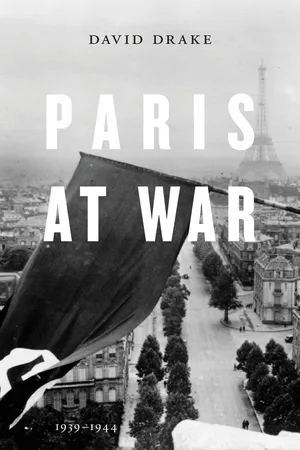
Paris at War chronicles the lives of ordinary Parisians during World War II, from September 1939 when France went to war with Nazi Germany to liberation in August 1944. Readers will relive the fearful exodus from the city as the German army neared the capital, the relief and disgust felt when the armistice was signed, and the hardships and deprivations under Occupation. David Drake contrasts the plight of working-class Parisians with the comparative comfort of the rich, exposes the activities of collaborationists, and traces the growth of the Resistance from producing leaflets to gunning down German soldiers. He details the intrigues and brutality of the occupying forces, and life in the notorious transit camp at nearby Drancy, along with three other less well known Jewish work camps within the city.
The book gains its vitality from the diaries and reminiscences of people who endured these tumultuous years. Drake's cast of characters comes from all walks of life and represents a diversity of political views and social attitudes. We hear from a retired schoolteacher, a celebrated economist, a Catholic teenager who wears a yellow star in solidarity with Parisian Jews, as well as Resistance fighters, collaborators, and many other witnesses.
Drake enriches his account with details from police records, newspapers, radio broadcasts, and newsreels. From his chronology emerge the broad rhythms and shifting moods of the city. Above all, he explores the contingent lives of the people of Paris, who, unlike us, could not know how the story would end.
- 550 pages
- English
- ePUB (mobile friendly)
- Available on iOS & Android
eBook - ePub
About this book
Information
1
The Phoney War
SEPTEMBER 3, 1939–MAY 10, 1940
WHEN THE POET Paul Valéry heard the news that France was at war, he reacted by mimicking the speaking clock: “At the fourth stroke it will be the end of the world precisely.”1 The journalist Geneviève Tabouis was equally fatalistic: “Tomorrow all this will have disappeared; our beloved Paris will exist no more.”2 A writer and journalist, Wladimir d’Ormesson, noted in his diary, “We knew, with a regime run by a bunch of gangsters established at the heart of Europe, that war was inevitable. But now it is here we can’t believe that the catastrophe is real. It is a whole civilisation, a way of life, our lives, everything which is collapsing. It is an abyss into which every one of us is falling.”3
At a quarter to four in the morning on September 4 came the sound the Parisians had been dreading: the wail of the air-raid siren described by the writer and literary critic Paul Léautaud as “a terrible, slow, drawn-out, modulated melody, a cry of anguish and of despair.… They really could have found something else,” he added grumpily.4
At the sound of the sirens, most Parisians rushed for cover, unaware that this was just the first of many, many “practice alerts.” Some made for the cellars under the block of flats where they lived, others to one of the eighty or so public shelters. These included designated underground Métro stations, one of the biggest of which—at the place des Fêtes in northeastern Paris—could accommodate up to 5,000 people.5 But sheltering in the Métro could be dangerous. During the alert on September 4 three young women in the Saint-Martin Métro station in the centre of the city were seriously burned when they wandered onto the tracks; the electric current had been accidentally turned on.6 That night Simone de Beauvoir was staying with two friends, Pardo and Gégé. When the sirens went off, Gégé came into her bedroom and they both looked out of the window. They saw people walking or running towards the shelters. “We went down to the concierge’s lodge where the concierge had already put on her gas mask,” Simone told her diary. “Then, convinced it was a false alarm, we went upstairs again.”7
During the many alerts that followed, those sheltering in a Métro station had to stay there until a civil defence warden gave permission for them to leave. This would be granted only after the all-clear had sounded aboveground. Unfortunately, it was impossible to hear the all-clear in the depths of the underground transport system, so the wardens had to keep sending up messengers to street level to find out whether it was safe to reemerge.
Conditions in the Métro stations or in the cellars were often rudimentary, although people did their best to make themselves comfortable. In contrast, the cellars of the Ritz Hotel had been converted into shelters equipped with fur rugs and Hermès sleeping bags. The authorities were only too aware that homes left empty by people making for the local shelters offered burglars an unprecedented choice of targets. On September 2 the government issued a decree stating that anyone found guilty of robbing a home during an air-raid alert was liable to be sentenced to death.
In the early days of September, the air-raid sirens sounded so frequently that Parisians began going to bed early to get a few hours’ sleep before they had to find a safer place to spend the night. Others simply ignored the sirens; some even went into the street to see if they could see any planes flying overhead—much to the annoyance of those who took the alerts seriously. During the night of September 5–6 there were two alerts: a few days later, Albert Sarrault, the French minister of the interior, admitted privately that the second one had been triggered by a French plane flying over Paris, which had been fired on by French anti-aircraft guns in the belief it was a German aircraft. The French pilot had managed to land safely at Le Bourget airport.8
That night Charles Braibant took refuge in his bathroom, which “P. had made air-tight and so gas-proof by sticking paper over all the chinks around the windows”;9 however, even a good citizen like Braibant gave up and went to bed before the all-clear sounded. He was not alone in this: the newspaper Le Temps reported disapprovingly that by the time the second all-clear sounded at 7:05, “a number of tenants had already gone back to their flats, and in some cases to their beds.”10 In his September 7 diary entry, Paul Léautaud referred to a newspaper article of the previous day by a French general complaining that the practice alerts could lead to a sort of public indifference, which would be dangerous on the day when the alerts sounded for real.11
Despite the alerts and the blackout, the conflict seemed strangely distant. De Beauvoir wrote on September 5, “It just does not feel like a proper war. We are waiting, but for what? The horrors of the first battle? For the moment it seems like a farce—people looking self-important as they go around carrying their gas masks, the cafés blacked out. The communiqués do not tell us anything. ‘Military operations are proceeding normally.’ Has anyone been killed yet?”12
After the expiration of the British and French deadlines on September 3, virtually no military activity had taken place at the front line, and no sign of an air assault on Paris or anywhere else in France had appeared. Very soon the French were referring to it as la drôle de guerre (a funny sort of a war); the British had begun to call it “the Phoney War,” while the Germans described it as a Sitzkrieg (sit-down war). This absence of military action at the front filtered back to the home front, where people were soon starting to wonder if hostilities would really break out or perhaps it would all blow over and the men would be home soon.
One or two very early front-line skirmishes involving French and German soldiers occurred, but these were isolated, almost haphazard events. The most serious clash was on September 7 when ten French divisions with air support advanced cautiously into the German Saarland, but they stopped after five miles. This tentative advance resulted in the loss of some 2,000 French soldiers killed, wounded, or reported missing and six pilots killed. This action was all France had to show for its commitments to come to Poland’s aid.13
In Paris, everybody was supposed at all times to carry a gas mask in the tubular cases provided. Even prostitutes had them hanging at their sides.14 But very soon Parisians were taking no more notice of this than they were of the rule to take cover in a shelter when the sirens went off and stay there until the all-clear sounded. As early as September 9 the newspaper Le Jour reported, “Yesterday morning, many more pedestrians than the day before were to be seen without their precious mask.”15 About two weeks later the satirical weekly Le Canard enchaîné reported that Parisian women had cheekily removed their masks from their cases and were now using them as “handbags in which they kept lipstick, powder compacts, books of bus tickets, Métro tickets and the latest letter from their lover in the army.”16 The family magazine Les Veillées des chaumières, on the other hand, adopted a more sober tone, advising its readers that the gas mask should be above all a memento mori. “The sight of this object hanging in our office or on our bedstead should be a constant reminder that death can strike at any moment.”17
The early days of September ticked past and there were no German gas attacks or bombing raids on Paris. However, the fear that the city could still be attacked from the air persisted both on the streets and in the corridors of power. This was one reason why, despite all its fighting talk about intervening in Poland, the French government, like its British counterpart, did nothing as German troops murdered, raped, and pillaged their way through Poland. Édouard Daladier had opposed a British plan to drop mines in the River Rhine because he feared Germany would retaliate by bombing Paris. When the Polish ambassador bitterly accused France of failing to honour its commitments to Poland, French foreign minister George Bonnet simply asked the ambassador if he really wanted the women and children of Paris to be massacred.18
Meanwhile, it was unclear to Parisians what, if anything, was happening at the front. In wartime, all governments ban the publication of any material likely to encourage the enemy or demoralise their own population, but in France this was taken to absurd lengths. The News and Information Commissariat (Le Commissariat général à l’information, or CI) had existed on paper since the end of July 1939 but its importance increased significantly at the end of August when Daladier appointed Jean Giraudoux, a celebrated playwright and essayist, as its head. Based in the swanky, government-requisitioned Hôtel Continental on the rue de Rivoli, the CI was responsible for censoring all French reading matter, radio broadcasts, posters, and films. Paris, the national centre of media and communications, was particularly affected by the government’s draconian and frequently ridiculous decisions.
When Hitler invaded Poland the French media had been forbidden to refer to “a German advance,” and neither Britain’s nor France’s ultimatum to Germany over Poland was in any circumstances to be referred to as “an ultimatum.” The press was forbidden (allegedly because of Mussolini’s extreme sensitivity and Italy’s status as a nonbelligerent state) to place the Italian leader on the same footing as Hitler and Stalin, and in no circumstances were newspapers to refer to the war as an “anti-fascist” conflict.
Just two weeks after France went to war, Charles Braibant identified the problems that this Phoney War, this war with little or no fighting, raised: “The most serious danger for the combatants will be inaction, idleness, interminable periods of just waiting … already my brother, my nephew, all those close to me who are at the front have written to me to say they are bored stiff.”19 Other conscripts, like Sartre, took advantage of all this free time—in his case by writing. By the time the Phoney War was over, he had completed fourteen notebooks and had written daily to his mother and Wanda Kosakiewicz, his latest flame. De Beauvoir subsequently published a two-volume selection of Sartre’s letters to her: those written between September 2, 1939, and June 10, 1940, take up more than 500 pages.20 Sartre also found time to write the first draft of his novel The Age of Reason. In all, he produced an output of about one million words.21
France had gone to war to defend Poland against Nazi aggression, but, at home, it looked to many that, rather than confronting Nazi sympathisers, the French government was more intent on tracking down anti-fascist foreigners and French Communists. Before the war, German anti-Nazis had sought refuge in France, and many had been rounded up and held in camps, even before the outbreak of war. On September 5 de Beauvoir recorded the passing of a decree ordering the detention of all German residents in French concentration camps, where they joined the thousands of Spanish republicans who had been interned after crossing the Pyrenees following General Franco’s victory in the Spanish Civil War. Another anti-Spanish crackdown in Paris was ordered in mid-September.
Although Communist parliamentary representatives in the Chamber of Deputies had unanimously voted for war credits on September 2, the Daladier government set about driving the Communists out of the political and social life of the country. Before the end of September, the government had dissolved the Communist parliamentary grouping, banned the Communist Party, and given itself powers to suspend any local councils with an elected Communist majority.22 And anticommunism, fuelled by the press, was not restricted to governmental measures. In September in the eastern suburb of Bagnolet a crowd of residents, seething with anger at the Nazi-Soviet Pact, refused to allow a local Communist councillor into a shelter, shouting, “It’ll serve you right if your friends’ bombs land on your head!”23
The government’s anticommunist offensive was felt particularly acutely in factories in and around the capital, where thousands of Communist workers had been arrested. At the same time, all factory workers exempted from conscription because of the importance of their work to the war effort found that they were legally obliged to work a sixty-hour week. This increased social tensions, since many workers believed that members of wealthy families had managed to dodge the call-up and land themselves a sinecure or were lazing around in their second homes in the provinces. Factory bosses, meanwhile, were complaining that not enough workers had been excused military service and that this was adversely affecting production. In September, for example, Louis Renault, whose factory at Boulogne-Billancourt in the southwestern suburbs of Paris was supplying the army and the air force, protested to Daladier that he had lost half his workforce. He was promised an extra 13,000 men within two months, but fewer than 600 materialised. Meanwhile, as orders trebled, the factory operated only by day and 6,000 machine tools lay...
Table of contents
- Cover
- Title Page
- Copyright
- Dedication
- Contents
- Maps
- Prologue
- Introduction: The Road to War, September 1938–September 1939
- 1. The Phoney War, September 3, 1939–May 10, 1940
- 2. Blitzkrieg and Exodus, May 10, 1940–June 14, 1940
- 3. Parisians and Germans, Germans and Parisians
- 4. Paris, German Capital of France
- 5. Unemployment, Rationing, Vichy against Jews, Montoire
- 6. From Mass Street Protest to the “Führer’s Generous Gesture”
- 7. Protests, Pillaging, “V” for Victory, the First Roundup of Jews
- 8. Resistance and Repression
- 9. Resistance, Punishment, Allied Bombs, and Deportation
- 10. SS Seizure of Security, the Yellow Star, the Vél’d’Hiv’ Roundup, La Relève
- 11. Denunciations, Distractions, Deprivations
- 12. Labour Conscription, Resistance, the French Gestapo
- 13. Anti-Bolshevism, Black Market, More Bombs, Drancy
- 14. A Serial Killer on the Run, Pétain in Paris, the Milice on the Rampage, the Allies on Their Way
- 15. The Liberation of Paris
- Conclusion
- Illustrations
- Notes
- Bibliography
- Chronology
- Dramatis Personae
- Glossary
- Acknowledgements
- Index
Trusted by 375,005 students
Access to over 1.5 million titles for a fair monthly price.
Study more efficiently using our study tools.
Frequently asked questions
Yes, you can cancel anytime from the Subscription tab in your account settings on the Perlego website. Your subscription will stay active until the end of your current billing period. Learn how to cancel your subscription
No, books cannot be downloaded as external files, such as PDFs, for use outside of Perlego. However, you can download books within the Perlego app for offline reading on mobile or tablet. Learn how to download books offline
Perlego offers two plans: Essential and Complete
- Essential is ideal for learners and professionals who enjoy exploring a wide range of subjects. Access the Essential Library with 800,000+ trusted titles and best-sellers across business, personal growth, and the humanities. Includes unlimited reading time and Standard Read Aloud voice.
- Complete: Perfect for advanced learners and researchers needing full, unrestricted access. Unlock 1.5M+ books across hundreds of subjects, including academic and specialized titles. The Complete Plan also includes advanced features like Premium Read Aloud and Research Assistant.
We are an online textbook subscription service, where you can get access to an entire online library for less than the price of a single book per month. With over 1.5 million books across 990+ topics, we’ve got you covered! Learn about our mission
Look out for the read-aloud symbol on your next book to see if you can listen to it. The read-aloud tool reads text aloud for you, highlighting the text as it is being read. You can pause it, speed it up and slow it down. Learn more about Read Aloud
Yes! You can use the Perlego app on both iOS and Android devices to read anytime, anywhere — even offline. Perfect for commutes or when you’re on the go.
Please note we cannot support devices running on iOS 13 and Android 7 or earlier. Learn more about using the app
Please note we cannot support devices running on iOS 13 and Android 7 or earlier. Learn more about using the app
Yes, you can access Paris at War by David Drake in PDF and/or ePUB format, as well as other popular books in History & French History. We have over 1.5 million books available in our catalogue for you to explore.