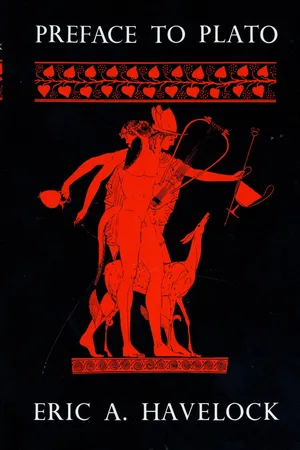
Plato's frontal attack on poetry has always been a problem for sympathetic students, who have often minimized or avoided it. Beginning with the premise that the attack must be taken seriously, Eric Havelock shows that Plato's hostility is explained by the continued domination of the poetic tradition in contemporary Greek thought.
The reason for the dominance of this tradition was technological. In a nonliterate culture, stored experience necessary to cultural stability had to be preserved as poetry in order to be memorized. Plato attacks poets, particularly Homer, as the sole source of Greek moral and technical instruction—Mr. Havelock shows how the Iliad acted as an oral encyclopedia. Under the label of mimesis, Plato condemns the poetic process of emotional identification and the necessity of presenting content as a series of specific images in a continued narrative.
The second part of the book discusses the Platonic Forms as an aspect of an increasingly rational culture. Literate Greece demanded, instead of poetic discourse, a vocabulary and a sentence structure both abstract and explicit in which experience could be described normatively and analytically: in short a language of ethics and science.
- 343 pages
- English
- PDF
- Available on iOS & Android
eBook - PDF
Preface to Plato
About this book
Information
Table of contents
- Contents
- Part One: The Image-Thinkers
- Part Two: The Necessity of Platonism
Trusted by 375,005 students
Access to over 1.5 million titles for a fair monthly price.
Study more efficiently using our study tools.
Frequently asked questions
Yes, you can cancel anytime from the Subscription tab in your account settings on the Perlego website. Your subscription will stay active until the end of your current billing period. Learn how to cancel your subscription
No, books cannot be downloaded as external files, such as PDFs, for use outside of Perlego. However, you can download books within the Perlego app for offline reading on mobile or tablet. Learn how to download books offline
Perlego offers two plans: Essential and Complete
- Essential is ideal for learners and professionals who enjoy exploring a wide range of subjects. Access the Essential Library with 800,000+ trusted titles and best-sellers across business, personal growth, and the humanities. Includes unlimited reading time and Standard Read Aloud voice.
- Complete: Perfect for advanced learners and researchers needing full, unrestricted access. Unlock 1.5M+ books across hundreds of subjects, including academic and specialized titles. The Complete Plan also includes advanced features like Premium Read Aloud and Research Assistant.
We are an online textbook subscription service, where you can get access to an entire online library for less than the price of a single book per month. With over 1.5 million books across 990+ topics, we’ve got you covered! Learn about our mission
Look out for the read-aloud symbol on your next book to see if you can listen to it. The read-aloud tool reads text aloud for you, highlighting the text as it is being read. You can pause it, speed it up and slow it down. Learn more about Read Aloud
Yes! You can use the Perlego app on both iOS and Android devices to read anytime, anywhere — even offline. Perfect for commutes or when you’re on the go.
Please note we cannot support devices running on iOS 13 and Android 7 or earlier. Learn more about using the app
Please note we cannot support devices running on iOS 13 and Android 7 or earlier. Learn more about using the app
Yes, you can access Preface to Plato by Eric A. Havelock,Eric A. HAVELOCK in PDF and/or ePUB format, as well as other popular books in Literature & Ancient & Classical Literary Criticism. We have over 1.5 million books available in our catalogue for you to explore.