In 1871 Paris was a city in crisis. Besieged during the Franco-Prussian War, its buildings and boulevards were damaged, its finances mired in debt, and its new government untested. But if Parisian authorities balked at the challenges facing them, entrepreneurs and businessmen did not. Selling Paris chronicles the people, practices, and politics that spurred the largest building boom of the nineteenth century, turning city-making into big business in the French capital.
Alexia Yates traces the emergence of a commercial Parisian housing market, as private property owners, architects, speculative developers, and credit-lending institutions combined to finance, build, and sell apartments and buildings. Real estate agents and their innovative advertising strategies fed these new residential spaces into a burgeoning marketplace. Corporations built empires with tens of thousands of apartments under management for the benefit of shareholders. By the end of the nineteenth century, the Parisian housing market caught the attention of the wider public as newspapers began reporting its ups and downs.
The forces that underwrote Paris's creation as the quintessentially modern metropolis were not only state-centered or state-directed but also grew out of the uncoordinated efforts of private actors and networks. Revealing the ways housing and property became commodities during a crucial period of urbanization, Selling Paris is an urban history of business and a business history of a city that transforms our understanding of both.
eBook - ePub
Selling Paris
Property and Commercial Culture in the Fin-de-siècle Capital
- 360 pages
- English
- ePUB (mobile friendly)
- Available on iOS & Android
eBook - ePub
About this book
Information
Topic
EconomiaSubtopic
Real Estate1
The Business of the City
STONE MASON and republican politician Martin Nadaud addressed the National Assembly in 1850 in a bid to secure government subsidies for public works. He invoked a proverb already familiar to his audience, and with which he would afterward be indelibly associated: “Quand le bâtiment va, tout va”—when construction prospers, everything prospers.1 The phrase captured the long-standing perception that Paris’s economy was entirely reliant on the health and vigor of its building industry. Construction was consistently one of the largest employment sectors in the capital city, with perhaps 10 percent of its residents reliant on the industry throughout the nineteenth century.2 Then as now, the construction industry was a chief indicator of national economic well-being and public works were an established strategy for economic stimulus (think of the National Workshops in 1848). Yet the sector was not without its downsides. The building industries were important sources of labor for migrant workers, whose presence in Paris was often viewed as a source of social instability, criminality, and even revolution. What is more, if these so-called “dangerous classes” threatened the peace and order of the capital city, the provinces were also suffering as their laborers increasingly opted for permanent installation in Paris as the century progressed.3 Rural lands lost one-third of their value between 1880 and 1900, and policy makers scrambled to introduce measures that would preserve the country’s “traditional” balance between agriculture and industry.4 As Paris grew, commentators such as municipal administrators and journalists Félix and Louis Lazare worried over “the son of a peasant who abandons the spade for the hammer [and] will never again take up the plow.”5 The alleged need for Paris to build to survive was in constant conflict with the myriad perceived dangers that “armies” of workers assembled in the capital posed to the nation’s economic and political life.
Today the notion that cities are entities destined for growth is a commonplace. From the late-nineteenth-century boosters of the American Midwest to the “growth machines” that captured post–World War II urban governance, our moment is heir to a century that has conceptualized and organized cities primarily as sites and engines of economic development.6 The transatlantic planning communities that emerged at the beginning of the twentieth century were instrumental in establishing an understanding of urban growth as inevitable and potentially beneficial—provided, of course, that it was rationally managed.7 The acceptance of growth sprang from an emerging perspective that viewed cities as organic entities developing according to natural processes of evolution. In France, Marcel Poëte, an urban historian and administrator who helped found the École des Hautes Études Urbaines in Paris in 1919, filled his foundational texts with biological metaphors, writing of the city as “a collective human being,” a “living organism” with functions structured by a “natural zoning” that reflected “the organic needs of a constantly evolving agglomeration.”8 Yet the metaphysical élan vital that drove a city’s evolution remained chiefly organized by economic imperatives: “Generally speaking, it is commercial and industrial fundamentals that determine the direction in which the city develops.” And this growth required that cities abandon enclosures, the fortified walls that “encircle the city and reduce it to living on its own resources,” in favor of structures fostering expansion—roads that radiate from the city, carrying the lifeblood of new individuals to its core, without which “a city is doomed to decline.”9 Emerging from international professionalization movements of burgeoning urbanists and municipal administrators, as well as from the experience of wartime planning and needs of postwar reconstruction, the vision of the urban that dominated the early-twentieth-century “science of the city” took the intelligent cultivation of growth as its fundamental principle.
The strength of this consensus should not obscure its novelty. In nineteenth-century France, as in other European countries, the virtues and means of urban growth were by no means settled. Successive governments of the ancien régime had grappled with the dangers and unmanageability of Parisian expansion. While Enlightenment planning ideals favored an open city, no less than thirty-one edicts defining and reinforcing the limits of the capital were issued between 1548 and 1766.10 The July Monarchy famously rewalled the city in the 1840s, erecting a ring of fortifications that cut through Paris’s suburban towns, rewriting the city’s physical and imaginary boundaries.11 Even Prefect of the Seine Baron Georges-Eugène Haussmann, viewed by historians and contemporaries alike as an unmitigated devotee of development, contemplated with trepidation the “Babel” that would result from any administrative expansion of the capital.12 Indeed, fin-de-siècle urban professionals such as architect Eugène Hénard faulted Haussmann’s midcentury renovations specifically for their lack of a coherent growth strategy.13
Nevertheless, nineteenth-century legal reforms tended toward greater acceptance of urban expansion. In 1824 King Charles X formally overturned the image of the city as a closed space when he lifted the ban on building outside Paris’s tax wall. In the same period, laws requiring that individuals housing visitors in the capital report them to local authorities—even when they were relatives or friends—passed out of use.14 And the erection of the fortifications in fact facilitated the annexation of those territories that they enclosed.15 The necessity of dismantling the fortifications was evident from the 1880s, inaugurating a long debate on their destruction and the reuse of their lands.16 These measures recognized the city as a space of expansion and development, and worked to adjust its administrative practices to economic ideologies that demanded openness and circulation.17
Urban growth was a pressing and deeply politicized problem for Paris’s administrators at the beginning of the Third Republic. In 1871 the city was granted an elected municipal council with significant authority and regular elections for the first time since the Revolution.18 Its members inherited the material and social legacies of Haussmannization and the Commune, legacies that had to be managed in accordance with the new republic’s political sensibilities. The widespread renovations that characterized Haussmannization not only had fundamentally changed the city’s built landscape, but had also altered the relationship between the government and Parisian residents by dramatically imposing central authority over local prerogatives.19 Critics of the regime’s projects spoke and wrote passionately about the danger of dispossession confronting Parisian residents as the city appeared to degenerate from a place of work and production to a “ville-décor” whose only function was to elicit “admiring exclamations from foreigners.”20 New public spaces favored the promenade rather than the workers’ commute, and tourist amenities intended for the great showcases of Universal Exhibitions, held in 1855 and 1867, oriented the real estate developments of Second Empire financiers.21 The urban insurgency known as the Paris Commune (March–May 1871) arose partially in response to these phenomena. Triggered by the experience of wartime defeat, siege, and occupation by the Prussian army, an insurrectionary government and armed citizenry repossessed and repurposed the streets and buildings of Haussmann’s Paris before suffering a bloody defeat at the hands of France’s new republican government. Exile and executions did away with tens of thousands of the city’s residents; shelling and fires ravaged public and private property across the city (Figure 1.1). The nine months of the Prussian siege and Commune took a terrible toll on the city’s economy, while the peace conditions imposed upon the French required a massive indemnity payment that drained further resources from investors and governments. Getting Paris back on its feet was, in short, a monumental undertaking that urgently confronted the new administration.
How the city’s governors went about this task reveals the particular political economy of urban development that emerged from the revolutionary experiences of the Second Empire and the Commune. The previous regime was by no means excised in 1870–1871. The debts accumulated for its urban projects exerted tremendous pressure on municipal finances; uncompleted projects left outstanding compulsory purchase orders and truncated streets that required completion; Haussmann’s collaborator and former director of parks Adolphe Alphand was appointed the city’s director of works in 1871 (and held the position until his death in 1891); Haussmann himself became, for a time, director of the Rente Foncière and the Crédit Mobilier, important financing companies closely linked to the real estate speculations of the Second Empire. Yet it was clear that the business of the city—and business in the city—could not proceed upon its former foundations. As the initial work of reconstruction was followed rapidly by a significant building boom and bust, Paris’s appointed and elected representatives joined observers from building trades, property owner associations, and national politicians in fiercely debating the virtues and vices of state-sponsored public works, attempting to work out the proper relationship between public authority and private enterprise. The building question—which encompassed matters ranging from immigrant labor and workers’ housing to state ownership of land and public debt—consistently confronted the new city government, forcing combative articulation of the political and economic principles shaping municipal development policy. The republican majority was strongly opposed to policies that appeared to continue those of the Second Empire, rejecting (at least initially) public borrowing that fueled “exaggerated” building campaigns that flooded the city with “unlucky emigrants,” “a plague for true Parisians.”22 In interrogating the agents, form, and impact of urban development, the new municipality attempted to find a politically and fiscally acceptable balance of public utility and private profit in the wake of Second Empire urbanism.
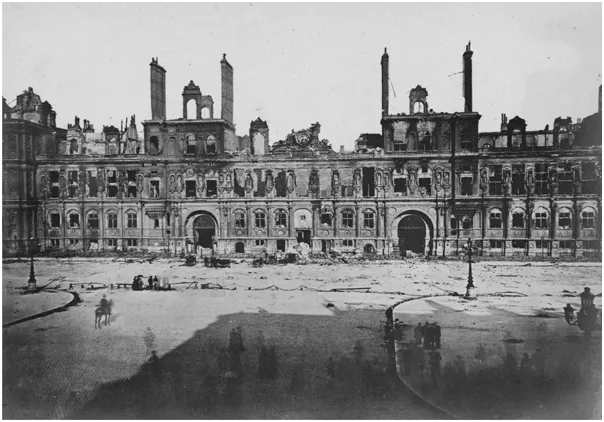
FIGURE 1.1 The ruin of the Hôtel de Ville, Paris’s City Hall, 1871. The Council resumed sessions in the reconstructed building in 1882. Source: Charles Deering McCormick Library of Special Collections, Northwestern University Library
The municipal government was also concerned with establishing itself as the representative of the general interest of the city, imbued with expertise and obligations that distinguished its sphere of action from that of private pursuits. The April 14, 1871 law on municipal elections restored Paris’s elected city government, yet the city’s dual status as locality and national capital dictated a special regime. Its administration remained divided between state-appointed prefects—the prefect of the Seine and the prefect of police, whose offices employed a combined staff of nearly 28,000 at an annual cost of almost 50 million francs—and the eighty-member city council.23 The council was subordinate to the prefectures; it enjoyed the power to initiate debates and deliberate on a multitude of questions, but executive authority remained with the Prefecture of the Seine. Despite the limitations on its powers, the council was the chief site of debate for all issues relating to local administration, and its commissions and deliberations bore particular weight in the realm of urbanism. The city’s public works constituted the single largest expense of the municipal budget after the annual cost of the debt, and municipal property management was one of the most important areas of autonomy enjoyed by the council.24 The business of city government, then, was worked out largely in the arenas of property administration and development. Rather than a simple platform for preexisting dispositions, navigating the building question was a process through which the economic ideologies and “dreams of commerce” of the Third Republic took shape, inscribed not only in political discourse but in the avenues and building sites of the French capital.25
The Building Question
The neighborhood known in the 1870s as the Quartier Marbeuf was a low-lying area sandwiched between the Champs-Élysées and the Seine. Previous public works—the development of the monumental promenade of the Champs under the first Empire, then those of Avenue de l’Alma (today’s Avenue George V) under the Second—had left the district several meters lower than its surrounds, its streets reduced to “absolute cesspits,” “horrible worms on the beautiful fruit” of the Champs-Élysées.26 Residents petitioned and complained to authorities for decades for improvement.27 The municipal government recognized the need to elevate the district but balked at the cost. The area concerned was large, approximately 70,000 square meters, and its location in the otherwise ritzy west end of the city was so obviously destined for luxury development that property owners drove hard bargains with the city’s agents; some estimates placed the net cost for expropriations and roadworks as high as 8 million francs.28 Luckily for some the area’s development potential also attracted private enterprise. In the late 1870s the city considered proposals from several groups of financiers and developers, each offering to renovate the neighborhood in exchange for various subsid...
Table of contents
- Cover
- Title Page
- Copyright
- Contents
- Introduction: Selling Paris
- 1: The Business of the City
- 2: Seeing Like a Speculator
- 3: The Problem of Property
- 4: The Unceasing Marketplace
- 5: Marketing the Metropolis
- 6: Districts of the Future
- Epilogue: Illicit Speculation and Impossible Markets
- Appendix
- Notes
- Acknowledgments
- Index
Trusted by 375,005 students
Access to over 1.5 million titles for a fair monthly price.
Study more efficiently using our study tools.
Frequently asked questions
Yes, you can cancel anytime from the Subscription tab in your account settings on the Perlego website. Your subscription will stay active until the end of your current billing period. Learn how to cancel your subscription
No, books cannot be downloaded as external files, such as PDFs, for use outside of Perlego. However, you can download books within the Perlego app for offline reading on mobile or tablet. Learn how to download books offline
Perlego offers two plans: Essential and Complete
- Essential is ideal for learners and professionals who enjoy exploring a wide range of subjects. Access the Essential Library with 800,000+ trusted titles and best-sellers across business, personal growth, and the humanities. Includes unlimited reading time and Standard Read Aloud voice.
- Complete: Perfect for advanced learners and researchers needing full, unrestricted access. Unlock 1.5M+ books across hundreds of subjects, including academic and specialized titles. The Complete Plan also includes advanced features like Premium Read Aloud and Research Assistant.
We are an online textbook subscription service, where you can get access to an entire online library for less than the price of a single book per month. With over 1.5 million books across 990+ topics, we’ve got you covered! Learn about our mission
Look out for the read-aloud symbol on your next book to see if you can listen to it. The read-aloud tool reads text aloud for you, highlighting the text as it is being read. You can pause it, speed it up and slow it down. Learn more about Read Aloud
Yes! You can use the Perlego app on both iOS and Android devices to read anytime, anywhere — even offline. Perfect for commutes or when you’re on the go.
Please note we cannot support devices running on iOS 13 and Android 7 or earlier. Learn more about using the app
Please note we cannot support devices running on iOS 13 and Android 7 or earlier. Learn more about using the app
Yes, you can access Selling Paris by Alexia M. Yates in PDF and/or ePUB format, as well as other popular books in Economia & Real Estate. We have over 1.5 million books available in our catalogue for you to explore.