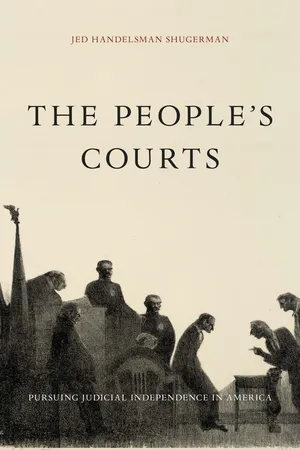
In the United States, almost 90 percent of state judges have to run in popular elections to remain on the bench. In the past decade, this peculiarly American institution has produced vicious multi-million-dollar political election campaigns and high-profile allegations of judicial bias and misconduct. The People's Courts traces the history of judicial elections and Americans' quest for an independent judiciary—one that would ensure fairness for all before the law—from the colonial era to the present.
In the aftermath of economic disaster, nineteenth-century reformers embraced popular elections as a way to make politically appointed judges less susceptible to partisan patronage and more independent of the legislative and executive branches of government. This effort to reinforce the separation of powers and limit government succeeded in many ways, but it created new threats to judicial independence and provoked further calls for reform. Merit selection emerged as the most promising means of reducing partisan and financial influence from judicial selection. It too, however, proved vulnerable to pressure from party politics and special interest groups. Yet, as Shugerman concludes, it still has more potential for protecting judicial independence than either political appointment or popular election.
The People's Courts shows how Americans have been deeply committed to judicial independence, but that commitment has also been manipulated by special interests. By understanding our history of judicial selection, we can better protect and preserve the independence of judges from political and partisan influence.
- 392 pages
- English
- PDF
- Available on iOS & Android
eBook - PDF
About this book
Information
Table of contents
- Contents
- Introduction: America’s Peculiar Institution
- 1. Declaring Judicial Independence
- 2. Judicial Challenges in the Early Republic
- 3. Judicial Elections as Separation of Powers
- 4. Panic and Trigger
- 5. The American Revolutions of 1848
- 6. The Boom in Judicial Review
- 7. Reconstructing Independence
- 8. The Progressives’ Failed Solutions
- 9. The Great Depression, Crime, and the Revival of Appointment
- 10. The Puzzling Rise of Merit
- 11. Judicial Plutocracy after 1980
- Conclusion: Interests, Ideas, and Judicial Independence
- Appendixes
- Notes
- Acknowledgments
- Index
Trusted by 375,005 students
Access to over 1.5 million titles for a fair monthly price.
Study more efficiently using our study tools.
Frequently asked questions
Yes, you can cancel anytime from the Subscription tab in your account settings on the Perlego website. Your subscription will stay active until the end of your current billing period. Learn how to cancel your subscription
No, books cannot be downloaded as external files, such as PDFs, for use outside of Perlego. However, you can download books within the Perlego app for offline reading on mobile or tablet. Learn how to download books offline
Perlego offers two plans: Essential and Complete
- Essential is ideal for learners and professionals who enjoy exploring a wide range of subjects. Access the Essential Library with 800,000+ trusted titles and best-sellers across business, personal growth, and the humanities. Includes unlimited reading time and Standard Read Aloud voice.
- Complete: Perfect for advanced learners and researchers needing full, unrestricted access. Unlock 1.5M+ books across hundreds of subjects, including academic and specialized titles. The Complete Plan also includes advanced features like Premium Read Aloud and Research Assistant.
We are an online textbook subscription service, where you can get access to an entire online library for less than the price of a single book per month. With over 1.5 million books across 990+ topics, we’ve got you covered! Learn about our mission
Look out for the read-aloud symbol on your next book to see if you can listen to it. The read-aloud tool reads text aloud for you, highlighting the text as it is being read. You can pause it, speed it up and slow it down. Learn more about Read Aloud
Yes! You can use the Perlego app on both iOS and Android devices to read anytime, anywhere — even offline. Perfect for commutes or when you’re on the go.
Please note we cannot support devices running on iOS 13 and Android 7 or earlier. Learn more about using the app
Please note we cannot support devices running on iOS 13 and Android 7 or earlier. Learn more about using the app
Yes, you can access The People’s Courts by Jed Handelsman Shugerman in PDF and/or ePUB format, as well as other popular books in Law & North American History. We have over 1.5 million books available in our catalogue for you to explore.