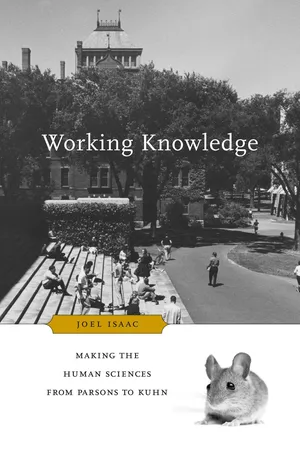
The human sciences in the English-speaking world have been in a state of crisis since the Second World War. The battle between champions of hard-core scientific standards and supporters of a more humanistic, interpretive approach has been fought to a stalemate. Joel Isaac seeks to throw these contemporary disputes into much-needed historical relief. In Working Knowledge he explores how influential thinkers in the twentieth century's middle decades understood the relations among science, knowledge, and the empirical study of human affairs.
For a number of these thinkers, questions about what kinds of knowledge the human sciences could produce did not rest on grand ideological gestures toward "science" and "objectivity" but were linked to the ways in which knowledge was created and taught in laboratories and seminar rooms. Isaac places special emphasis on the practical, local manifestations of their complex theoretical ideas. In the case of Percy Williams Bridgman, Talcott Parsons, B. F. Skinner, W. V. O. Quine, and Thomas Kuhn, the institutional milieu in which they constructed their models of scientific practice was Harvard University. Isaac delineates the role the "Harvard complex" played in fostering connections between epistemological discourse and the practice of science. Operating alongside but apart from traditional departments were special seminars, interfaculty discussion groups, and non-professionalized societies and teaching programs that shaped thinking in sociology, psychology, anthropology, philosophy, science studies, and management science. In tracing this culture of inquiry in the human sciences, Isaac offers intellectual history at its most expansive.
- 305 pages
- English
- ePUB (mobile friendly)
- Available on iOS & Android
eBook - ePub
About this book
Information
1
The Interstitial Academy
Harvard and the Rise of the American University
In the late summer and early autumn of 1936, Harvard University celebrated its tercentenary.1 The timing could hardly have been more inauspicious. Americans were mired in an unprecedented economic downturn; a fascist coup against the democratic government in Spain threatened to spark an international conflagration; Nazi Germany stood emboldened by its seizure of the Rhineland; and the grim show trials of Stalin’s political opponents were opening in Moscow. Like other academic festivals of the Depression era, the Harvard tercentenary bristled with the tension between optimism about science and learning and the acknowledgment of what looked to many like the crisis of Western civilization.2 In one example of this striking juxtaposition, on the evening of September 17, the British-based anthropologist Bronislaw Malinowski delivered a minatory oration to the Harvard Chapter of Phi Beta Kappa on the topic of “war as a menace to our immediate future.” Malinowski cautioned against an American “relapse into fictitious natural pacifism” while arguing that warfare was neither a permanent feature of human societies nor, in its contemporary mechanized form, a fruitful tool of national policy. As Malinowski marshaled ethnographic data to warn of the pressing danger of armed conflict, a far larger audience—some 350,000 souls—gathered along the banks of the Charles River to watch a fireworks display. Rockets and roman candles were set alight on a moving barge that processed up the Charles, with the Harvard Band following behind, providing a musical accompaniment. When the flotilla reached the Harvard Houses near Weeks Bridge, red fire flares were ignited along the riverfront.3
If bathos was unavoidable in the 1930s, its presence in the precincts of the Harvard Yard was apt. In the years surrounding the tercentenary, Harvard was caught uncertainly between worlds. Since the end of the Civil War, the university had embraced some of the reforms that had reshaped American higher education in that period, notably the concepts of scientific research and the elective curriculum. Yet Harvard remained close to the traditional folkways and thoughtways of metropolitan Boston—the world in which the university had been safely ensconced since the turn of the nineteenth century. The stresses and strains produced by these competing poles of attraction were exacerbated by Harvard’s institutional eclecticism. Harvard, like many other American universities, was not a single coherent entity but a matrix of distinctive, often isolated, components: departments of the liberal arts, colleges, professional schools, museums, observatories, gardens, and research laboratories.4 The integration of these elements was never total, and at times the stitched-together whole split along the seams. This tendency was particularly characteristic of the nation’s older colleges and universities, which scrambled to incorporate administrative and pedagogical reforms into preexisting—and often intractable—institutional forms. Harvard faced similar pressures during the decades spanning the two world wars. My purpose in this chapter is to assess the origins and results of this institutional fragmentation.
I shall focus on the emergence at Harvard of what I have termed the interstitial academy. A product of centrifugal forces operating on America’s universities, Harvard’s interstitial academy provided practitioners of nascent research programs with enclaves in which to exchange ideas and conduct inquiries outside of established departments and curricula. The growth of such interstitial spaces within emergent research universities was by no means limited to Harvard. During the middle decades of the twentieth century old and new universities alike nurtured programs and seminars that stood self-consciously outside of conventional departments and professional schools: the University of Chicago’s interdisciplinary committee system for graduate training was an obvious example of an interstitial academic space, as were the “University Seminars” developed at Columbia by the historian Frank Tannenbaum.5 More generally, interwar efforts to develop core undergraduate curricula were intended to overcome disciplinary fragmentation and professional specialization in the colleges. Harvard’s interstitial academy was therefore not uncharacteristic of America’s universities in this period, but it did fulfill some unique functions in its own local context. At its peak in the decades after World War I, Harvard’s interstitial programs and seminars provided a unique space in which hitherto marginal projects in the human sciences were able to come to fruition. At Harvard, fields such as sociology, psychology, cultural anthropology, the history and methodology of science, social systems theory, and analytic philosophy began as fugitive professional ventures. Only slowly, given the breathing space allowed by the interstitial academy, did they acquire institutional legitimacy. It was in Harvard’s interstitial academy that the tradition of scientific philosophy became useful to would-be human scientists attempting to ply their craft.
Beyond the Pioneer Paradigm
Presupposed in talk of an interstitial academy is the existence of an established institutional framework for the American university. There is certainly evidence to warrant this assumption. During the three decades between 1890 and 1920, there emerged a stable, if also diverse, organizational pattern in higher education.6 In these years, faculty and university leaders came to hold shared commitments to the advancement of knowledge, academic freedom in teaching and research, the importance of graduate education in the liberal arts, and the confirmation of the undergraduate college as the gateway to the university. By 1900, the management of universities was sufficiently bureaucratic to warrant the publication of manuals for the new class of academic administrators.7 Universities had become another outlet for the gospel of efficiency promoted by the business executives of the progressive era.8 The creation of the American Association of Universities at the turn of the twentieth century marked the nationalization of this university ideal.9
Formative though this moment of crystallization was, the “interstitial” and “established” structures contrasted in this chapter can be characterized only in relative terms. Up to World War II, the American university was a fragile creature. As late as the 1920s, a number of academic leaders were asserting the primacy of collegiate values and warning of the dangers of university expansion and disciplinary specialization.10 Throughout the interwar decades, advanced research in universities relied almost exclusively on tithes from private industry and philanthropic foundations.11 Such countercurrents underline the fact that the Great Instauration of 1890–1920 embedded in American higher education not a streamlined “university,” but a somewhat loose assemblage of institutions and educational goals, many of which were either distinct from, or even in tension with, one another.12 The components welded uncertainly together in the early-twentieth-century research university had usually been advanced independently of one another: separable ideals associated with the university movement included the promotion of specialized scientific and scholarly knowledge in undergraduate education; the provision of advanced training in the liberal arts; vocational training in the professions; the preservation of cultural treasures; and the extension of the frontiers of human knowledge. In short, the formation of research universities in the United States was a piecewise, haphazard, and halting process that began in the early national period and continued on into the Cold War years.13 Consequently, to observe that part of the institutional pattern of the university was “established” during the middle decades of the twentieth century is to imply neither permanence nor necessity.
Given the relative status of the university as an institutional form, a characterization of the interstitial academy requires a brief history of Harvard University, one that captures the contingency inherent in the development of Harvard from a liberal arts college into a research university. As well as the acknowledgment of the complex evolution of the American university, this task of historical reconstruction also entails the rejection of what we might call the pioneer paradigm. In a number of histories and biographies, the emergence of Harvard as a research university and the success of the national university movement are attributed to the leadership of Charles William Eliot and kindred spirits at new state and private universities such as Johns Hopkins, Cornell, Michigan, and Chicago.14 Samuel Eliot Morison wrote of Eliot’s election in 1869 in heroic terms: “More than at any age in our history, a leader was wanted. The leader was ready and waiting. He was thirty-five years old, and his name was Charles William Eliot.”15 “No one,” observed another historian of Eliot, “did more to establish higher education in general, and Harvard in particular, as an accomplice to American greatness.”16
These laudatory reviews are in large part the product of inherited prejudices about the academic scene in antebellum Cambridge. The prevailing image of Harvard College in a pre–Civil War state of apathy is owed above all to Henry Adams. In an oft-cited passage of his Education, he summarized his view of Harvard in mordant prose:
For generation after generation, Adamses and Brookses and Boylstons and Gorhams had gone to Harvard College, and although none of them had ever done any good there, or thought himself the better for it, custom, social ties, convenience, and, above all, economy, kept each generation in the track. Any other education would have required serious effort, but no one took Harvard College seriously. All went there because their friends went there, and the College was their ideal of social self-respect.17
Morison, confirming Adams’ verdict, observed that on the eve of Eliot’s election in 1869, “Harvard College was hidebound, the Harvard Law School senescent, the Medical School ineffective, and the Lawrence Scientific School ‘the resort of shirks and stragglers.’”18 The tendency to see Eliot’s election as a watershed has been reinforced by the new president’s attempts to clear his own path. Nowhere was this more evident than in his Delphic inaugural address of 1869, which attempted to draw a line under what Eliot suggested were petty curricular squabbles that had plagued the university in years past.19
The pioneer paradigm rests on a sharply dichotomous and teleological reading of the history of American higher education during the nineteenth century. This picture contrasts an antebellum epoch of falling enrolments, scholarly dissipation, and dogged commitment to the classical curriculum with the Gilded Age triumph of professional expertise and the secular university.20 In the 1950s, many historians were deeply swayed by Donald Tewksbury’s account of the college movement before the Civil War, which highlighted both the explosion in the establishment of colleges as the frontier moved rapidly west after the Louisiana Purchase and the strikingly high attrition rate of the frontier colleges.21 Tewksbury himself described the antebellum college as a classic “frontier institution” and linked its efflorescence to Frederick Jackson Turner’s vision of the frontier as a crucible of American democracy.22 Looking back on these developments in the Eisenhower era, however, historians were less sanguine. The exponential increase in colleges, they argued, led to the dilution of standards and the sidelining of academic principles that had begun to take shape in the small cohort of Eastern colleges before and immediately after the Revolution. During the “Great Retrogression” of the antebellum decades, Richard Hofstadter argued, the forward march of secular higher education in the United States was interrupted by the Second Great Awakening, whose interdenominational rivalries led to the establishment of competing sectarian colleges across the nation.23
Hofstadter and others depicted the “old-time college” as a reactionary bastion in a democratic age. With the nation in need of skilled engineers and practical men of affairs, the college, they insisted, stuck doggedly to the elitist precepts of the trivium and quadrivium.24 The stage was set, after the Civil War, for the concerted reforms of Eliot and likeminded academic pioneers such as Daniel Coit Gilman of the Johns Hopkins University, Andrew D. White of Cornell University, James Angell of the University of Michigan, and William Rainey Harper at the University of Chicago; the “old-time college” was swept aside by the “university ideal,” which had succeeded by 1900 in giving birth to a small and elite set of secular, research-oriented institutions of higher education.25
To be sure, the story told by the consensus historians of the 1950s was neither entirely false nor irremediably simplistic. They succeeded in showing how the university movement of the 1870s and 1880s had been pieced together from a variety of sources, from the Morrill Act of 1862—the so-called Land Grant Act providing public lands to the states for the purpose of endowing technical colleges—to the professional academic associations and scientific societies founded in the late nineteenth century. Nevertheless, in the writings of these scholars, the basic contrast remained between antebellum retrogression and Gilded Age reform—what George Peterson felicitously described as “a morality play written in two acts.”26 The story of Eliot’s presidency has often been assimilated to this wider narrative concerning the fortunes of higher education in the Victorian era. Beginning in the 1970s, however, a series of studies overturned prevailing stereotypes surrounding the antebellum college and questioned the discontinuity between ante- and postbellum higher learning. Charges that the denominational college was either unpopular, unresponsive to curricular innovation, or subject to inordinately high rates of failure have been called into question.27 Likewise, the reforms of Eliot, Gilman, and others have been placed in a more nuanced context: the significance of German commitments to pure research and academic freedom have been qualified and the economic and intellectual conditions for the rise of the research university have been connected to a longer lineage that stretches back to the early national period.28 Reassessments of this kind compel us to sharpen our grasp of complex process by which research universities were jerry-built during the nineteenth and early twentieth centuries.
Harvard University occupies a pivotal position in this reassessment of the transformation of the college and the rise of the university. In virtually every innovation in higher education that we will trace in this chapter, another institution claimed precedence over Harvard. What typified Harvard’s evolution into a research university was not the boldness of its leaders, Eliot included, but rather the University’s ability to finesse major pedagogical, intellectual, and organizational challenges. By hook or by crook, Harvard throughout the nineteenth century was able to remain flexible enough institutionally to respond to dramatic changes elsewhere—even if this entailed a conservative attitude toward graduate education, research specialization, and collegiate values. Harvard prospered, in other words, because it was able to sustain a certain measure of institutional “give” as a result of its size and its connections to metropolitan Boston. As Wor...
Table of contents
- Cover
- Title Page
- Copyright
- Contents
- Prologue: How Paradigms Are Made
- 1: The Interstitial Academy: Harvard and the Rise of the American University
- 2: Making a Case: The Harvard Pareto Circle
- 3: What Do the Science-Makers Do? Migrations of Operationism
- 4: Radical Translation: W. V. Quine and the Reception of Logical Empiricism
- 5: The Levellers: Harvard’s Social Scientists from World War to Cold War
- 6: Lessons of the Revolution: History, Sociology, and Philosophy of Science
- Epilogue: The Great Disembedding
- Notes
- Acknowledgments
- Index
Trusted by 375,005 students
Access to over 1.5 million titles for a fair monthly price.
Study more efficiently using our study tools.
Frequently asked questions
Yes, you can cancel anytime from the Subscription tab in your account settings on the Perlego website. Your subscription will stay active until the end of your current billing period. Learn how to cancel your subscription
No, books cannot be downloaded as external files, such as PDFs, for use outside of Perlego. However, you can download books within the Perlego app for offline reading on mobile or tablet. Learn how to download books offline
Perlego offers two plans: Essential and Complete
- Essential is ideal for learners and professionals who enjoy exploring a wide range of subjects. Access the Essential Library with 800,000+ trusted titles and best-sellers across business, personal growth, and the humanities. Includes unlimited reading time and Standard Read Aloud voice.
- Complete: Perfect for advanced learners and researchers needing full, unrestricted access. Unlock 1.5M+ books across hundreds of subjects, including academic and specialized titles. The Complete Plan also includes advanced features like Premium Read Aloud and Research Assistant.
We are an online textbook subscription service, where you can get access to an entire online library for less than the price of a single book per month. With over 1.5 million books across 990+ topics, we’ve got you covered! Learn about our mission
Look out for the read-aloud symbol on your next book to see if you can listen to it. The read-aloud tool reads text aloud for you, highlighting the text as it is being read. You can pause it, speed it up and slow it down. Learn more about Read Aloud
Yes! You can use the Perlego app on both iOS and Android devices to read anytime, anywhere — even offline. Perfect for commutes or when you’re on the go.
Please note we cannot support devices running on iOS 13 and Android 7 or earlier. Learn more about using the app
Please note we cannot support devices running on iOS 13 and Android 7 or earlier. Learn more about using the app
Yes, you can access Working Knowledge by Joel Isaac in PDF and/or ePUB format, as well as other popular books in History & 20th Century History. We have over 1.5 million books available in our catalogue for you to explore.