
- 304 pages
- English
- ePUB (mobile friendly)
- Available on iOS & Android
eBook - ePub
About this book
"Spectacular vernacular—delivered with fresh flavor."—Playboy
"Hang with this slang and reep these righteous words!" This entertaining, highly readable book pulses with the vernacular of young Americans, tracing slang terms and expressions from the end of the nineteenth century to the present. In addition to alphabetical listings for each decade, it features fascinating word histories and sidebars about language and culture—jazz cat jive, the argot of Beat poets, gritty inner-city street talk, and other captivating colloquialisms.
A master storyteller and wordsmith, Tom Dalzell is the author of The Concise New Partridge Dictionary of Slang and Unconventional English and The Routledge Dictionary of Modern American Slang and Unconventional English. In Flappers 2 Rappers, he presents more than just lists of words. His introductions to each chronological chapter offer fascinating insights into the ways in which slang reflects the era's historical mood and significance. Great for browsing, this unique reference will delight students of history as well as word and language enthusiasts.
"Hang with this slang and reep these righteous words!" This entertaining, highly readable book pulses with the vernacular of young Americans, tracing slang terms and expressions from the end of the nineteenth century to the present. In addition to alphabetical listings for each decade, it features fascinating word histories and sidebars about language and culture—jazz cat jive, the argot of Beat poets, gritty inner-city street talk, and other captivating colloquialisms.
A master storyteller and wordsmith, Tom Dalzell is the author of The Concise New Partridge Dictionary of Slang and Unconventional English and The Routledge Dictionary of Modern American Slang and Unconventional English. In Flappers 2 Rappers, he presents more than just lists of words. His introductions to each chronological chapter offer fascinating insights into the ways in which slang reflects the era's historical mood and significance. Great for browsing, this unique reference will delight students of history as well as word and language enthusiasts.
Frequently asked questions
Yes, you can cancel anytime from the Subscription tab in your account settings on the Perlego website. Your subscription will stay active until the end of your current billing period. Learn how to cancel your subscription.
At the moment all of our mobile-responsive ePub books are available to download via the app. Most of our PDFs are also available to download and we're working on making the final remaining ones downloadable now. Learn more here.
Perlego offers two plans: Essential and Complete
- Essential is ideal for learners and professionals who enjoy exploring a wide range of subjects. Access the Essential Library with 800,000+ trusted titles and best-sellers across business, personal growth, and the humanities. Includes unlimited reading time and Standard Read Aloud voice.
- Complete: Perfect for advanced learners and researchers needing full, unrestricted access. Unlock 1.4M+ books across hundreds of subjects, including academic and specialized titles. The Complete Plan also includes advanced features like Premium Read Aloud and Research Assistant.
We are an online textbook subscription service, where you can get access to an entire online library for less than the price of a single book per month. With over 1 million books across 1000+ topics, we’ve got you covered! Learn more here.
Look out for the read-aloud symbol on your next book to see if you can listen to it. The read-aloud tool reads text aloud for you, highlighting the text as it is being read. You can pause it, speed it up and slow it down. Learn more here.
Yes! You can use the Perlego app on both iOS or Android devices to read anytime, anywhere — even offline. Perfect for commutes or when you’re on the go.
Please note we cannot support devices running on iOS 13 and Android 7 or earlier. Learn more about using the app.
Yes, you can access Flappers 2 Rappers by Tom Dalzell in PDF and/or ePUB format, as well as other popular books in Languages & Linguistics & Linguistics. We have over one million books available in our catalogue for you to explore.
Information
Chapter 1
Before the Flapper
“23 Skidoo!”
To be sure, young people in the United States did not suddenly start using slang with the advent of the Jazz Age in about 1920. Slang has long been an integral component of American English, and the young have never distinguished themselves by confining their speech to standard English.
A viable slang idiom, though, is dependent upon a viable subculture, for the creation of slang is by its very nature a social and group process. Further, the transmission of slang among a group depends on either the mobility of the group (as is the case with the slang of workers or criminals) or the existence of means of mass communication, such as comic strips in newspapers, phonograph records, radio, movies, or television.
Before World War I, a viable youth subculture did not exist anywhere other than on the campuses of colleges and possibly within pockets of youthful vagrants, criminals, and workers. There was little mobility among the young (or in the nation for that matter), and the various forms of mass communication which would make the national spread of slang possible did not begin to emerge until the 1920s.
It is thus no surprise that before World War I the specialized study of the slang idiom of the young was limited to the study of the slang of college students. College slang was then (and to some degree is now) the product of institutional, not generational forces. Each college or university was a closed social system which developed its own traditions, customs, and language. While some words were nearly universal (such as pony for a literal translation of a work in a foreign language), many were institutional-specific. Most of the vocabulary dealt with academic or institutional subjects such as campus landmarks, intracollege rivalries, academic subjects, and one’s level of performance in studies. The big subjects treated by 20th-century youth slang (greetings and farewells, status, intoxication, and sex) were all but ignored by pre-1920 slang.
College Slang in the 1850s
Probably the earliest treatment of the language used by young people in the United States was A Collection of College Words and Customs by John Bartlett (Cambridge: John Bartlett, 1851).1 Bartlett addressed English and American institutions, and overall he paid as much attention to customs as to language. Much of the language that Bartlett recorded was jargon, while much of the actual slang dealt with college-specific subjects and situations. For example, there was a diverse slang idiom to describe a student’s performance on recitations, ranging from the poor recitation (barney, bull, lump, smash, ticker) to the good (rowl or shine), showy (squirt), or perfect (curl or sail).
Some of the slang not pertaining specifically to college life as reported by Bartlett follows:
B
blood Excellent
bos Desserts
buck Excellent
bull To discuss at length
bos Desserts
buck Excellent
bull To discuss at length
C
coax To curry favor through flattery
collar To appropriate
cork An utter failure or stopper
Cuz John A privy
collar To appropriate
cork An utter failure or stopper
Cuz John A privy
D
dead Unprepared, unable
decent Tolerable
devil To idle
dig To study hard
diked out Dressed up stylishly. What a difference a century would make with this one!
decent Tolerable
devil To idle
dig To study hard
diked out Dressed up stylishly. What a difference a century would make with this one!
F
fag To labor to the point of weariness. And this one!
fat Containing money (said of a letter). Heads up rappers, here comes a word!
ferg To regain one’s poise
fish To ingratiate oneself and curry favor through flattery
flummux A failure
fork on To appropriate to oneself
fat Containing money (said of a letter). Heads up rappers, here comes a word!
ferg To regain one’s poise
fish To ingratiate oneself and curry favor through flattery
flummux A failure
fork on To appropriate to oneself
G
gas To deceive or cheat
gonus A dimwit
gorm To eat voraciously
gum A deception
gonus A dimwit
gorm To eat voraciously
gum A deception
H
hard up The object of a joke
hunch A tip or implication
L
lem A privy
long ear A sober and religious person
M
minor A privy
N
number ten A privy
nuts Despicable, foolish
R
ragtail An annoying person
ray An insight or clue, as in “He doesn’t have a ray.”
S
seed A youth
seedy Rowdy
short ear A rowdy person
skin To plagiarize
skunk To fail to pay a debt
smouge To procure without permission
spoony Silly, absurd, often used to describe someone who is drunk
squirty Gaudy
seedy Rowdy
short ear A rowdy person
skin To plagiarize
skunk To fail to pay a debt
smouge To procure without permission
spoony Silly, absurd, often used to describe someone who is drunk
squirty Gaudy
T
temple A privy
tight Pleasantly intoxicated
tight fit A good joke
tight Pleasantly intoxicated
tight fit A good joke
W
wire A trick
College Slang Circa 1900
At the turn of the century, the American Dialect Society performed a comprehensive examination of the language used by college students throughout the United States. The two seminal articles were “College Words and Phrases” by Eugene H. Babbit, Dialect Notes, Volume II, Part I (1900) and “College Slang Words and Phrases,” Dialect Notes, Volume IV, Part III (1915). From these two articles and sev...
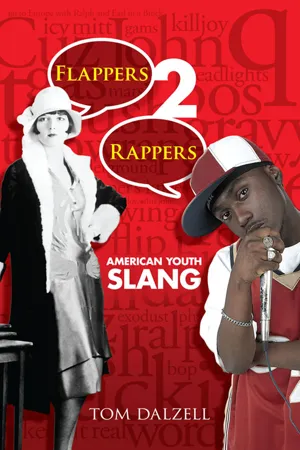
Table of contents
- Title Page
- Copyright Page
- Dedication
- Acknowledgments
- Table of Contents
- Introduction
- Chapter 1 Before the Flapper
- Chapter 2 The 1920s: The Flapper
- Chapter 3 The 1930s:The Joe and the Jerk
- Chapter 4 The 1940s: The Jive Generation
- Chapter 5 The Mainstream 1950s
- Chapter 6 The Beat Counterculture of the 1950s
- Chapter 7 The Mainstream 1960s
- Chapter 8 The Hippie Counterculture of the 1960s
- Chapter 9 The 1970s and 1980s
- Chapter 10 Hip-Hop & Rap
- Chapter 11 And Then . . . the 1990s
- Chapter 12 Generation Y2K
- Epilogue
- Bibliography
- INDEX
- A CATALOG OF SELECTED DOVER BOOKS IN ALL FIELDS OF INTEREST