As the twentieth century drew to a close, computers, the Internet, and nanotechnology were central to modern American life. Yet the advances in physics underlying these applications are poorly understood and widely underappreciated by U.S. citizens today. In this concise overview, David C. Cassidy sharpens our perspective on modern physics by viewing this foundational science through the lens of America's engagement with the political events of a tumultuous century.
American physics first stirred in the 1890s—around the time x-rays and radioactivity were discovered in Germany—with the founding of graduate schools on the German model. Yet American research lagged behind the great European laboratories until highly effective domestic policies, together with the exodus of physicists from fascist countries, brought the nation into the first ranks of world research in the 1930s. The creation of the atomic bomb and radar during World War II ensured lavish government support for particle physics, along with computation, solid-state physics, and military communication. These advances facilitated space exploration and led to the global expansion of the Internet.
Well into the 1960s, physicists bolstered the United States' international status, and the nation repaid the favor through massive outlays of federal, military, and philanthropic funding. But gradually America relinquished its postwar commitment to scientific leadership, and the nation found itself struggling to maintain a competitive edge in science education and research. Today, American physicists, relying primarily on industrial funding, must compete with smaller, scrappier nations intent on writing their own brief history of physics in the twenty-first century.
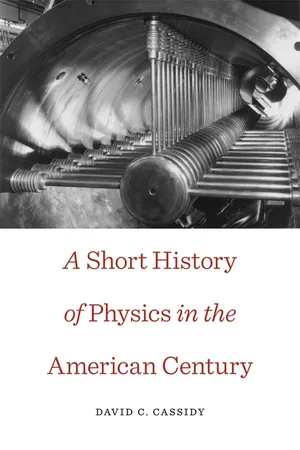
- 220 pages
- English
- PDF
- Available on iOS & Android
eBook - PDF
A Short History of Physics in the American Century
About this book
Information
Publisher
Harvard University PressYear
2011Print ISBN
9780674725829
9780674049369
eBook ISBN
9780674062740
Topic
Physical SciencesSubtopic
North American HistoryTable of contents
- Contents
- Introduction
- 1. Entering the New Century
- 2. American Physics Comes of Age
- 3. Surviving the Depression
- 4. The Physicists’ War
- 5. Taming the Endless Frontier
- 6. The New Physics
- 7. Sputnik: Action and Reaction
- 8. Revising the Partnership
- Appendix: Tables
- Notes
- Acknowledgments
- Index
Trusted by 375,005 students
Access to over 1.5 million titles for a fair monthly price.
Study more efficiently using our study tools.
Frequently asked questions
Yes, you can cancel anytime from the Subscription tab in your account settings on the Perlego website. Your subscription will stay active until the end of your current billing period. Learn how to cancel your subscription
No, books cannot be downloaded as external files, such as PDFs, for use outside of Perlego. However, you can download books within the Perlego app for offline reading on mobile or tablet. Learn how to download books offline
Perlego offers two plans: Essential and Complete
- Essential is ideal for learners and professionals who enjoy exploring a wide range of subjects. Access the Essential Library with 800,000+ trusted titles and best-sellers across business, personal growth, and the humanities. Includes unlimited reading time and Standard Read Aloud voice.
- Complete: Perfect for advanced learners and researchers needing full, unrestricted access. Unlock 1.5M+ books across hundreds of subjects, including academic and specialized titles. The Complete Plan also includes advanced features like Premium Read Aloud and Research Assistant.
We are an online textbook subscription service, where you can get access to an entire online library for less than the price of a single book per month. With over 1.5 million books across 990+ topics, we’ve got you covered! Learn about our mission
Look out for the read-aloud symbol on your next book to see if you can listen to it. The read-aloud tool reads text aloud for you, highlighting the text as it is being read. You can pause it, speed it up and slow it down. Learn more about Read Aloud
Yes! You can use the Perlego app on both iOS and Android devices to read anytime, anywhere — even offline. Perfect for commutes or when you’re on the go.
Please note we cannot support devices running on iOS 13 and Android 7 or earlier. Learn more about using the app
Please note we cannot support devices running on iOS 13 and Android 7 or earlier. Learn more about using the app
Yes, you can access A Short History of Physics in the American Century by David C. Cassidy in PDF and/or ePUB format, as well as other popular books in Physical Sciences & North American History. We have over 1.5 million books available in our catalogue for you to explore.