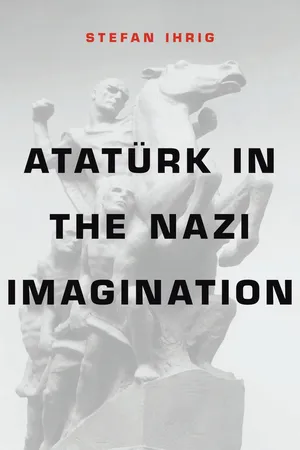
Early in his career, Adolf Hitler took inspiration from Benito Mussolini, his senior colleague in fascism—this fact is widely known. But an equally important role model for Hitler and the Nazis has been almost entirely neglected: Mustafa Kemal Atatürk, the founder of modern Turkey. Stefan Ihrig's compelling presentation of this untold story promises to rewrite our understanding of the roots of Nazi ideology and strategy.
Hitler was deeply interested in Turkish affairs after 1919. He not only admired but also sought to imitate Atatürk's radical construction of a new nation from the ashes of defeat in World War I. Hitler and the Nazis watched closely as Atatürk defied the Western powers to seize government, and they modeled the Munich Putsch to a large degree on Atatürk's rebellion in Ankara. Hitler later remarked that in the political aftermath of the Great War, Atatürk was his master, he and Mussolini his students.
This was no fading fascination. As the Nazis struggled through the 1920s, Atatürk remained Hitler's "star in the darkness," his inspiration for remaking Germany along nationalist, secular, totalitarian, and ethnically exclusive lines. Nor did it escape Hitler's notice how ruthlessly Turkish governments had dealt with Armenian and Greek minorities, whom influential Nazis directly compared with German Jews. The New Turkey, or at least those aspects of it that the Nazis chose to see, became a model for Hitler's plans and dreams in the years leading up to the invasion of Poland.
- 312 pages
- English
- ePUB (mobile friendly)
- Available on iOS & Android
eBook - ePub
Atatürk in the Nazi Imagination
About this book
Information
1
Turkish Lessons for Germany
The Turkish War of Independence as a Major Weimar Media Event, 1919–1923
For German nationalists, World War I and the German-Ottoman alliance ended in a disaster of truly biblical proportions—in the literal sense, as illustrations in satirical journals of the time aptly show with their depictions of the apocalyptic horsemen over Germany, Germany as a “national Jesus” suffering under the degradations of the Entente, or a French Genghis Khan laying waste to Germany.1 The sense of despair and the failure to understand events must have been paramount in these first years of the Weimar Republic. But World War I did not quite end everywhere in 1918. Violence continued in Russia with the Reds and the Whites fighting over huge stretches of territory. There was Freikorps activity in the Baltics, and there was Fiume (today’s Rijeka), where the men around the poet Gabriele D’Annunzio did not accept the proposed territorial changes, seized power, and tried to annex the city to Italy. If the events in Fiume were already well suited to spark the revisionist and militaristic imagination of German nationalists, then the events in Anatolia simply set it on fire.
The Ottoman army had been in disarray since the final stages of the war, lacking weaponry and ammunition and plagued by a large number of desertions. In the summer of 1919, Allied police patrolled the streets of Constantinople, and Christian minorities flew the flags of their nations and dreamed of creating their own states in the territory of the Ottoman Empire. There were plans to set up an independent Armenia, to give huge parts of western Anatolia to Greece, and perhaps even to form a second Greek or a Greco-Armenian Pontic state on the shores of the Black Sea. There was intensive lobbying activity in the United States to rid Europe of the Turks forever and expel them altogether, including from Constantinople. Greater Greek nationalist dreams—the Megali Idea (great idea) of reviving the Byzantine Empire, perhaps even with its capital at Constantinople—seemed to be within grasp when the Greek army occupied Smyrna and its hinterland in 1919. The occupation was executed at the behest of the Allies and in advance of a final peace treaty when the world was still “in session in Paris.” Allied gunships were pointing their canons at the centuries-old palaces of the Ottomans, and the sultan and his government gave in to Allied demands time and again in the years following the end of the war.
But then everything was to turn around. In May 1919 Mustafa Kemal Pasha landed in eastern Anatolia and, as the official historiography of the Turkish Republic tells us, the Turkish War of Independence began. Originally sent to reorganize Ottoman troops in the region, Mustafa Kemal began organizing a national resistance movement against the dismemberment of the Turkish heartland of Anatolia. Incited by fears of Greek expansionism and Armenian retribution, and eager to liberate Constantinople, the seat of the sultan-caliph, his movement rapidly gained in strength. The resistance not only had to fight the Armenians and the Greek army, but was de facto at war with all the Allied powers and for brief stretches fought the Ottoman army as well. And yet it was successful. In a struggle that lasted four years, from mid-1919 until mid-1923, the Turkish nationalists secured their homeland in the Treaty of Lausanne (1923), thereby revising a Paris peace treaty, the Treaty of Sèvres (1920).
In the eyes of a desperate and desolate Germany, this was a nationalist dream come true, or rather something like hypernationalist pornography. In this chapter, I will explore this German postwar fixation with the events in Turkey that bordered on the obsessive. A fixation that resulted in such an immense amount of newspaper coverage that by all definitions the Turkish War of Independence became a major media event of the new Weimar Republic.2 Take, for example, the testimony of Ernst Röhm, Hitler’s leader of the paramilitary SA (Sturmabteilung; Storm Detachment). He wrote in his memoirs that world politics in the weeks before Mussolini’s March on Rome (October 1922) had been entirely “dominated by the Turkish struggle for independence led by Kemal Pasha.”3 Or as the Nazi paper, the Völkische Beobachter put it at around the same time, in September 1922, Mustafa Kemal’s name was on everybody’s lips.4
The Nazis were also part of this desolate and desperate Germany that was watching Turkey obsessively. As we will see in this chapter and in Chapter 2, the Nazis “grew up” with Turkey and were even more excited than other German nationalists about the events in Turkey and the potential “Turkish lessons” for Germany. But before turning to the Nazis themselves, it is crucial to explore the broader German nationalist excitement about Turkey. The newspaper discourse as reconstructed in this chapter is not simply part of the background for the Nazi vision of Atatürk and the New Turkey that I explore in this book; it is much more, and it is directly connected to it all. The völkisch, and especially the Nazi, newspapers usually gave few reports on day-to-day events, and even fewer on foreign events. These papers consisted almost exclusively of running commentary by Nazi and völkisch authors on what was going on but without any actual coverage in these papers themselves. To understand their commentary, the imagined reader of a völkisch or Nazi paper needed to have information on current events, which they would have found only in the bigger, especially national, newspapers. Thus, the nationalist fringe papers presupposed that their readers would get their information about day-to-day events from other newspapers. Furthermore, völkisch authors wrote on Turkey and other topics not only for the völkisch papers but also for more mainstream newspapers. Given that we have little documentation on what the leading Nazis themselves thought of the world for the time before 1923/1924, and given the narrow focus of the Nazi and völkisch papers at that time, we must look at broader tendencies in postwar public discourse to grasp the significance of the topic “Turkey” in the ideas and thoughts of the völkisch and Nazi fringe of the early Weimar years.
“Nationalist pornography” aside—and this aspect unfolded its true force only in the course of the war—what might we expect of the potential press coverage on Turkey after the end of World War I? On the one hand, Germany had its hands full with the new democracy, the “red menace,” the problems it was facing in relation to the Entente (the winners of World War I), such as reparations and coming to terms with actually having lost the war, and much more besides. With good cause we tend to assume that German public discourse immediately after the war was focused exclusively on Germany—there was little reason to expect many in Germany to have the luxury to care about distant events like those in Anatolia—but, at the same time, we know surprisingly little about German media coverage of international events in these “years of crisis.” On the other hand, there was a specific German tradition of caring about the Orient and the Ottoman Empire, an Orientpolitik even, and a deep entanglement with the Ottoman Empire up until 1919. That empire had been an ally in the Great War and, particularly in Wilhelm II’s time, had been of very special interest to Germany. Not only had many German officers and soldiers fought on the Oriental front, but for much of World War I many different branches of the Ottoman military were under the command of German military pashas. And just like Germany, the Ottoman Empire exited the war as a loser. All this by itself could have merited at least some further attention from the German media. But in early 1919 news coverage of Turkey seemed to peter out. The armistices, to be confirmed by both the Treaty of Versailles and the Treaty of Sèvres, had put an end to official German-Turkish relations and required Germans in Turkey and Turks in Germany to return home. Now that the Germans in Constantinople had left, German Orientpolitik, “to which once great, fantastic hopes had been tied,” seemed to come to a close, as one paper put it on February 5, 1919.5
The German postwar newspaper forest was an especially thick and confusing one, with dozens of large papers, but with none with truly national reach as is the case in most societies today. To give us a good view of German nationalist media opinion, especially on the conservative to far right, I will discuss a whole range of newspapers. One paper in particular served as a backbone of the analysis here, the Neue Preussische Zeitung—called Kreuzzeitung because of the iron cross in its header.6 The Kreuzzeitung had been the flagship of conservatism in the Kaiserreich and had often featured Bismarck himself as a contributor; it had acquired something of a semiofficial status. In the early Weimar Republic it was a small but still very influential elite paper. Most politicians and other German elites, such as diplomats, priests, and the aristocracy, but most importantly journalists of the other papers, read it and frequently reacted to its articles in their own publications.7 Although its circulation was small in absolute numbers, it was perhaps the most important trendsetter in the center-to-right spectrum. In any case, as cross-checks with other papers show, its coverage of Turkey was well in line with and indeed representative of that of the other major papers. Like most papers of the time, the Kreuzzeitung had a morning and an evening edition. In the early Weimar Republic and therefore during the Turkish War of Independence, it was often a mere four pages thick; sometimes, by including special supplements, it ran up to ten pages. Usually only the first two pages and a small portion of the last page were available for nondomestic news. But within these pages, German topics clearly dominated the overall space available for political news. Thus, for any topic, but especially for nondomestic ones, space was extremely limited. Very often the front page was exclusively devoted to German politics. Furthermore, like other papers analyzed here, the Kreuzzeitung was closely aligned with the Deutschnationale Volkspartei (DNVP), which was one of the central revisionist, antidemocratic, and, as its championing of the stab-in-the-back myth betrays, also anti-Semitic parties.8 Because the völkisch and Nazi newspapers did not report much on foreign policy or day-to-day political developments, the Kreuzzeitung, the Deutsche Allgemeine Zeitung, and other papers with similar worldviews would have been German readers’ sources for such coverage. I will analyze a rather broad range of newspapers, including the Deutsche Zeitung, the Berliner Lokal-Anzeiger, the Vossische Zeitung, and the Deutsche Tageszeitung, and at times also the Frankfurter Zeitung and even the Social Democratic Vorwärts, in order to draw conclusions about the broader political atmosphere of the time, not just the center right and far right. I will look at not only elite papers but also a variety of “mass papers” and tabloids to shed light on overall media trends.9 I have also included satirical papers like the Kladderadatsch, which by itself already encapsulates all the central points of this German excitement for and obsession with Turkey.
Given the widespread aversion to the new democracy and the Treaty of Versailles, the political center is exceedingly difficult to locate in the immediate postwar years. And even centrist papers, such as the rather republican and liberal Vossische Zeitung, often expressed views similar to those of the farther right when it came to Turkey. Surprisingly perhaps, even the Social Democrat Vorwärts sometimes, but obviously not always, converged with the overall trends of coverage of the Turkish War of Independence. The whole spectrum of newspapers, from the nationalist center to the fringe far-right, developed an almost monolithic discourse on Turkey in combination with an overall high frequency of reporting.
While it is true that “Germany” was the main prism of all the news, domestic and international, “Turkey” had a very central place in all of this. The press simply turned the Turkish War of Independence into a German media event, ever-present and widely debated. It was relevant to Germany as a fascinating and continuing news story, not least because it had all the qualities of an epic. The events in Anatolia had a larger significance, beyond Turkey, and this was clear to German observers from the start. From very early on, the German press recognized that...
Table of contents
- Cover
- Title Page
- Copyright
- Dedication
- Contents
- Prologue: Leaving “Enverland”
- 1. Turkish Lessons for Germany: The Turkish War of Independence as a Major Weimar Media Event, 1919–1923
- 2. “Ankara in Munich”: The Hitler Putsch and Turkey
- 3. Hitler’s “Star in the Darkness”: Nazi Admiration for Atatürk and His New Turkey
- 4. The “Turkish Führer”: Nazi Hagiography and National Education
- 5. The New Turkey: Nazi Visions of a Modern Völkisch State
- 6. The Second World War and Turkey: Another Spain?
- Epilogue: First to Stone, Then to Dust
- Note on Sources and Historiography
- Notes
- Acknowledgments
- Index
Trusted by 375,005 students
Access to over 1.5 million titles for a fair monthly price.
Study more efficiently using our study tools.
Frequently asked questions
Yes, you can cancel anytime from the Subscription tab in your account settings on the Perlego website. Your subscription will stay active until the end of your current billing period. Learn how to cancel your subscription
No, books cannot be downloaded as external files, such as PDFs, for use outside of Perlego. However, you can download books within the Perlego app for offline reading on mobile or tablet. Learn how to download books offline
Perlego offers two plans: Essential and Complete
- Essential is ideal for learners and professionals who enjoy exploring a wide range of subjects. Access the Essential Library with 800,000+ trusted titles and best-sellers across business, personal growth, and the humanities. Includes unlimited reading time and Standard Read Aloud voice.
- Complete: Perfect for advanced learners and researchers needing full, unrestricted access. Unlock 1.5M+ books across hundreds of subjects, including academic and specialized titles. The Complete Plan also includes advanced features like Premium Read Aloud and Research Assistant.
We are an online textbook subscription service, where you can get access to an entire online library for less than the price of a single book per month. With over 1.5 million books across 990+ topics, we’ve got you covered! Learn about our mission
Look out for the read-aloud symbol on your next book to see if you can listen to it. The read-aloud tool reads text aloud for you, highlighting the text as it is being read. You can pause it, speed it up and slow it down. Learn more about Read Aloud
Yes! You can use the Perlego app on both iOS and Android devices to read anytime, anywhere — even offline. Perfect for commutes or when you’re on the go.
Please note we cannot support devices running on iOS 13 and Android 7 or earlier. Learn more about using the app
Please note we cannot support devices running on iOS 13 and Android 7 or earlier. Learn more about using the app
Yes, you can access Atatürk in the Nazi Imagination by Stefan Ihrig in PDF and/or ePUB format, as well as other popular books in History & 20th Century History. We have over 1.5 million books available in our catalogue for you to explore.