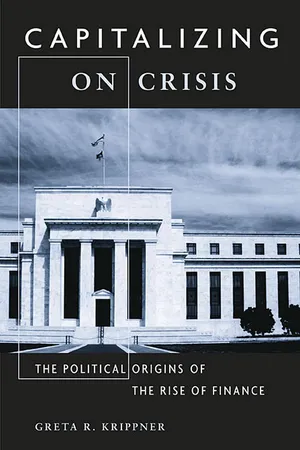
In the context of the recent financial crisis, the extent to which the U.S. economy has become dependent on financial activities has been made abundantly clear. In Capitalizing on Crisis, Greta Krippner traces the longer-term historical evolution that made the rise of finance possible, arguing that this development rested on a broader transformation of the U.S. economy than is suggested by the current preoccupation with financial speculation.
Krippner argues that state policies that created conditions conducive to financialization allowed the state to avoid a series of economic, social, and political dilemmas that confronted policymakers as postwar prosperity stalled beginning in the late 1960s and 1970s. In this regard, the financialization of the economy was not a deliberate outcome sought by policymakers, but rather an inadvertent result of the state's attempts to solve other problems. The book focuses on deregulation of financial markets during the 1970s and 1980s, encouragement of foreign capital into the U.S. economy in the context of large fiscal imbalances in the early 1980s, and changes in monetary policy following the shift to high interest rates in 1979.
Exhaustively researched, the book brings extensive new empirical evidence to bear on debates regarding recent developments in financial markets and the broader turn to the market that has characterized U.S. society over the last several decades.
- 222 pages
- English
- ePUB (mobile friendly)
- Available on iOS & Android
eBook - ePub
About this book
Information
Publisher
Harvard University PressYear
2012Print ISBN
9780674066199
9780674050846
eBook ISBN
9780674735316
CHAPTER ONE
Introduction
IN 1967, the sociologist, cultural critic, and social forecaster Daniel Bell made a prediction about U.S. society in the year 2000. Observing the social and political turmoil of the late 1960s, Bell argued that the state would become embroiled in explosive social conflict as its role in managing economy and society became increasingly politicized. He wrote, “The only prediction about the future that one can make with certainty is that public authorities will face more problems than they have at any time in history” (1967: 7; emphasis added). But this prediction was not borne out. A second prediction, for which Bell is better known, was linked to the first and fared considerably better. Bell (1973) suggested that the trend already evident toward the dominance of services in the U.S. economy would continue, inaugurating a “postindustrial’ society by century’s end. This prediction that the dramatic ascent of services would define the contours of the economic structure of late twentieth-century society was realized, although with a slight twist: rather than the rise of services in a generic sense, the rise of a particular kind of service—finance—proved to be the dominant trend in subsequent decades.1
Bell was more prescient than is suggested by a superficial accounting of how well his two predictions performed, however. Indeed, Bell never intended his forecasts as “point-in-time” predictions, but rather as “speculative constructs” against which developments in later decades could be compared in order to tease out the forces shaping the changing structure of society (Bell 1973: lxxxvii).2 Looking backward from the year 2000, it is possible to discern a different relationship between Bell’s successful and unsuccessful prognostications than Bell himself posed looking forward to the millennium. Bell had assumed that the main driver of the growth of services would be the public sector as a “revolution of rising entitlements” led to ever-expanding demands for state provision. The resulting burden on the state would increase inflationary pressures, undermining the ability of policymakers to negotiate competing social demands and plunging the state into political conflicts over the allocation of scarce resources (Bell 1973, 1976). But, as we now know, the growth of the service economy in the post-1970s period was accompanied not by the expansion of state provision but by a dramatic turn to the market. In fact, this turn to the market—in particular, the turn to financial markets—was integrally related to the crisis that did not materialize for the state.
The central thesis of this book is that the turn to finance allowed the state to avoid a series of economic, social, and political dilemmas that confronted policymakers beginning in the late 1960s and 1970s, paradoxically preparing the ground for our own era of financial manias, panics, and crashes some three decades later. In the following pages, I develop this argument by introducing the notion of financialization as a more specific way of describing the underlying shift in the structure of the U.S. economy that Bell identified with the term “post-industrialism.”3 By financialization, I refer to a broad-based transformation in which financial activities (rather than services generally) have become increasingly dominant in the U.S. economy over the last several decades. Although changes in firm strategy, market structure, and the availability of new technologies all shaped financialization, the state was not merely passive in this transformation. Rather, as policymakers improvised solutions to the various difficulties that Bell and other observers writing in the late 1960s and 1970s believed would soon overwhelm the state,4 they constructed a policy regime that deepened and extended the turn to finance in the U.S. economy. Thus financialization was not a deliberate outcome sought by policymakers but rather an inadvertent result of the state’s attempts to solve other problems.
This element of inadvertency is worth underscoring. A starting point for many accounts of the rise of the market in the period since the 1970s is Karl Polanyi’s (2001: 147) famous dictum that “laissez-faire was planned”—that is, that “freeing” the market has required the active hand of state intervention.5 The account presented in this book is in fundamental agreement with the Polanyian view that state action was absolutely central in producing conditions conducive to financialization through the deregulation of financial markets and other related policy changes typically captured under the rubric of “neoliberalism.”6 But it takes a step away from overly voluntarist conceptions of this role by suggesting that the rise of the market resulted from a series of contingent discoveries on the part of policymakers. Laissez-faire may have been planned, but this planning process was an emergent one, subject to trial and error, and not nearly as seamless as it has sometimes been presented.
In emphasizing how the state’s efforts to extricate itself from the crisis conditions of the late 1960s and 1970s sowed the seeds of the turn to finance in the U.S. economy, this book offers a rather different perspective on financialization than offered by existing accounts. The conventional way of understanding the rise of finance is to suggest that the U.S. economy has been caught in the grip of a speculative mania in recent years, pulling households and firms alike into the vortex created by spiraling asset values (Shiller 2000, 2008). A second, very different perspective on financialization points to the emergence of new conceptions of management, arguing that the notion of “shareholder value” has reoriented firms to financial markets, reorganizing the broader society in what sociologist Gerald Davis (2009) refers to as a “Copernican Revolution”7 (cf. Fligstein 2001). A third approach associated with Marxist and world-systems theories interprets the turn to finance as rooted in the crisis of the 1970s, but views this as a structural pattern generated by deep-seated tendencies operating at the level of capitalist system as a whole (Arrighi 1994; Bellamy Foster and Magdoff 2009; Harvey 2003). Although all three perspectives have a great deal to offer to our understanding of recent developments in U.S. political economy, none provides a fully satisfactory account of the role of the state in shaping the turn to finance or, conversely, of the role of the turn to finance in shaping the state (but see Davis 2009: chap. 6).
The Rise of Finance
There is little question that the U.S. economy has experienced a remarkable turn toward financial activities in recent years. By the time the U.S. stock market was cresting in 2001, financial sector profits had rocketed up to represent more than 40 percent of total profits in the U.S. economy.8 This figure, although striking, actually underestimates the importance of financial activities in the U.S. economy, as nonfinancial firms too have become increasingly dependent on financial revenues as supplement to—or at times substitute for—earnings from traditional productive activities. One careful study, for example, showed that the Ford Motor Company, the quintessential American manufacturing company, has in recent years generated its profits primarily by selling loans to purchase cars rather than through the sale of the cars themselves (Froud et al. 2006). Like Ford, General Motors, and General Electric, many U.S. nonfinancial firms own captive financial companies, and even for those firms that are not owners of financial services operations, managing financial investments has become a major focus of activity—and profits (see Davis 2009; Fligstein 2001). As one Morgan Stanley investment strategist observed, “Corporate America is rapidly becoming Bank America.”9
In this book, I describe these trends with the term “financialization,” which I use to refer to the tendency for profit making in the economy to occur increasingly through financial channels rather than through productive activities (cf. Arrighi 1994). Here “financial” references the provision (or transfer) of capital in expectation of future interest, dividends, or capital gains; by “productive,” I refer to the range of activities involved in the production or trade of commodities. In offering this definition of financialization, I do not intend to mystify the distinction between “finance” and “production,” nor to suggest that financial activities are necessarily unproductive.10 Financial and productive activities are closely related to each other, and much financial activity supports production—although clearly not all of it does (Harvey 1999; Leyshon and Thrift 2007). It is nonetheless possible to draw a distinction between profits realized on the car loan and profits made on the sale of the car, even though the one facilitates the other. To suggest that the economy has become financialized is to claim that the balance between these two sets of activities has swung strongly toward finance, not that the financial economy has become entirely uncoupled from production.
Speculative Manias
The existing literature offers at least three distinct vantage points on this transformation, each emphasizing different (and sometimes incongruous) aspects of the rise of finance. The most prevalent view—especially in the wake of the recent financial crisis—treats the growing importance of financial activities in the economy as a consequence of a speculative mania that carried first equities and then real estate prices to unsustainable levels in the 1980s, 1990s, and 2000s (Shiller 2000, 2008). The popular notion that a financial bubble developed in the U.S. economy in recent years, shaping (or more aptly, distorting) patterns of economic activity, rests on a now venerable academic literature that contests the idea that financial markets are “efficient.”11 Arguments for market efficiency make the claim that assets traded on financial markets are always valued correctly, because if they were not, traders (or arbitrageurs) could profit by buying or selling mispriced assets—quickly eliminating any divergence from fundamental values. Economists from a variety of different approaches have cast doubt on the efficient markets hypothesis, suggesting that situations exist where the only reason that a financial asset is priced highly today is the expectation that its price will be still higher tomorrow (Stiglitz 1990). Once such expectations are unleashed, prices in financial markets can quickly become divorced from intrinsic values—the defining characteristic of a speculative mania.
The key to this perspective is the claim that the mechanisms that generate bubbles are endogenous to financial markets. In this respect, theories of speculative bubbles directly contradict the efficient markets hypothesis, which sees market processes as tending naturally toward equilibrium until interrupted by some unexpected, external event (Cooper 2008: 13). In contrast, bubble theories view processes internal to markets as inherently destabilizing rather than stabilizing. For theorists of speculative bubbles, an external event may precipitate a speculative mania, but this external shock is not the ultimate source of instability. For example, in economic historian Charles Kindleberger’s (1978) well-known theory of financial manias—which draws on the ideas of heterodox economist Hyman Minsky (1975, 1982, 1986)—a speculative episode begins when some “displacing event” changes profit opportunities in the economy. The event that initiates a speculative mania may take a variety of forms—the introduction of a new technology, a bumper harvest or a crop failure, war or the cessation of war, or a policy mistake. But whatever the nature of the displacing event, it sets into motion social and psychological processes intrinsic to financial markets that quickly build into a speculative mania (cf. Shiller 2000).
In particular, the tendency of economic actors to become overconfident over the course of a business expansion creates a sense of euphoria among investors. In this context, the belief that asset prices will continue their upward trajectory becomes a self-fulfilling prophecy as investors acting on this belief propel markets higher. In addition, credit standards tend to deteriorate during periods of financial exuberance, allowing speculators to leverage their bets and further inflating asset prices. Paradoxically, this expansion of credit makes the economy vulnerable to a sudden reversal should optimism turn sour on the news of a bankruptcy, a financial scandal, or any other development that causes investors to revise their expectations—events that are increasingly likely as the economy comes to rest on a precarious foundation of debt-fueled growth. Once expectations turn negative, the same self-fulfilling prophecies that fueled the boom on the way up can quickly give way to panic on the way down. In this manner, the economy cycles between boom and bust, as periods of prosperity engender excessive risk-taking and the accumulation of unsustainable levels of debt, eventually bringing the crash and starting the cycle anew (Minsky 1982, 1986).
For Kindleberger and Minsky, the state has a critical role to play in mitigating the depth and intensity of these cycles by acting as a lender of last resort, providing liquidity to distressed financial institutions during periods of panic. Of course, this role is a tricky one: if financial institutions know that they will be bailed out, they are encouraged to speculate with abandon, making the crash more severe when it finally comes (see especially Minsky 1982, 1986). But these theorists ultimately remain confident that, with some trial and error, policymakers are capable of reining in excesses and containing the credit expansion that drives the boom. Minsky (1986: 11) notes, “Incoherence need not be fully realized because institutions and policy can contain the thrust to instability. We can, so to speak, stabilize instability.” To the extent that the state fails to do this, the failure is typically conceptualized as an intellectual one—policymakers simply do not understand that the boom rests on unsustainable asset price movements, often because they have fallen under the sway of the efficient markets hypothesis (e.g., Cooper 2008; Shiller 2008). In this regard, policy imperfections can be addressed by providing policymakers with a correct model of financial market behavior.
There is little doubt that asset price bubbles—typically in the stock market, but also in real estate markets—have played a significant role in propelling the rise of finance in the U.S. economy in recent years. But there are also some important limitations associated with a perspective that understands financialization solely in terms of speculative dynamics in financial markets. The most important is that in focusing on intrinsic properties of financial markets, this approach treats the state and politics as exogenous to the analysis. In other words, although state actions may provide the trigger that sparks a speculative mania, and although the state may also attempt to contain the mania once it is under way, these actions are outside the frame of what is to be explained. This in part accounts for the overly sanguine view of the state’s role in managing financial manias in this literature—a corollary of the position that instability is generated by processes internal to financial markets is a rather benign view of the state as a source of stability. More broadly, the emphasis on processes internal to financial markets also means that this approach cannot explain why certain historical periods seem more prone to episodes of financial exuberance than others. To understand why the decades since the 1970s have been characterized by serial asset price bubbles, for example, we cannot simply point to the tendency of investors to become overconfident following a period of sustained prosperity (because this tendency is not unique to the post-1970s period).12 Rather, it is necessary to put speculative manias on a wider analytical canvas by investigating the social and political conditions that provided fertile ground for the turn to finance in the U.S. economy over the past several decades. Such an analysis suggests that financialization represents a broader transformation of the economy, with deeper historical roots, than is indicated by a focus on speculative manias.
Shareholder Value
The sociological literature on the emergence of “shareholder value,” developed primarily by organizational theorists, offers a second perspective on the rise of finance in the U.S. economy. This literature broadens the analysis from processes internal to financial markets to examine the relationship between nonfinancial firms, financial sector actors, and the state in creating and enforcing a new paradigm for management. The concerns of this literature are somewhat orthogonal to the literature on speculative manias, as the objective is not to explain how speculative bubbles emerge and develop, but rather to examine the growing orientation of nonfinancial firms to financial markets (Davis 2009). Although these are ostensibly quite different problems, both are relevant for the more general problem of understanding why finance and financial activities have assumed greater salience in the economy in recent years.
The literature on shareholder value contains multiple strands, but it is possible to distill from various contributions a more or less unified account of the basic transformations driving the turn to finance in the U.S. economy in recent decades (e.g., Davis 2009; Davis, Diekmann, and Tinsley 1994; Davis and Stout 1992; Davis and Thompson 1994; Dobbin and Zorn 2005; Fligstein 2001, 2005; Lazonick and O’Sullivan 2000; Useem 1996; Zorn et al. 2004). The notion of “shareholder value” refers to the idea that the sole purpose of the firm is to return value—in the form of an appreciating share price—to the owners of the company. The central question raised by this literature is how shareholder value became the privileged metric for assessing corporate success (or failure) in the 1980s and 1990s13—with attendant changes in corporate governance that have drawn nonfinancial firms increasingly into the orbit of financial markets. Rather than viewing this development simply as an “efficient” solution to problems posed by the separation of ownership and control of corporations,14 sociologists offer a nuanced historical account that sees the emergence of shareholder value as the outcome of a fundamental reconceptualization of the nature of the firm (Davis 2009; Davis, Diekmann, and Tinsley 1994; Espeland and Hirsch 1990; Fligstein 2001).
According to this account, the shareholder value revolution rested on an earlier transformation in which firms came to be viewed as “bundles of assets” rather than as bounded entities with discrete organizational identities centered on a product or industry (Davis 2009; Espeland and Hirsch 1990; Fligstein 1990, 2001). This “portfolio theory of the firm” was associated with the construction of large conglomerates in the 1950s and 1960s in which risk diversification was achieved by combining firms in unrelated industries, much as a mutual fund attempts to diversify risk by spreading capital across unrelated investments. The creation of these sprawling enterprises was encouraged by the passage of a law in 1950 restricting horizontal and vertical mergers, with the result that in order to grow, firms had to combine businesses in unrelated lines. The conglomerate strategy was also promoted by finance executives, whose own power inside firms rose w...
Table of contents
- Cover
- Title
- Copyright
- Dedication
- Contents
- List of Figures
- Acknowledgments
- 1 Introduction
- 2 What Is Financialization?
- 3 The Social Politics of U.S. Financial Deregulation
- 4 The Reagan Administration Discovers the Global Economy
- 5 The Making of U.S. Monetary Policy
- 6 Conclusion
- Appendix A: Notes on Sources
- Appendix B: Interview Subjects
- Appendix C: Economic Data
- Notes
- References
- Index
Trusted by 375,005 students
Access to over 1.5 million titles for a fair monthly price.
Study more efficiently using our study tools.
Frequently asked questions
Yes, you can cancel anytime from the Subscription tab in your account settings on the Perlego website. Your subscription will stay active until the end of your current billing period. Learn how to cancel your subscription
No, books cannot be downloaded as external files, such as PDFs, for use outside of Perlego. However, you can download books within the Perlego app for offline reading on mobile or tablet. Learn how to download books offline
Perlego offers two plans: Essential and Complete
- Essential is ideal for learners and professionals who enjoy exploring a wide range of subjects. Access the Essential Library with 800,000+ trusted titles and best-sellers across business, personal growth, and the humanities. Includes unlimited reading time and Standard Read Aloud voice.
- Complete: Perfect for advanced learners and researchers needing full, unrestricted access. Unlock 1.5M+ books across hundreds of subjects, including academic and specialized titles. The Complete Plan also includes advanced features like Premium Read Aloud and Research Assistant.
We are an online textbook subscription service, where you can get access to an entire online library for less than the price of a single book per month. With over 1.5 million books across 990+ topics, we’ve got you covered! Learn about our mission
Look out for the read-aloud symbol on your next book to see if you can listen to it. The read-aloud tool reads text aloud for you, highlighting the text as it is being read. You can pause it, speed it up and slow it down. Learn more about Read Aloud
Yes! You can use the Perlego app on both iOS and Android devices to read anytime, anywhere — even offline. Perfect for commutes or when you’re on the go.
Please note we cannot support devices running on iOS 13 and Android 7 or earlier. Learn more about using the app
Please note we cannot support devices running on iOS 13 and Android 7 or earlier. Learn more about using the app
Yes, you can access Capitalizing on Crisis by Greta R. Krippner in PDF and/or ePUB format, as well as other popular books in Social Sciences & Economic History. We have over 1.5 million books available in our catalogue for you to explore.