Listen to a short interview with Giles SladeHost: Chris Gondek | Producer: Heron & Crane
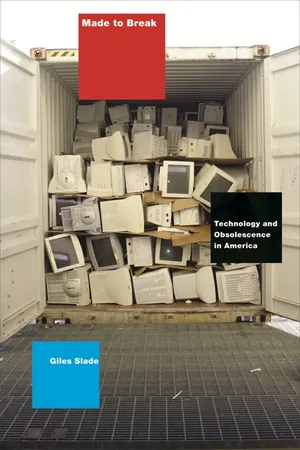
If you've replaced a computer lately--or a cell phone, a camera, a television--chances are, the old one still worked. And chances are even greater that the latest model won't last as long as the one it replaced. Welcome to the world of planned obsolescence--a business model, a way of life, and a uniquely American invention that this eye-opening book explores from its beginnings to its perilous implications for the very near future.
Made to Break is a history of twentieth-century technology as seen through the prism of obsolescence. America invented everything that is now disposable, Giles Slade tells us, and he explains how disposability was in fact a necessary condition for America's rejection of tradition and our acceptance of change and impermanence. His book shows us the ideas behind obsolescence at work in such American milestones as the inventions of branding, packaging, and advertising; the contest for market dominance between GM and Ford; the struggle for a national communications network, the development of electronic technologies--and with it the avalanche of electronic consumer waste that will overwhelm America's landfills and poison its water within the coming decade.
History reserves a privileged place for those societies that built things to last--forever, if possible. What place will it hold for a society addicted to consumption--a whole culture made to break? This book gives us a detailed and harrowing picture of how, by choosing to support ever-shorter product lives we may well be shortening the future of our way of life as well.
- 337 pages
- English
- PDF
- Available on iOS & Android
eBook - PDF
About this book
Information
Publisher
Harvard University PressYear
2009Print ISBN
9780674025721
9780674022034
eBook ISBN
9780674043756
Table of contents
- Contents
- Introduction
- 1 Repetitive Consumption
- 2 The Annual Model Change
- 3 Hard Times
- 4 Radio, Radio
- 5 The War and Postwar Progress
- 6 The Fifties and Sixties
- 7 Chips
- 8 Weaponizing Planned Obsolescence
- 9 Cell Phones and E-Waste
- Notes
- Acknowledgments
- Index
Trusted by 375,005 students
Access to over 1.5 million titles for a fair monthly price.
Study more efficiently using our study tools.
Frequently asked questions
Yes, you can cancel anytime from the Subscription tab in your account settings on the Perlego website. Your subscription will stay active until the end of your current billing period. Learn how to cancel your subscription
No, books cannot be downloaded as external files, such as PDFs, for use outside of Perlego. However, you can download books within the Perlego app for offline reading on mobile or tablet. Learn how to download books offline
We are an online textbook subscription service, where you can get access to an entire online library for less than the price of a single book per month. With over 1.5 million books across 990+ topics, we’ve got you covered! Learn about our mission
Look out for the read-aloud symbol on your next book to see if you can listen to it. The read-aloud tool reads text aloud for you, highlighting the text as it is being read. You can pause it, speed it up and slow it down. Learn more about Read Aloud
Yes! You can use the Perlego app on both iOS and Android devices to read anytime, anywhere — even offline. Perfect for commutes or when you’re on the go.
Please note we cannot support devices running on iOS 13 and Android 7 or earlier. Learn more about using the app
Please note we cannot support devices running on iOS 13 and Android 7 or earlier. Learn more about using the app
Yes, you can access Made to Break by Giles Slade in PDF and/or ePUB format, as well as other popular books in Technology & Engineering & Science History. We have over 1.5 million books available in our catalogue for you to explore.