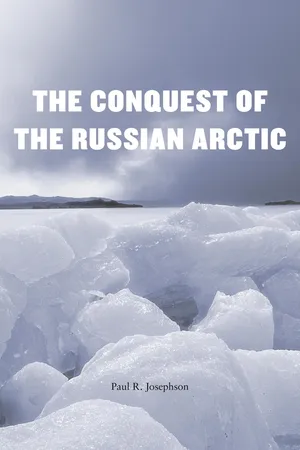
Spanning nine time zones from Norway to the Bering Strait, the immense Russian Arctic was mostly unexplored before the twentieth century. This changed rapidly in the 1920s, when the Soviet Union implemented plans for its conquest. The Conquest of the Russian Arctic, a definitive political and environmental history of one of the world's remotest regions, details the ambitious attempts, from Soviet times to the present, to control and reshape the Arctic, and the terrible costs paid along the way.
Paul Josephson describes the effort under Stalin to assimilate the Arctic into the Soviet empire. Extraction of natural resources, construction of settlements, indoctrination of nomadic populations, collectivization of reindeer herding—all was to be accomplished so that the Arctic operated according to socialist principles. The project was in many ways an extension of the Bolshevik revolution, as planners and engineers assumed that policies and plans that worked elsewhere in the empire would apply here. But as they pushed ahead with methods hastily adopted from other climates, the results were political repression, destruction of traditional cultures, and environmental degradation. The effects are still being felt today. At the same time, scientists and explorers led the world in understanding Arctic climes and regularities.
Vladimir Putin has redoubled Russia's efforts to secure the Arctic, seen as key to the nation's economic development and military status. This history brings into focus a little-understood part of the world that remains a locus of military and economic pressures, ongoing environmental damage, and grand ambitions imperfectly realized.
- 441 pages
- English
- ePUB (mobile friendly)
- Available on iOS & Android
eBook - ePub
The Conquest of the Russian Arctic
About this book
Information
1
Charting the Arctic Landscape
In winter, the persistent Arctic night; in the summer, the unending Arctic sun. Under those two extremes lay a landscape rich in natural and mineral resources, but with inadequate infrastructure to develop them. Beginning in the second half of the nineteenth century, Russian explorers turned their attention increasingly to the polar regions of the empire to chart them. In some cases they followed expeditions of Norwegian, Danish, and British explorers and businessmen who recognized the vast natural and mineral wealth of the northern regions, especially fish, but also lumber, graphite, and some diamonds and gold. The Russians followed not because of lack of interest or any hesitancy associated with fear, but because of the lack of support of their professional scientific societies, disbelief that such modern technologies as icebreakers might enable exploration, and insufficient government funding.
With the turn of the twentieth century and the grudging recognition among Tsarist bureaucrats of the economic and military significance of the region from Arkhangelsk on the White Sea shore to Novaia Zemlia between 70° and 78° north latitude that serves as the “border” between the Barents and Kara seas, explorers and scientists began to make their way into the treacherous Arctic Ocean with its short navigation season from late June to mid-autumn. They sought a Northern Sea Route around Norway, past the Kola Peninsula, through the Barents Sea, perhaps near the Novaia Zemlia island archipelago and through the Kara Gates or south to Vaigach Island and through the Iugorskii Strait to the Kara Sea.1 Steamers skirted the north Siberian coast through the Laptev Sea, the East Siberian Sea, and the Bering Strait to the Pacific Ocean.
Gradually, captains and explorers learned about the Arctic basin navigation season, ice floes, cyclones, and currents that made passage hazardous. They learned about the rich geology of the region, of coal, iron ore, and later oil and gas. They identified extensive fisheries that Norwegian sailors had already managed to exploit with motorboats, while the local Pomor fisherman struggled to fish with sailboats. Often out of foolish haste they belatedly realized the dangers associated with Arctic exploration; they knew little of water chemistry, ice regime, and weather patterns, and they did not have the icebreakers and research vessels appropriate to explore the Arctic seas. Until discovery of extensive fossil fuel, mineral, and other resources in the twentieth century, fishing was the most important activity of local residents and international visitors.
But geopolitics further stimulated Arctic exploration. Ultimately, Tsar Nicholas II determined to compete with European, Chinese, and Japanese interests in the Far East. This accelerated the development of the Northern Sea Route, both for its own sake and to assist in and accompany the construction of the Trans-Siberian Railway. For reasons of national self-determination and national defense and growing recognition of the extent of natural resources, the episodic nature of exploration and discovery of the Russian Arctic ended in the 1920s. Augmented by the Bolshevik certainty that explorers could conquer all obstacles, an atmosphere dedicated to promoting new Soviet heroes, and determined leadership under Joseph Stalin, Arctic assimilation accelerated in the 1930s. There would be countless victims of the Arctic, of the weather, the ice, the backward technology, and also of the Stalinist prison labor camps and purges. But welcoming significant government support, polar explorers charted the great wealth of the region, ethnographers studied the indigenous people of the region, and political operatives set out to reorder the region in the name of modernity.
Early Russian Efforts in the Arctic
In one of the first major Russian expeditions in the mid-1880s, the poet and amateur naturalist Konstantin Sluchevskii traveled more than 11,000 kilometers, 8,000 by ship, through the Russian north, accompanying the Grand Duke and brother of Tsar Nicholas II, Vladimir Alexandrovich. One of his goals was to get a sense of daily life of local residents. In their lengthy travels they visited a whaling factory, opened in 1883 on the Ura Bay northwest of today’s Murmansk on the Kola Peninsula. Founded in the 1860s, by this time Ura had 200 residents in the summer months, most of whom were male. The men sailed in fifteen undecked whaling boats and while ashore tended seventy-four head of cattle, sixty sheep, 309 reindeer, and one horse. Meanwhile the woman folk apparently remained in Kem on the White Sea coast. In addition to modest whale harvesting the men caught sharks for their oil and fat. Sluchevskii found little of interest in the factory, but learned about the Pomor people—Russian and Norwegian settlers whose life centered on the sea, which they feared for its unpredictability and which they had personified in their dialect. Hiking with some difficulty some 200 meters up the Murman fjord, Sluchevskii and the Grand Duke viewed the landscape—“endless tundra, swamp, low-growing forest, completely devoid of human habitation and roads, if you don’t consider those shacks in numbers of one or two, dispersed at great distances.”2
As those explorers who followed him, Sluchevskii saw great promise in development of northern resources, but also tremendous challenges. The British and Norwegians fished extensively in the region, not so the Russians, and the most successful local residents were Finns. Sluchevskii noted a large number of bays with potential to serve as a permanent sheltered harbor for the Russian merchant marine and navy. But the main point was how the region remained so undefended and the fact that the Ekaterina harbor (now Murmansk, a city of 250,000 people) and the entire Arctic northwest were so desolate, with the people at great risk from the elements and ignored by the tsars in their poverty and in poor health. The Tsarist government made small steps to end the isolation with limited and indirect support with the construction of a railroad across the Kola Peninsula during World War I, in part built with slave labor, to permit military supplies to reach Petrograd and Moscow from the north.3 This has been a long pattern of Russian history for the government actively to promote technological change only in a moment of crisis—usually some military defeat and always with a self-conscious recognition among thinking statesmen about how backward Russia was in comparison with European powers—in fact, this has persisted under the Tsars and the Soviets and in the Russian Federation under Presidents Medvedev and Putin.
By the mid-nineteenth century sea captains knew that the extension of the Gulf Stream (the North Atlantic drift) made it all the way to the Barents Sea and even to the shores of Novaia Zemlia, a phenomenon first predicted in 1848 on the basis of the comparatively high air temperatures observed in Arctic regions. In 1870 the Russian Alexander Middendorff explored Novaia Zemlia and the Taimyr Peninsula, followed by Fridtjof Nansen, who explored the Siberian Arctic on the “Fram” from 1893–96, and Roald Amundsen in the small sloop “Gjøa,” equipped with a thirteen-horsepower engine, who was the first to traverse Canada’s northwest passage in a three-year journey beginning in 1902, and all of whom contributed to understanding of Arctic conditions, climate, and resources.4
The Gulf Stream keeps Murmansk, some 200 kilometers north of the Arctic Circle, ice free year-round. In 1871 the Ministry of Finance formed a commission to look at the construction of a port to support the development of the rich Barents Sea fisheries and establish a military presence. After a survey, the commission determined to equip Kildin Island roughly at the entrance to the Murmansk fjord. The commission also considered a site 350 kilometers to the southeast on the Iokanskie Islands protected by Cape Sviatyi Nos—a very small naval base was established here in 1915.5 The cape divides the Barents and White seas, and a beautiful lighthouse sits above the water, rich with marine wildlife. The Pomors had a proverb about the rich fisheries near Sviatyi Nos: “Wherever fish swim, they do not miss Sviatyi Nos.” The Soviet Union later established a submarine base here.
There were several stimuli to more extensive exploration of the Northern Sea Route at the turn of the century. One was the economic wealth of Siberia. Between 1893 and 1899 several British companies struggled to establish regular commercial voyages to the Ob and Enisei rivers to engage in trade for lumber, gold, and other products. But they eventually tired of fighting the short navigation season. Moving ice floes that varied in thickness from two to six meters hampered sailing at the best of times. The absence of year-round meteorological stations precluded any regular weather communications.6 An 1893 expedition to bring rails and other equipment from England indicated how inadequate knowledge and equipment prevented normal transport. On July 18, a crew of six officers, a doctor, and forty-three sailors from Kronstadt Naval Base departed Dumbarton for the Enisei River with fourteen months of food supplies. The Tsarist government decided not to finance the trip, but the Committee for the Siberian Railroad secured support from the Englishman Francis Leyborne-Popham who organized a convoy under the direction of Captain Joseph Wiggins. Wiggins had made a series of cargo trips supported by British syndicates.7 Wiggins, with 1,500 tons of rail destined for the Trans-Siberian Railway and several vessels, joined the Russians at Varde on August 5, 1893. Wiggins’s knowledge of the Kara Sea, in spite of the fact he had traveled to the Enisei and Ob at least eight times, was primitive; he did not even have charts based on his previous voyages. The expedition ran into all sorts of bad luck including an “orgy of storms” and inadequate conditions on arrival. Six barges at Golchika on the upper reaches of the Enisei met the ships, all in poor condition and springing leaks; three of them sank immediately with nearly 3,000 rails on them, although apparently most of the rails were recovered the following year. The Committee of the Siberian Railroad nevertheless declared the expedition successful.8
Not only economic interests stimulated Arctic research; concern about the precarious life of the Pomor also played a role. In 1898 the oceanographer Nikolai Knipovich initiated the “Expedition for Fisheries Research off the Coasts of Murman.” He commenced the research in response to a freak storm that devastated Pomor fishing communities and the failure of the Tsarist government to respond with emergency support; of course, governments have learned glacially throughout the twentieth century how to respond to natural and other disasters. As a first step, Knipovich carried out survey work from a small sailing vessel, Pomor, to study meteorological and oceanographic conditions. But in 1899 Knipovich took delivery of a specially designed research vessel, the Andrey Pervozvannyi, and in that summer the ship completed her first season of field work. During the next decade the vessel carried out an impressive range of surveys of the fisheries and the oceanography of the Barents Sea and acted as a valuable training ground for an impressive group of young scientists. They sailed primarily in the southern Barents Sea to just south of 76°, took 2,000 biological and 1,500 hydrological observations, and gained better understand of the annual oscillation in the amount of heat of the Gulf Stream and its influence on atmospheric conditions and animal life.9 These expeditions contributed to the rise of Arctic trawling industry, although Russian industry remained extremely modest. Between 1908 and 1913 Russian fisherman harvested in all 512 tons while England and Germany fished more than 86,000 tons.10 Eventually, the Murmansk Scientific-Industrial Expedition received more than one million rubles from the Tsarist government.
Another important facility to generate scientific data on which to expand fisheries was the Murmansk Biological Station, at first located on the Solovetski (or Solovki) Islands in the middle of the White Sea. Founded in 1881 at the initiative of Nikolai Petrovich Vagner, known better by his literary pseudonym, Kota-Murlyki, the station was moved to Ekaterina Harbor in 1899; it operates to this day in another incarnation. Because of insufficient funds, the construction of a building and purchase of laboratory equipment lagged, and it opened officially only in 1904. Vagner (1829–1907) was a zoologist and entomologist, but gained fame for his fairy tales and short stories including The Tales of Kot-Murlyka (1908). The Arctic had yet to capture the national imagination as it would under the Soviets, in part because of low literacy rates, in part because the Tsarist government did not tout the achievements of Arctic explorers, let alone sponsor them, and in part because educated society thought of the Arctic as largely barren.11
Of course, plying the Arctic Ocean required more than intrepid escapades. In order to achieve success, new equipment was needed, especially icebreakers. A naval visionary, Admiral Stepan Makarov, gained funding from Minister of Finance Sergei Witte to build a 6,000-ton experimental ship, the Ermak, to demonstrate the feasibility of icebreakers. The Ermak was the first of several Russian icebreakers built in Newcastle. It set sail in 1899 to Spitsbergen Island and later approached the North Pole.12 Witte, who doggedly pushed the Trans-Siberian Railway as crucial to Russia’s modernization, believed the icebreaker would enable Russian to open trade in the Pacific Ocean, compete with England and Japan, and serve as an example of the way that infrastructure generally was the key to Russia’s economic future.13 Yet Makarov’s achievements did little to dispel continued skepticism. First, several figures opposed further developments because they saw the Arctic as providing natural protection against aggressors in its ice fields.14 Second, not only was the government bureaucracy unable to support polar research consistently and sufficiently, it could not even organize simple matters in the Arctic. On one occasion Petersburg bureaucrats instructed the governor of the Enisei region to order indigenous people, the “Samoeds,” to “extend their wanderings farther to the north so as to meet the expedition, deliver its mail and also pick up any outgoing mail” during its wintering on the Taimyr Peninsula. This order reflected why ignorance of indigenous people required study to remedy. Officials in the capital had no understanding of the fact that the “natives” spent the summers along the Arctic Ocean, then returned to the forests about 300 kilometers from the seacoast in the winter for shelter from constant storms and blizzards for themselves and their reindeer. Delivering the mail would upset this time-proven way of life.15
Admiral Nikolai Chikhachev, minister of the navy, hoped to see the railway built quickly because of Russia’s growing military and economic interests in the Far East and the fact that the railroad would more rapidly and cheaply ship military supplies to Vladivostok. He proposed that the Committee for the Siberian Railroad employ the Kara Sea for transportation of railway cargo that would be purchased in England and shipped to construction sites upstream on the Ob and Enisei rivers as Captain Wiggins had attempted. The absence of telegraph made it difficult to communicate with the ships, to ensure timely deliveries, and to coordinate labor and capital, and the rivers needed to be dredged in many places.16 The proposal foundered because of opposition from officials in Witte’s ministry of finance both because of their protectionist views and because the navigability of the Kara Sea remained an open question. Ultimately, the Committee for the Siberian Railroad budgeted only 300,000 rubles of its total budget of 21.9 million rubles (1.5 percent) for the development of the Northern Sea Route.17 In contrast, the Soviet Union pushed transport, communication, and scientific technologies northward with great determination.
The Russo-Japanese War (1904–5) demonstrated the importance of a Northern Sea Route, in addition to a Siberian railroad, because Russia had to send its naval units to Japan by way of the Cape of Good Hope, while the Trans-Siberian Railway was “overloaded” to the breaking point with soldiers and materiel and fully finished only in 1916. Siberia itself was then afflicted by shortages of grain, sugar, and kerosene. Rolling stock and track had to be transported from European Russia to Siberia. On top of this, the distance from Moscow to Arkhangelsk by rail and by sea to Tiski at the Lena River delta totals 5,337 kilometers, while from Moscow and Irkutsk by rail thence by river and sea was 9,421 kilometers and involved several transfers of cargo. On March 28, 1905, Minister of Transportation M. I. Khilkov chaired a meeting to discuss how to ship freight through the Kara Sea to the Enisei River. Russian shipyards were unable to build the ships quickly enough, so the government turned to Germany and Holland to build them with small ...
Table of contents
- Cover
- Title Page
- Copyright Page
- Contents
- List of Illustrations and Tables
- Note on Transliteration
- Map: Russia’s western Arctic Circle
- Introduction
- 1. Charting the Arctic Landscape
- 2. Neither Cod nor Coal
- 3. The Role of the Gulag in Arctic Conquest
- 4. The Arctic Sciences of Places and People
- 5. The Nickel That Broke the Reindeer’s Back
- 6. Transformation of Taiga and Tundra
- 7. Rediscovering the Arctic
- Notes
- Acknowledgments
- Index
Trusted by 375,005 students
Access to over 1.5 million titles for a fair monthly price.
Study more efficiently using our study tools.
Frequently asked questions
Yes, you can cancel anytime from the Subscription tab in your account settings on the Perlego website. Your subscription will stay active until the end of your current billing period. Learn how to cancel your subscription
No, books cannot be downloaded as external files, such as PDFs, for use outside of Perlego. However, you can download books within the Perlego app for offline reading on mobile or tablet. Learn how to download books offline
Perlego offers two plans: Essential and Complete
- Essential is ideal for learners and professionals who enjoy exploring a wide range of subjects. Access the Essential Library with 800,000+ trusted titles and best-sellers across business, personal growth, and the humanities. Includes unlimited reading time and Standard Read Aloud voice.
- Complete: Perfect for advanced learners and researchers needing full, unrestricted access. Unlock 1.5M+ books across hundreds of subjects, including academic and specialized titles. The Complete Plan also includes advanced features like Premium Read Aloud and Research Assistant.
We are an online textbook subscription service, where you can get access to an entire online library for less than the price of a single book per month. With over 1.5 million books across 990+ topics, we’ve got you covered! Learn about our mission
Look out for the read-aloud symbol on your next book to see if you can listen to it. The read-aloud tool reads text aloud for you, highlighting the text as it is being read. You can pause it, speed it up and slow it down. Learn more about Read Aloud
Yes! You can use the Perlego app on both iOS and Android devices to read anytime, anywhere — even offline. Perfect for commutes or when you’re on the go.
Please note we cannot support devices running on iOS 13 and Android 7 or earlier. Learn more about using the app
Please note we cannot support devices running on iOS 13 and Android 7 or earlier. Learn more about using the app
Yes, you can access The Conquest of the Russian Arctic by Paul R. Josephson in PDF and/or ePUB format, as well as other popular books in History & 20th Century History. We have over 1.5 million books available in our catalogue for you to explore.