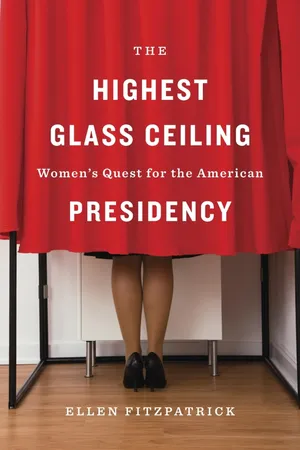
In The Highest Glass Ceiling, best-selling historian Ellen Fitzpatrick tells the story of three remarkable women who set their sights on the American presidency. Victoria Woodhull (1872), Margaret Chase Smith (1964), and Shirley Chisholm (1972) each challenged persistent barriers confronted by women presidential candidates. Their quest illuminates today's political landscape, showing that Hillary Clinton's 2016 campaign belongs to a much longer, arduous, and dramatic journey.
The tale begins during Reconstruction when the radical Woodhull became the first woman to seek the presidency. Although women could not yet vote, Woodhull boldly staked her claim to the White House, believing she might thereby advance women's equality. Republican Senator Margaret Chase Smith came into political office through the "widow's mandate." Among the most admired women in public life when she launched her 1964 campaign, she soon confronted prejudice that she was too old (at 66) and too female to be a creditable presidential candidate. She nonetheless became the first woman to have her name placed in nomination for President by a major party. Democratic Congresswoman Shirley Chisholm ignored what some openly described as the twin disqualifications of race and gender in her spirited 1972 presidential campaign. She ran all the way to the Democratic convention, inspiring diverse followers and angering opponents, including members of the Nixon administration who sought to derail her candidacy.
As The Highest Glass Ceiling reveals, women's pursuit of the Oval Office, then and now, has involved myriad forms of influence, opposition, and intrigue.
- 318 pages
- English
- ePUB (mobile friendly)
- Available on iOS & Android
eBook - ePub
About this book
Information
NOTES
Prologue
1. “Iron My Shirt,” New York Times, January 7, 2008, available at http://thecaucus.blogs.nytimes.com/2008/01/07/iron-my-shirt/; “Sexist Hecklers Interrupt Hillary: ‘Iron My Shirt!’” Huffington Post, March 28, 2008, available at http://www.huffingtonpost.com/2008/01/07/sexist-hecklers-interrupt_n_80361.html; “Postfeminism and Other Fairy Tales,” New York Times, March 16, 2008, WK 1; “Hillary’s Back,” Pittsburgh Post Gazette, January 11, 2008, B7.
2. “A Woman President?” Presidential Gender Watch 2016, Center for Women and American Politics, available at http://presidentialgenderwatch.org/polls/a-woman-president/. There is a wide literature, across an array of fields, addressing women and the American presidency as well as women and electoral politics more broadly. Among the key studies are Jill Norgren, Belva Lockwood: The Woman Who Would Be President (New York: New York University Press, 2007); Erika Falk, Women for President: Media Bias in Nine Campaigns, 2nd ed. (Urbana: University of Illinois Press, 2010); Jo Freeman, We Will Be Heard: Women’s Struggles for Political Power in the United States (Lanham, Md.: Rowman & Littlefield, 2008); Eleanor Clift and Tom Brazaitis, Madam President: Shattering the Last Glass Ceiling (New York: Scribner, 2000); Nichola D. Gutgold, Paving the Way for Madam President (Lanham, Md.: Lexington Books, 2006); Anne E. Kornblut, Notes from the Cracked Ceiling: What It Will Take for a Woman to Win (New York: Broadway, 2011); Lori Cox Han and Caroline Heldman, Rethinking Madam President: Are We Ready for a Woman in the White House? (Boulder: Lynne Rienner Publishers, 2007); Marianne Schnall, What Will It Take to Make a Woman President? (Berkeley: Seal Press, 2013); Kristina Horn Sheeler and Karrin Vasby Anderson, Woman President: Confronting Postfeminist Political Culture (College Station: Texas A & M University Press, 2013); Janet M. Martin, The Presidency and Women: Promise, Performance, and Illusion (College Station: Texas A & M Press, 2003); Deborah Jordan Brooks, He Runs, She Runs: Why Gender Stereotypes Do Not Harm Women Candidates (Princeton: Princeton University Press, 2013); Jennifer L. Lawless and Richard L. Fox, It Still Takes a Candidate: Why Women Don’t Run for Office (Cambridge: Cambridge University Press, 2010); Kristin A. Goss, The Paradox of Gender Equality (Ann Arbor: University of Michigan Press, 2013); Sue Thomas and Clyde Wilcox, Women and Elective Office: Past, Present, and Future (New York: Oxford University Press, 2014).
3. Harriet Beecher Stowe, My Wife and I: Or Harry Henderson’s History (New York: J. B. Ford and Company, 1872), pp. 262–263. For an in-depth assessment of the gender dynamics of Hillary Clinton’s 2008 run see Rebecca Traister, Big Girls Don’t Cry: The Election That Changed Everything for American Women (New York: Free Press, 2010).
4. James T. Havel, U.S. Presidential Candidates and the Elections: A Biographical and Historical Guide, vol. 1, The Candidates, and vol. 2, The Elections, 1789–1992 (New York: Macmillan, 1996). I am indebted to Nadia Fajood for her analysis of this data.
Victoria Woodhull
1. “The Correspondence between the Victoria League and Victoria C. Woodhull,” in Madeleine B. Stern, ed., The Victoria Woodhull Reader (Weston, Ma.: M & S Press, 1974), no page numbers. According to Woodhull biographer Lois Beachy Underhill, Woodhull herself was the driving force in organizing the Victoria League and the Equal Rights Party for which she served as nominee. See Lois Beachy Underhill, The Woman Who Ran for President: The Many Lives of Victoria Woodhull (Bridgehampton, N.Y.: Bridge Works Publishing Co., 1995), pp. 163–167. On nineteenth-century political nomination practices, see Gil Troy, See How They Ran: The Changing Role of the Presidential Candidate (Cambridge, Ma.: Harvard University Press, 1996), pp. 17–18 and Chapters 4 and 5.
2. “Correspondence between the Victoria League and Victoria C. Woodhull”; Victoria C. Woodhull, Letter to the Editor, “The Coming Woman,” New York Herald, April 2, 1870, p. 8; Morton Keller, Affairs of State: Public Life in Nineteenth Century America (Cambridge, Ma.: Harvard University Press, 1977), Chapter 1; Kate Masur, An Example for All the Land: Emancipation and the Struggle over Equality in Washington, D.C. (Chapel Hill: University of North Carolina Press, 2010), Chapter 5 esp.; Eric Foner, Reconstruction: America’s Unfinished Revolution, 1863–1877 (New York: Harper and Row, 1988), pp. 255–256; Ellen C. DuBois, “Outgrowing the Compact of the Fathers: Equal Rights, Woman Suffrage, and the United States Constitution, 1820–1878,” Journal of American History, vol. 74, no. 3 (December 1987), pp. 844–847.
3. On the fate of Reconstruction, see Foner, Reconstruction; Kenneth M. Stampp, The Era of Reconstruction, 1865–1877 (New York: Vintage, 1965); Steven Hahn, A Nation under Our Feet: Black Political Struggles in the Rural South from Slavery to the Great Migration (Cambridge, Ma.: Harvard University Press, 2005); Masur, An Example for all the Land; Douglas R. Egerton, The Wars of Reconstruction: The Brief, Violent History of America’s Most Progressive Era (New York: Bloomsbury, 2014); and Garrett Epps, Democracy Reborn: The Fourteenth Amendment and the Fights for Equal Rights in Post–Civil War America (New York: Holt, 2007).
4. Woodhull has been the subject of several recent biographies including Underhill, The Woman Who Ran for President; Barbara Goldsmith, Other Powers: The Age of Suffrage, Spiritualism, and the Scandalous Victoria Woodhull (New York: Harper Collins, 1999); Mary Gabriel, Notorious Victoria: The Life of Victoria Woodhull, Uncensored (Chapel Hill: Algonquin Books, 1998); Myra MacPherson, Scarlet Sisters: Sex, Suffrage, and Scandal in the Gilded Age (New York: Twelve, 2014); as well as a muckraking account published in 1929 by Emanie Sachs entitled The Terrible Siren: Victoria Woodhull, 1838–1927 (New York: Harper Bros., 1928). See also Amanda Frisken’s excellent study of Woodhull and the culture of late nineteenth-century America: Amanda Frisken, Victoria Woodhull’s Sexual Revolution: Political Theater and the Popular Press in Nineteenth-Century America (Philadelphia: University of Pennsylvania Press, 2004). Underhill, The Woman Who Ran for President does develop her presidential run at length. Woodhull’s life presents tremendous difficulties of reconstruction for the historian. For penetrating discussions of the challenges see Frisken, Victoria Woodhull’s Sexual Revolution, pp. 9–15; and Helen Lefkowitz Horowitz, “A Victoria Woodhull for the 1990s,” Reviews in American History, vol. 27, no. 1 (March 1999), pp. 87–97.
5. On the frivolous nature of her presidential run, see, for example, Eleanor Flexner, Century of Struggle: The Woman’s Rights Movement in the United States (Cambridge, Ma.: Harvard University Press, 1975), p. 147; Aileen S. Kraditor, Ideas of the Woman Suffrage Movement, 1890–1920 (New York: W. W. Norton, 1981), p. 114; Richard Brookhiser, “The Happy Medium,” New York Times Book Review, March 29, 1998, p. 11.
6. Theodore Tilton, Victoria C. Woodhull: A Biographical Sketch (New York: The Golden Age, 1871), pp. 3–6; Underhill, Woman Who Ran for President, pp. 11–19; Goldsmith, Other Powers, pp. 13–16, 18–19, 25–27.
7. Tilton, Victoria C. Woodhull, pp. 3–6, 8–12; Underhill, Woman Who Ran for President, 15–19; Goldsmith, Other Powers, Chapters 1 and 2. Woodhull’s description of her visit by angels is quoted from Goldsmith, Other Powers, p. 25.
8. Underhill, The Woman Who Ran for President, pp. 156–157; Goldsmith, Other Powers, pp. 48–49; Morton Keller, Affairs of State, p. 249; Ann Braude, Radical Spirits: Spiritualism and Women’s Rights in Nineteenth-Century America (Bloomi...
Table of contents
- Cover
- Title Page
- Copyright
- Dedication
- Contents
- Prologue: New Hampshire, 2008
- Victoria Woodhull
- Margaret Chase Smith
- Shirley Chisholm
- Epilogue: 2016
- Notes
- Acknowledgments
- Index
Trusted by 375,005 students
Access to over 1.5 million titles for a fair monthly price.
Study more efficiently using our study tools.
Frequently asked questions
Yes, you can cancel anytime from the Subscription tab in your account settings on the Perlego website. Your subscription will stay active until the end of your current billing period. Learn how to cancel your subscription
No, books cannot be downloaded as external files, such as PDFs, for use outside of Perlego. However, you can download books within the Perlego app for offline reading on mobile or tablet. Learn how to download books offline
We are an online textbook subscription service, where you can get access to an entire online library for less than the price of a single book per month. With over 1.5 million books across 990+ topics, we’ve got you covered! Learn about our mission
Look out for the read-aloud symbol on your next book to see if you can listen to it. The read-aloud tool reads text aloud for you, highlighting the text as it is being read. You can pause it, speed it up and slow it down. Learn more about Read Aloud
Yes! You can use the Perlego app on both iOS and Android devices to read anytime, anywhere — even offline. Perfect for commutes or when you’re on the go.
Please note we cannot support devices running on iOS 13 and Android 7 or earlier. Learn more about using the app
Please note we cannot support devices running on iOS 13 and Android 7 or earlier. Learn more about using the app
Yes, you can access The Highest Glass Ceiling by Ellen Fitzpatrick in PDF and/or ePUB format, as well as other popular books in Politica e relazioni internazionali & Storia nordamericana. We have over 1.5 million books available in our catalogue for you to explore.