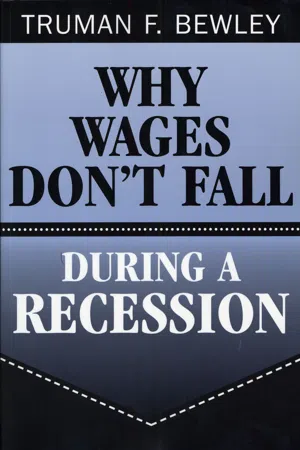
A deep question in economics is why wages and salaries don't fall during recessions. This is not true of other prices, which adjust relatively quickly to reflect changes in demand and supply. Although economists have posited many theories to account for wage rigidity, none is satisfactory. Eschewing "top-down" theorizing, Truman Bewley explored the puzzle by interviewing—during the recession of the early 1990s—over three hundred business executives and labor leaders as well as professional recruiters and advisors to the unemployed.
By taking this approach, gaining the confidence of his interlocutors and asking them detailed questions in a nonstructured way, he was able to uncover empirically the circumstances that give rise to wage rigidity. He found that the executives were averse to cutting wages of either current employees or new hires, even during the economic downturn when demand for their products fell sharply. They believed that cutting wages would hurt morale, which they felt was critical in gaining the cooperation of their employees and in convincing them to internalize the managers' objectives for the company. Bewley's findings contradict most theories of wage rigidity and provide fascinating insights into the problems businesses face that prevent labor markets from clearing.
- 538 pages
- English
- PDF
- Available on iOS & Android
eBook - PDF
Why Wages Don't Fall during a Recession
About this book
Information
Publisher
Harvard University PressYear
2009Print ISBN
9780674009431
9780674952416
eBook ISBN
9780674020900
Table of contents
- Contents
- Acknowledgements
- 1. Introduction
- 2. Methods
- 3. Time and Location
- 4. Morale
- 5. Company Risk Aversion
- 6. Internal Pay Structure
- 7. External Pay Structure
- 8. The Shirking Theory
- 9. The Pay of New Hires in the Primary Sector
- 10. Raises
- 11. Resistance to Pay Reduction
- 12. Experiences with Pay Reduction
- 13. Layoffs
- 14. Severance Benefits
- 15. Hiring
- 16. Voluntary Turnover
- 17. The Secondary Sector
- 18. The Unemployed
- 19. Information, Wage Rigidity, and Labor Negotiations
- 20. Existing Theories
- 21. Remarks on Theory
- 22. Whereto from Here?
- Notes
- References
- Index
Trusted by 375,005 students
Access to over 1.5 million titles for a fair monthly price.
Study more efficiently using our study tools.
Frequently asked questions
Yes, you can cancel anytime from the Subscription tab in your account settings on the Perlego website. Your subscription will stay active until the end of your current billing period. Learn how to cancel your subscription
No, books cannot be downloaded as external files, such as PDFs, for use outside of Perlego. However, you can download books within the Perlego app for offline reading on mobile or tablet. Learn how to download books offline
Perlego offers two plans: Essential and Complete
- Essential is ideal for learners and professionals who enjoy exploring a wide range of subjects. Access the Essential Library with 800,000+ trusted titles and best-sellers across business, personal growth, and the humanities. Includes unlimited reading time and Standard Read Aloud voice.
- Complete: Perfect for advanced learners and researchers needing full, unrestricted access. Unlock 1.5M+ books across hundreds of subjects, including academic and specialized titles. The Complete Plan also includes advanced features like Premium Read Aloud and Research Assistant.
We are an online textbook subscription service, where you can get access to an entire online library for less than the price of a single book per month. With over 1.5 million books across 990+ topics, we’ve got you covered! Learn about our mission
Look out for the read-aloud symbol on your next book to see if you can listen to it. The read-aloud tool reads text aloud for you, highlighting the text as it is being read. You can pause it, speed it up and slow it down. Learn more about Read Aloud
Yes! You can use the Perlego app on both iOS and Android devices to read anytime, anywhere — even offline. Perfect for commutes or when you’re on the go.
Please note we cannot support devices running on iOS 13 and Android 7 or earlier. Learn more about using the app
Please note we cannot support devices running on iOS 13 and Android 7 or earlier. Learn more about using the app
Yes, you can access Why Wages Don't Fall during a Recession by Truman F. Bewley,Truman F. BEWLEY in PDF and/or ePUB format, as well as other popular books in Business & Business Development. We have over 1.5 million books available in our catalogue for you to explore.