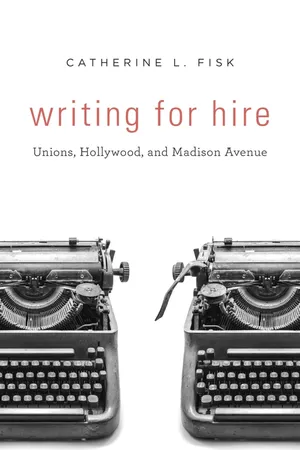
Required to sign away their legal rights as authors as a condition of employment, professional writers may earn a tidy living for their work, but they seldom own their writing. Writing for Hire traces the history of labor relations that defined authorship in film, TV, and advertising in the mid-twentieth century. Catherine L. Fisk examines why strikingly different norms of attribution emerged in these overlapping industries, and she shows how unionizing enabled Hollywood writers to win many authorial rights, while Madison Avenue writers achieved no equivalent recognition.
In the 1930s, the practice of employing teams of writers to create copyrighted works became widespread in film studios, radio networks, and ad agencies. Sometimes Hollywood and Madison Avenue employed the same people. Yet the two industries diverged in a crucial way in the 1930s, when screenwriters formed the Writers Guild to represent them in collective negotiations with media companies. Writers Guild members believed they shared the same status as literary authors and fought to have their names attached to their work. They gained binding legal norms relating to ownership and public recognition—norms that eventually carried over into the professional culture of TV production.
In advertising, by contrast, no formal norms of public attribution developed. Although some ad writers chafed at their anonymity, their nonunion workplace provided no institutional framework to channel their demands for change. Instead, many rationalized their invisibility as creative workers by embracing a self-conception as well-compensated professionals devoted to the interests of clients.
- 308 pages
- English
- ePUB (mobile friendly)
- Available on iOS & Android
eBook - ePub
About this book
Information
Topic
JuraSubtopic
Nordamerikanische GeschichteNotes
Introduction
The epigraph is from C. Wright Mills, White Collar: The American Middle Classes (New York: Oxford University Press, 1951, 2002), 151.
1. This account of the 1973 credit arbitration is based on WGA files. I am grateful for the WGA’s permission to read dozens of WGA credit arbitration files. Because revealing the names of the films and the writers might upset the participants and damage the credit arbitration process, and is unnecessary to understanding the credit arbitration process, I promised not to reveal the names of people or projects.
2. 17 U.S.C. § 201.
3. Andrew Sarris is generally credited with introducing French auteur film theory to America with a series of articles in journals and then his book, The American Cinema: Directors and Directions, 1929–1968 (New York: Dutton, 1968).
4. Charles Brackett, “Address for the Samuel Goldwyn Award for Creative Writing,” Apr. 22, 1957, folder 20.f-48, Charles Brackett Papers, Herrick Library; David Kipen, The Schreiber Theory: A Radical Rewrite of American Film History (Hoboken, NJ: Melville House Publishing, 2006). I am grateful to Ronny Regev’s superb dissertation for introducing me to the cited document in the Charles Brackett papers at the Herrick. Ronny Regev, “‘It’s a Creative Business’: The Ideas, Practices, and Interaction that Made the Hollywood Film Industry” (PhD diss., Princeton Univ., 2013).
5. Mark Rose, Authors and Owners: The Invention of Copyright (Cambridge: Harvard University Press, 1993).
6. WGA, Alliance of Motion Picture and Television Producers Theatrical and Television Basic Agreement, 29 (2011) [hereinafter 2011 MBA], available at http://www.wga.org. The current MBA, in effect from 2014, is largely the same as the 2011 version, but at the time of this writing is in the form of a Memorandum of Understanding, listing revisions to the 2011 MBA. Theatrical Schedule A to the Basic Agreement has provided without substantial change for several decades that the “decision of the Guild Arbitration Committee, and any Policy Review Board established by the Guild in connection therewith, with respect to writing credits, insofar as it is rendered within the limitations of this Schedule A, shall be final, and the Company will accept and follow the designation of screen credits contained in such decision and all writers shall be bound thereby.” Schedule A, 2011 MBA, at 270; WGA, Screen Credits Manual (2010); Statement of the Credits Review Committee to all WGA Members (June 2008); Screen Credits Review Committee File (2009); Constitution and By-Laws of WGAW, Art. VII, § 6 (revised June 17, 2009), available at http://www.wga.org/uploadedFiles/who_we_are/leadership/constitution09.pdf.
7. See Stone v. Writers Guild of Am. W., Inc., 101 F.3d 1312, 1314 (9th Cir. 1996) (holding state law claims for fraud and intentional infliction of emotional distress are preempted by federal labor law); Marino v. Writers Guild of Am. E., Inc., 992 F.2d 1480, 1481 (9th Cir. 1993); Eddy v. Radar Pictures, Inc., 215 Fed. App’x. 575 (9th Cir. 2006) (rejecting claims that WGA’s participating writer determination was arbitrary, discriminatory, or in bad faith; finding other claims against union and production companies preempted).
8. The separated rights provision allows the credited writer of an original story to retain some rights to write a derivative work based on the story elements of a script other than through the film or TV show (such as the right to publish a novel or play based on the story) and also allows a writer to reacquire a script that is not produced within a stated term. 2011 MBA, art. 16. To be eligible for separated rights, the writer must receive “story by,” “written by,” or “screen story by” credit on a motion picture; or “story by,” “written by,” or, in certain circumstances, “television story by” credit on a television movie; or “created by” credit on an episodic television series. Ibid.
9. Melville Nimmer & David Nimmer, Nimmer on Copyright, vol. 1, ch. 5 (2011) (form contracts for hiring for writing services or sale of screenplay).
10. David Weil, The Fissured Workplace: Why Work Became So Bad for So Many and What Can Be Done to Improve It (Cambridge: Harvard University Press, 2014).
11. The quote is from a 2009 memo in the files of the WGAW Screen Credits Review Committee. The WGAW Executive Director made the same point about the importance of credit determinations in a news interview. Charles Schreger, “Screen Credits: Who Gets What—and How,” L.A. Times, Apr. 16, 1979, F1.
12. Actually, since 1954 the WGA has been two unions: the Writers Guild of America—East (which represents writers in the eastern part of the United States) and the Writers Guild of America—West (which represents writers in the west). I refer to them collectively as the WGA or Guild or Writers Guild except where the differences between them matter. The WGAE and WGAW were formed by an amalgamation of the Screen Writers Guild (which represented film writers from 1933 onward), the Radio Writers Guild, and various groups that formed to represent television writers in the 1940s and 1950s. Abbreviated histories of the formation of these guilds are in Chapters 2, 4, and 5.
13. Alan Hyde, Working in Silicon Valley: Economic and Legal Analysis of a High-Velocity Labor Market (Armonk, N.Y.: M. E. Sharpe, Inc., 2003).
14. Catherine L. Fisk, “The Modern Author at Work on Madison Avenue,” in Paul K. Saint-Amour, ed., Modernism and Copyright (New York: Oxford University Press, 2011).
15. Staff Meeting Minutes, October 26, 1932, Box 5. In describing the history of the Jergens Lotion campaign, Ruth Waldo noted, “Mr. Steichen, by the way, has taken the photographs almost from the beginning of the [Jergens] Lotion advertising.” Patricia Johnston, Real Fantasies: Edward Steichen’s Advertising Photography (Berkeley: University of California Press, 1997), 55–65; Fisk, “The Modern Author at Work,” 181.
16. Michele H. Bogart, Artists, Advertising, and the Borders of Art (Chicago: University of Chicago Press, 1995).
17. Thomas Frank, The Conquest of Cool: Business Culture, Counterculture, and the Rise of Hip Consumerism (Chicago: University of Chicago Press, 1997), 71.
18. On attribution in scientific authorship, see Mario Biagioli & Peter Galison, eds., Scientific Authorship: Credit and Intellectual Property in Science (New York: Routledge, 2003).
19. Catherine L. Fisk, “Credit Where It’s Due: The Law and Norms of Attribution,” Georgetown Law Journal 95 (2006), 49, 88–92.
20. Erik Barnouw, Media Marathon: A Twentieth Century Memoir (Durham: Duke University Press, 1996), 121; Miranda Banks, The Writers: A History of American Screenwriters and Their Guild (New Brunswick: Rutgers University Press, 2015), 12, quoting Erik Barnouw, interview by the Writers Guild Oral History Project (Los Angeles: Writers Guild Foundation, 1978), 11.
21. Erik Barnouw, The Television Writer (New York: Hill & Wang, 1962), 18.
22. In 2009, the Guild polled its members about a variety of issues ranging from their views on the status of writers to their experience with status-based discrimination to their views on whether there should be more or fewer types of credits or whether credit bonuses should be prohibited; 54 percent of respondents said that there should be more credit for all writers. Credits Poll, in WGA File. WGA Screen Credits Review Comm. (2009).
23. 17 U.S.C. § 201; see Catherine L. Fisk, “The Origin of the Work for Hire Doctrine,” Yale Journal of Law & Humanities 15 (2003), 1; Catherine L. Fisk, Working Knowledge: Employee Innovation and the Rise of Corporate Intellectual Property, 1800–1930 (Chapel Hill: University of North Carolina Press, 2009); Banks, The Writers; John Thornton Caldwell, Production Culture: Indu...
Table of contents
- Cover
- Title Page
- Copyright
- Dedication
- Contents
- Abbreviations Used in the Text
- Introduction
- Act I: Beginnings
- Act II: Intersections
- Act III: Denouement
- Conclusion
- Notes
- Archival Sources
- Acknowledgments
- Index
Trusted by 375,005 students
Access to over 1.5 million titles for a fair monthly price.
Study more efficiently using our study tools.
Frequently asked questions
Yes, you can cancel anytime from the Subscription tab in your account settings on the Perlego website. Your subscription will stay active until the end of your current billing period. Learn how to cancel your subscription
No, books cannot be downloaded as external files, such as PDFs, for use outside of Perlego. However, you can download books within the Perlego app for offline reading on mobile or tablet. Learn how to download books offline
Perlego offers two plans: Essential and Complete
- Essential is ideal for learners and professionals who enjoy exploring a wide range of subjects. Access the Essential Library with 800,000+ trusted titles and best-sellers across business, personal growth, and the humanities. Includes unlimited reading time and Standard Read Aloud voice.
- Complete: Perfect for advanced learners and researchers needing full, unrestricted access. Unlock 1.5M+ books across hundreds of subjects, including academic and specialized titles. The Complete Plan also includes advanced features like Premium Read Aloud and Research Assistant.
We are an online textbook subscription service, where you can get access to an entire online library for less than the price of a single book per month. With over 1.5 million books across 990+ topics, we’ve got you covered! Learn about our mission
Look out for the read-aloud symbol on your next book to see if you can listen to it. The read-aloud tool reads text aloud for you, highlighting the text as it is being read. You can pause it, speed it up and slow it down. Learn more about Read Aloud
Yes! You can use the Perlego app on both iOS and Android devices to read anytime, anywhere — even offline. Perfect for commutes or when you’re on the go.
Please note we cannot support devices running on iOS 13 and Android 7 or earlier. Learn more about using the app
Please note we cannot support devices running on iOS 13 and Android 7 or earlier. Learn more about using the app
Yes, you can access Writing for Hire by Catherine L. Fisk in PDF and/or ePUB format, as well as other popular books in Jura & Nordamerikanische Geschichte. We have over 1.5 million books available in our catalogue for you to explore.