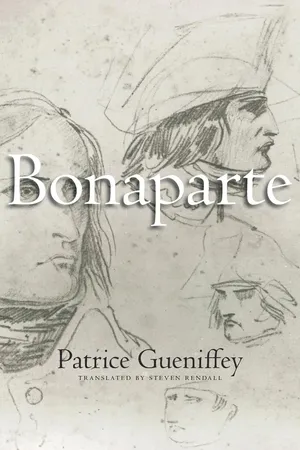
Patrice Gueniffey is the leading French historian of the Revolutionary and Napoleonic age. This book, hailed as a masterwork on its publication in France, takes up the epic narrative at the heart of this turbulent period: the life of Napoleon himself, the man who—in Madame de Staël's words—made the rest of "the human race anonymous." Gueniffey follows Bonaparte from his obscure boyhood in Corsica, to his meteoric rise during the Italian and Egyptian campaigns of the Revolutionary wars, to his proclamation as Consul for Life in 1802. Bonaparte is the story of how Napoleon became Napoleon. A future volume will trace his career as emperor.
Most books approach Napoleon from an angle—the Machiavellian politician, the military genius, the life without the times, the times without the life. Gueniffey paints a full, nuanced portrait. We meet both the romantic cadet and the young general burning with ambition—one minute helplessly intoxicated with Josephine, the next minute dominating men twice his age, and always at war with his own family. Gueniffey recreates the violent upheavals and global rivalries that set the stage for Napoleon's battles and for his crucial role as state builder. His successes ushered in a new age whose legacy is felt around the world today.
Averse as we are now to martial glory, Napoleon might seem to be a hero from a bygone time. But as Gueniffey says, his life still speaks to us, the ultimate incarnation of the distinctively modern dream to will our own destiny.
- 1,012 pages
- English
- ePUB (mobile friendly)
- Available on iOS & Android
eBook - ePub
About this book
Information
PART ONE
Napoleon and Corsica
1769–1793
ONE
An Italian Family in Corsica
Napoleon’s family origins have long been a subject of debate. We now know that his ancestors came from Sarzana.1 Since the thirteenth century the Buonapartes had been one of the leading families of this city between Tuscany and Liguria; they had produced administrators, governors, and ambassadors. In the fifteenth century, Sarzana was annexed by the Republic of Genoa. It was at that point—perhaps because life had become more difficult under the Genoese—that a Buonaparte decided to settle in Corsica. The Most Serene Republic had no plans to colonize the island, but it needed resident officials and magistrates, so it granted privileges to those of its citizens who agreed to move there. In 1483 a certain Giovanni Buonaparte went to Corsica, and his son Francesco, nicknamed “the moor of Sarzana,” settled there permanently in 1529.
From Sarzana to Ajaccio
The date of the Buonapartes’ arrival in Corsica has aroused no less debate than their origins. The nineteenth-century historian Hippolyte Taine suggested 1529, a date that we now know to be correct. Connecting this date with that of 1530, when on losing their independence to Charles V the republics of medieval Italy witnessed the end of “the great exploits of political adventures and successful usurpations,” Taine saw Corsica as the key to the part of Napoleon that was foreign to his time: “Just at the time when the energy and ambition, the vigorous and free sap of the Middle Ages begins to run down and then dry up in the shriveled trunk, a small detached branch takes root in an island, not less Italian but almost barbarous, amidst institutions, customs, and passions belonging to the primitive medieval epoch, and in a social atmosphere sufficiently rude for the maintenance of all its vigor and harshness.”2
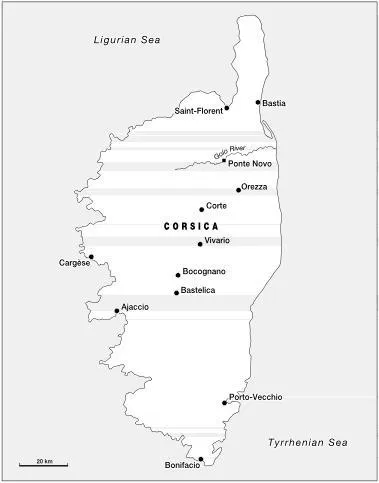
Corsica. © 2015 The President and Fellows of Harvard College
For Taine, Napoleon was “a great survivor of the fifteenth century,” the Buonapartes having emigrated to the rustic, untamed Italy that was Corsica, just when the mainland was entering a long slumber. Thus, through the generations of Buonapartes and of ancestors on his mother’s side, the Ramolinos,3 the spirit of the Middle Ages was supposed to have survived down to the century of the Enlightenment, finally to be reincarnated in Napoleon. In reality, the Buonapartes did not leave Sarzana for a wild country that had escaped the civilization of the mainland. The Corsica where they settled was not at all that of mountains and hereditary vendettas, but rather that of cities founded by the successive occupiers of the island, first Pisan and then Genoese. These presidios, as they were called, were small Italian enclaves established at intervals along the coast of the island. They were still Italy, a colonial Italy where the descendants of the first immigrants remained proud of their origins and did not want to be confused with the natives. But does that mean that we must conclude that in Corsica two distinct groups, one Italian, the other Corsican, lived alongside one another, very unequally divided between the cities on the coasts and the villages in the mountains? This distinction is not a myth, but it has to be qualified, because in Corsica things were in reality diverse. It probably holds true for Bonifacio, a city that long remained off-limits to native Corsicans, but it applies less well to the population of a Genoese colony like Ajaccio, whose people were entirely of Ligurian origin and soon mixed with Corsicans from the interior.
The Corsica of the presidios, at least in Ajaccio, was not an anti-Corsica but a different Corsica: different, to be sure, from that of the communities of the interior, but in no case a purely Ligurian bastion. If there was a sharp distinction, it was between those who lived in the city and those who lived in the country rather than between Italians and natives. It is true that the descendants of the Italian colonists were considered “foreigners” by indigenous Corsicans and were proud and even jealous of their continental origins. But nothing in fact connected them with the villages they considered the “homeland”—the land they had left to take up residence in Corsican cities. They may have presented themselves as continental out of a desire for honor and distinction, but this does not prove that they really were as foreign as Corsicans said, or as they themselves often imagined. In eighteenth-century Corsica, the descendants of the Genoese colonists were not the equivalents of twentieth-century French colonists in the Maghreb. We might even say that they grew all the more attached to their Italian origins as they moved further and further away from them, becoming ever more deeply integrated into Corsican society through marriages. This was as true of the Buonapartes as of anyone else: related to the Genoese and Tuscan nobilities by virtue of titles that were, to tell the truth, suspect.4 They were also relatives, by marriage and by birth, of the Pietrasantas, Costas, Paraviccinis, and Bonellis, all Corsican families from the interior. “I am more of an Italian, or a Tuscan, than a Corsican,”5 Napoleon was to say; in fact, he could have said, as Paul Valéry did concerning his own origins, that he was the product of a “Corsican-Italian mixture.”6
A Family of Notables
Travelers agreed unanimously that of all the colonies founded by the Genoese, Ajaccio was the most beautiful: “Three streets fanning out and intersected by a fourth, with houses of varying heights lined up one after another that one sees from afar jutting up among the bell towers, a tranquil harbor where a few sailboats lie quietly at anchor. Along the shore, beyond the ramparts, there is the suburb,… and all around, the countryside crowned with olive trees, with its vineyards and geometrical gardens.”7 Within Ajaccio’s walls lived a whole group of common people consisting of craftsmen and fishermen, not to mention a swarm of ecclesiastics; higher up, there was a small group of bourgeois who eked out a living from the exercise of military or administrative offices on behalf of the Most Serene Republic. In the little society of Ajaccio—which counted hardly more than 4,000 inhabitants at the end of the eighteenth century—the Buonapartes occupied an honorable and occasionally underestimated position. The life they led is in fact too often judged by reference to the precarious economic situation in which they found themselves after the death of Charles Buonaparte in 1785. Even if they were hard up at that time, they had seen better days. We know next to nothing about how well off they were, but when Charles and Letizia married in 1764, their combined dowries amounted to almost 14,000 livres, and in 1775 the couple owned three town houses, lands, a mill, and a large herd of livestock.8 These provided them with an average annual revenue of more than 7,000 livres, though Napoleon said that it amounted to 12,000 rather than 7,000.9 It matters little whether their annual revenue was 7,000 or 12,000 livres if we consider that at that time a worker’s salary hardly exceeded 1,000 livres per annum. In a society that was characterized by inequalities of wealth but in which the poor may have been a little less poor than on the continent, and the rich much less rich, the Buonapartes could at least maintain a respectable way of life, even if they were not part of the very closed world of the great landowners. In a country where the income of the most opulent rarely exceeded 20,000 livres, someone who had 7,000 was rich. It is true that this represented “wealth” only in comparison with the generally low standard of life prevailing on the island, and that the way of life enjoyed even by the most well-off remained modest and without luxury or ostentation. The fact that trade took place largely by barter attenuated the disparities in wealth. Napoleon was to recall, “In my family the main thing was to avoid spending money. Money was spent only on absolutely necessary objects such as clothes, furniture, etc., and not on food, except for coffee, sugar, rice, and other items that did not come from Corsica. Otherwise, everything was provided by the land.… What mattered was not spending money. Money was extremely rare. Paying for something in cash was a major event.”10
Napoleon connected this past affluence with his ancestors’ thriftiness and with a system of inheritance that favored keeping estates intact.11 In addition, there was the Buonapartes’ concern to make advantageous marriages. Their claim to belong to the class of notables was based not only on their possessions but also on their connections through marriage in a country where power was measured less by the bride’s dowry than by the number of relatives who could be called upon in the event of difficulty. Their cousins in Bocognano, a mountain village on the road to Corte whose inhabitants were said to be particularly rough and larcenous, and those on Letizia’s side, who lived in Bastelica, were as important as flocks and lands. “They were terrible people, these relatives, a great power on the island.”12 It was not nothing to be able, like the Buonapartes, to flaunt a cortege of some thirty cousins. Wealth was shown above all by the political influence and power that enabled a family to reach the top. Competition was ferocious; it required major investments, even if, when one succeeded, new opportunities to feather one’s nest presented themselves. Land and relatives conferred power, and power in turn increased wealth. Whoever was master of the community’s Council of Elders was master of the public wealth, and used it to benefit his own people, his relatives, friends, in-laws, and clients.
From Geronimo at the end of the sixteenth century to Giuseppe Maria, Napoleon’s grandfather who died in 1763, each generation of Buonapartes had had a representative among the “Noble Elders” who administered the city. Until Napoleon’s father reduced the family’s wealth almost to nothing, the Buonapartes had been one of the first families in Ajaccio by their possessions, prestige, and influence. Their prestige probably did not extend far beyond the area around Ajaccio, which helps us understand why Napoleon and his brothers played only a secondary role during the first years of the Revolution. The family revenue having collapsed in the course of a few years, they no longer had the means indispensable for political action—the means that had allowed their ancestors to occupy an enviable position in local society.13
Corsica, a Simple “Geographical Term”
Until the period of Corsica’s independence (1755–1769), the Buonapartes, like other notables in Ajaccio, had remained loyal to the Republic of Genoa, and then to the king of France after he landed his troops on the island to support his Genoese ally. Some historians see this as opportunism, or even “collaboration,” accusing the notables of the presidios of having used the authority conferred on them by their fellow citizens to serve their own interests and those of the occupying power. However, it is far from clear that elected officials sought only to promote the interests of their respective clans. In any case, to accuse the members of this ruling elite of opportunism is to forget that legally they were citizens not of Corsica but rather of Genoa; in serving the doge they were serving their country, and they similarly remained loyal when they pledged allegiance to the king of France when the latter intervened at the request of the Genoese government. It is also to exaggerate the independence of Corsica’s municipal institutions from the Genoese government: they were just one of the instruments through which the Republic exercised an—entirely relative—control over the island. Moreover, the local authorities showed their loyalty to Genoa as much through their status as through their self-interest: they owed their privileges and their influence to the government in Genoa, so their offices obliged them to represent that government more than the people of the island. Above all the accusation of collaboration presupposes the existence of a Corsican identity that was, in fact, foreign to the inhabitants of the presidios: even if they exaggerated their continental connections, they felt themselves to be less close to Corsica, whose sons they had become, than to Italy, where they sent their children to be educated.
The accusation of “betrayal” is ultimately based on a view of Corsican history that was shaped later on, after the French conquest of the island in 1769, and that is very different from the Corsica for which the young Napoleon made himself the spokesman in his Letters on Corsica: “The history of Corsica,” he wrote, “is merely a perpetual struggle between a small people that wants to be free and its neighbors that want to oppress it.”14 In this unfinished work, Napoleon traced the heroic history of the Corsican people unified behind its “national” heroes in order to show how it had forged its collective identity in the constantly renewed struggle between the “earthenware pot and the iron pot.”15 Reacting against this orthodox version of Corsican history created by Enlightenment writers and subsequently cultivated by others, Franco Venturi once wrote that Corsica was distinguished, on the contrary, by the absence of a history of its own to which it could refer to find the elements of a common identity.16 Let us be clear: nothing is more erroneous than the image of a Corsica untouched by the tumults of history, whose vicissitudes it certainly suffered. From the Romans to the Vandals, from the Saracens to the Holy See, from the Pisans to the Aragonese, from the Genoese to the French, all Europe marched through the island. How could it have been otherwise? As Seneca noted, the proximity of Italy made Corsica a tempting prey, while its poverty made it an easy one. Corsica could not belong to itself; it was a strategic stake in the struggle among European powers. To those who frowned and said that the conquest of that “useless pile of rocks” would be onerous for France, the partisans of conquest in 1768 replied that the possession of Corsica would enable France to become the dominant power in the Mediterranean region.17 But it would be a mistake to suppose that Corsica had always been the victim of the “great game” played by European states. Its history is no doubt unfortunate; yet it is not a history of subjection in which Corsicans, attacked by superior forces, were utterly deprived of control over their own destiny. They helped shape that destiny, and even the legend created by the Enlightenment could not conceal this aspect of the matter. Was not even Voltaire, after recalling how the Corsicans had been invaded, sold, and ceded by the dominant powers, obliged to conclude that the Corsicans had always been to blame for their own subjugation?18 Didn’t Sinucello fight the Genoese on behalf of the Pisans, to whom he was indebted? Wasn’t Vincentello d’Istria the liegeman of the king of Aragon? And two centuries after Genoa took legal possession of Corsica (in 1358), wasn’t it Sampiero Corso who brought in the French to help liberate the island? Should this constant in the island’s history be attributed to the Corsicans’ desire to involve powerful and prestigious partners in their destiny, because they were aware that they could not exist independently?19 This hypothesis might make us smile if we think about what kind of partnership such a poor island could have had with the Republic ...
Table of contents
- Cover
- Title Page
- Copyright
- Dedication
- Contents
- Maps
- Introduction
- Part One. Napoleon and Corsica: 1769–1793
- Part Two. Entry on Stage: 1793–1796
- Part Three. The Italian Campaign: 1796–1797
- Part Four. The Egyptian Expedition: 1798–1799
- Part Five. Crossing the Rubicon: 1799
- Part Six. A King for the Revolution: 1799–1802
- Illustrations
- Credits
- Notes
- Bibliography
- Index
Trusted by 375,005 students
Access to over 1.5 million titles for a fair monthly price.
Study more efficiently using our study tools.
Frequently asked questions
Yes, you can cancel anytime from the Subscription tab in your account settings on the Perlego website. Your subscription will stay active until the end of your current billing period. Learn how to cancel your subscription
No, books cannot be downloaded as external files, such as PDFs, for use outside of Perlego. However, you can download books within the Perlego app for offline reading on mobile or tablet. Learn how to download books offline
Perlego offers two plans: Essential and Complete
- Essential is ideal for learners and professionals who enjoy exploring a wide range of subjects. Access the Essential Library with 800,000+ trusted titles and best-sellers across business, personal growth, and the humanities. Includes unlimited reading time and Standard Read Aloud voice.
- Complete: Perfect for advanced learners and researchers needing full, unrestricted access. Unlock 1.5M+ books across hundreds of subjects, including academic and specialized titles. The Complete Plan also includes advanced features like Premium Read Aloud and Research Assistant.
We are an online textbook subscription service, where you can get access to an entire online library for less than the price of a single book per month. With over 1.5 million books across 990+ topics, we’ve got you covered! Learn about our mission
Look out for the read-aloud symbol on your next book to see if you can listen to it. The read-aloud tool reads text aloud for you, highlighting the text as it is being read. You can pause it, speed it up and slow it down. Learn more about Read Aloud
Yes! You can use the Perlego app on both iOS and Android devices to read anytime, anywhere — even offline. Perfect for commutes or when you’re on the go.
Please note we cannot support devices running on iOS 13 and Android 7 or earlier. Learn more about using the app
Please note we cannot support devices running on iOS 13 and Android 7 or earlier. Learn more about using the app
Yes, you can access Bonaparte by Patrice Gueniffey, Steven Rendall in PDF and/or ePUB format, as well as other popular books in History & Historical Biographies. We have over 1.5 million books available in our catalogue for you to explore.