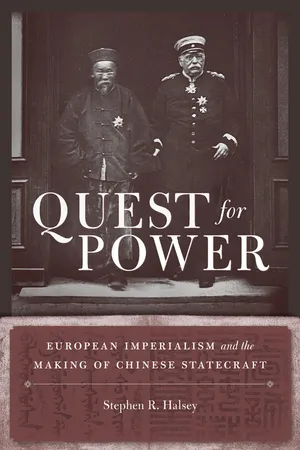
China's history in the nineteenth and early twentieth centuries has often been framed as a long coda of imperial decline, played out during its last dynasty, the Qing. Quest for Power presents a sweeping reappraisal of this narrative. Stephen Halsey traces the origins of China's great-power status in the twentieth century to this era of supposed decadence and decay. Threats from European and Japanese imperialism and the growing prospect of war triggered China's most innovative state-building efforts since the Qing dynasty's founding in the mid-1600s.
Through a combination of imitation and experimentation, a new form of political organization took root in China between 1850 and 1949 that shared features with modern European governments. Like them, China created a military-fiscal state to ensure security in a hostile international arena. The Qing Empire extended its administrative reach by expanding the bureaucracy and creating a modern police force. It poured funds into the military, commissioning ironclad warships, reorganizing the army, and promoting the development of an armaments industry. State-built telegraph and steamship networks transformed China's communication and transportation infrastructure. Increasingly, Qing officials described their reformist policies through a new vocabulary of sovereignty—a Western concept that has been a cornerstone of Chinese statecraft ever since. As Halsey shows, the success of the Chinese military-fiscal state after 1850 enabled China to avoid wholesale colonization at the hands of Europe and Japan and laid the foundation for its emergence as a global power in the twentieth century.
eBook - ePub
Quest for Power
European Imperialism and the Making of Chinese Statecraft
- 346 pages
- English
- ePUB (mobile friendly)
- Available on iOS & Android
eBook - ePub
About this book
Information
1
EUROPE’S GLOBAL CONQUEST
Between 1500 and 1914, Europe conquered the world. During the first half of this period, few observers could have predicted the triumph of Western arms, goods, and ideas, and large colonial empires took root only in the Americas and Australasia. At the beginning of the eighteenth century, the Mughal, Ottoman, and Qing dynasties continued to govern more than half the human race and dominated the continent of Asia from the eastern Mediterranean to the shores of the Pacific. Outside the Western Hemisphere, Europeans established a network of trading posts to engage in long-distance trade but maintained few territorial settlements. Instead colonialism in these areas remained a commercial project that relied on the use of coercive force when necessary. Powerful indigenous states in the Indian and Pacific Ocean basins relegated foreign interlopers to the margins of their territory, and Western soldiers, merchants, and adventurers lost as many battles as they won.
Yet, by 1700, the Muslim Mughal, Ottoman, and Safavid dynasties had entered a period of sharp decline, and Europeans took advantage of these circumstances to expand beyond the small trading stations of the early modern period. Over the course of the next two centuries, indigenous governments disintegrated under Western political, military, and economic pressures and, after 1870, increasingly fell prey to deliberate aggression planned by European central governments. As the Industrial Revolution transformed production, investment, and consumption, Europe came to dominate the global balance not only of power but of wealth as well. By the eve of World War I, Western countries had colonized 84.4 percent of the world’s land surface, and societies throughout Asia and Africa followed a common historical trajectory of invasion, annexation, and direct governance by the great powers.1
In South Asia, tribal breakouts undermined the power of the ruling dynasty at the same time that Europeans expanded inland from coastal enclaves like Calcutta and Bombay.2 The Mughal empire in the Indian subcontinent splintered into regional successor states in the early 1700s, and this process of political decentralization invited intervention by Western countries. Regional polities like the Maratha Confederacy and the sultanate of Mysore implemented a range of state-building projects to ensure their survival, but Britain exploited divisions in the subcontinent and won a narrow military victory by the early 1800s. In addition to the weaker military, fiscal, and administrative capacities of these states, the mercantile activities of the English East India Company (EEIC or the Company) helped to trigger the formal colonization of South Asia. In Bengal, for example, the EEIC’s business operations undermined the position of the indigenous ruler, resulting in disorder, warfare, and eventual subjugation by Western arms.
In Southwest Asia, the Ottoman dynasty also faced growing Western pressures after 1700, complicating efforts to suppress internal challenges to its authority. Russia and Austria pressed their territorial claims in southeastern Europe and Central Asia, while states like Britain and France undermined Istanbul’s power in the Mediterranean and North Africa. On several occasions, Ottoman armies stood outside the gates of Vienna, but as Western states amassed the sinews of power, the empire became “the sick man of Europe.” During the nineteenth century, a series of reforms known as the Tanzimat, or reorganization, narrowed the military gap with rival states to a certain extent, but this sprawling multiethnic empire fell victim to gradual territorial dismemberment. By the end of World War I in 1918, Turkey retained only the Anatolian heartlands of the former Ottoman empire.
At first, the conflicts with these Muslim dynasties and their successor states remained a close contest, but by the nineteenth century Western countries enjoyed an overwhelming advantage because they had experienced the Industrial Revolution. With few exceptions, the weaker states of Southeast Asia and Africa lacked the size, resource base, and bureaucracy to resist foreign aggression for a protracted period. As in Bengal, international commerce often disrupted existing patterns of political economy, causing political turmoil and European intervention in areas like the Malay peninsula and the Indonesian archipelago. In certain instances, local events pulled the West into a fuller colonial engagement with these regions, while Europeans conquered sub-Saharan Africa after 1880 by conscious design. In either case, indigenous governments in places such as Southeast Asia and central Africa succumbed to foreign aggression far more readily than the early modern Muslim empires. By the early 1900s, then, colonialism left almost no human being or part of the world untouched.
In contrast, China’s historical development diverged sharply from the broader global pattern of European conquest, annexation, and administrative control during the nineteenth and twentieth centuries. A series of unequal treaties with the West created conditions of “constrained sovereignty,” but China retained its political and territorial integrity during the zenith of European imperialism. Only five other countries remained independent states in this period: Persia, Turkey (the Ottoman Empire), Ethiopia, Thailand, and Japan. Britain and France established a system of informal empire in China after the Opium Wars of 1839–1842 and 1858–1860, and the rest of the great powers soon came to enjoy the same political, economic, and legal privileges. Diplomatic agreements extended most-favored-nation status to their signatories, established low tariffs on foreign imports into China, guaranteed Europeans, Americans, and, later, the Japanese immunity from prosecution under indigenous law, and opened a number of treaty ports to international trade. Unlike Bombay or Calcutta, these foreign enclaves never became the nuclei of territorial empires in China, and concession areas granted after 1895 reverted to Chinese sovereignty after a fixed term. The Qing dynasty continued to collect taxes, administer justice, negotiate treaties, and oversee a population of 450 million until 1911, and after that date ethnic Han regimes governed the emerging nation-state of China.
This chapter traces the growth of European territorial empires during the late eighteenth and nineteenth centuries and asks why China evolved in a different way from these regions. A cursory glance at the historical record suggests that China should have collapsed in the 1800s and become a formal colony of one or more of the great powers. It is remarkable that China survived as an autonomous state in this period, a fact that area experts tend to ignore because they lack the proper comparative perspective. This approach also places the narrative of modern China within a broader world-historical framework and casts into relief the factors that promoted European territorial annexations in regions like South Asia. This book argues that differences in “state capacity” and political economy diverted China from the familiar path of formal colonization but does not offer a comprehensive theory of empire in the modern period.3 Colonialism rarely remained a constant in a single region, much less on a global scale over the course of several centuries. Yet in multiple geographic, temporal, and cultural contexts, countries with weak state structures or “porous economies” collapsed far more often than they survived.4
COLONIALISM IN INDIA AND SOUTHWEST ASIA
The historian C. A. Bayly argues that the Mughal, Ottoman, and Safavid dynasties shared important patterns of historical development during the early modern period.5 In each of these Muslim empires, effective governance led to agricultural specialization, population growth, and the emergence of new commercial networks. Over time, these changes gave rise to wealthier and more sophisticated societies, but they also encouraged regional elites to assert their political, military, and fiscal autonomy from the throne. Tribal breakouts resulted in domestic disorder and political decentralization at the moment when Europeans began to pose a serious external challenge to imperial power. Breakaway provinces and regional successor states not only undermined the position of these ruling dynasties but also offered less intense resistance to Western countries. Internal trends within these Muslim states facilitated the first European conquests in Asia, but over time the disparities in power with the West continued to widen.
Prior to 1750, Europeans exercised little direct influence in South Asia outside the three “presidencies” of Calcutta, Bombay, and Madras. In fact, when the EEIC had challenged imperial prerogatives in the late seventeenth century, the Mughal dynasty dealt it a humiliating military defeat. This powerful Sunni Muslim empire governed a population numbering in the hundreds of millions, generating government income through taxes on land and agricultural production.6 The Mughal monarchs exercised a patrimonial form of rule, assigning important administrative duties to intermediaries at the provincial and district levels as well as relying on the regular bureaucracy.7 In many areas, responsibility for revenue collection rested with Hindu notables (zamindars), while regional magnates (mansabdars) served as royal officers and heads of their local communities.8 These Muslim grandees enjoyed the right to income from large estates (jagirs) in the provinces and in exchange provided the throne with political and military support.9 Village leaders maintained a considerable degree of autonomy from the loose bureaucratic structures of the Mughal state, and Delhi depended on the noble classes for financial and military resources. Generous patronage, powerful armies, and a series of forceful rulers sustained the cohesion of the Mughal empire, but dramatic change over the course of the seventeenth century produced a number of administrative problems.
The transformation of the economic order in South Asia after 1600 weakened the Mughal dynasty’s control of the provinces. New social groups began to challenge imperial prerogatives and replace Muslim military elites in the countryside. Agricultural and commercial development fostered the growth of a nouveau riche, and hereditary estates emerged in rural areas because of a shift to freehold property.10 Government revenues declined as Hindu notables, tax farmers, and members of the mercantile castes usurped the traditional fiscal role of regional magnates. At the same time, new provincial elites began to ignore Delhi’s political, legal, and military writ whenever circumstances permitted and consolidated power within their own territories.11 A Mughal ruler continued to occupy the Peacock Throne until 1858, but invasions from Central Asia and the revolt of groups like the Maratha had destroyed this diverse empire a hundred and fifty years earlier.
By the early eighteenth century, the dynasty had given way to a host of smaller regional states, and Western countries soon became integral components in the political equilibrium of the subcontinent. These rivalries triggered indigenous state-building activities in areas like the western Deccan, Mysore, and the Punjab, where the nascent Sikh empire invested in military modernization programs modeled on the EEIC.12 In the end, Britain conquered the subcontinent through its skillful manipulation of internal political divisions and use of South Asian resources. During the first half of the eighteenth century, however, this outcome seemed improbable if not unimaginable.
During the 1740s, warfare between Britain and France spread to India, and each side created coalitions of indigenous states to enhance their power in this distant theater. This pattern of alliance building foreshadowed not only the EEIC’s later military strategy but its means of exercising political control over the vast lands and population of India. Over the course of the following decades, the EEIC became a territorial ruler because of internal political weaknesses in South Asia and its commercial penetration of important regional economies.
The transition from business enterprise to de facto sovereign began with the indigenous attack on the “factory,” or trading post, of Calcutta in northeastern India in 1756. This incident resulted in a protracted military conflict with the ruler (nawab) of Bengal, the wealthiest region of the former Mughal empire. What caused this unexpected war? Over time, British trade in the interior of the province eroded the financial position of the government and threatened its continued grip on power. These important changes in political economy operated at three distinct levels and help to explain Nawab Siraj ud-Daula’s attack on the Company’s fort. An edict (farman) of 1717 granted the EEIC a number of commercial concessions, and international trade assumed a growing importance to Bengali political and mercantile elites. The influx of foreign silver further monetized the regional economy and promoted the growth of new commercial relationships in Bengal. By the mid-eighteenth century, the legal British trade in cotton textiles, silk, and opium diverted an increasing volume of commercial duties away from the state treasury, and the ruler began to reconsider the Company’s tax exemptions.
At the same time, Company employees and the “private English” used the EEIC’s seal (dastak) to illegally transport and sell commodities monopolized by the Bengali government. These not only included items of strategic importance like saltpeter but consumer goods such as salt, tobacco, and betel nut.13 For example, British efforts to enter the lucrative salt market in Patna and other upcountry venues provoked a frequent cycle of confiscation and protest, but foreign merchants continued to press further into the interior.14 Indian merchants also abused British commercial privileges in Bengal, reflagging ships on the Hooghly River or bribing EEIC officials to include their own goods in the Company’s consignments. Less than a decade after the edict of 1717 granted the EEIC these rights, a Company administrator acknowledged that Armenians and “black merchants [transport] vast quantitys [sic] of goods … by virtue of our dustucks [seals].”15
The growth of international trade after 1700 also encouraged the EEIC to establish close ties to the indigenous mercantile and banking classes (Jagat Seths) who controlled the state’s revenue administration. By midcentury, they supervised public finance in Bengal, remitting token tribute payments to the Mughal court in Delhi, superintending the mint, and advancing funds to cover shortfalls in the government’s treasuries.16 Yet their private interests also flourished under the stimulus of foreign trade, and these groups extended credit and arranged purchases of Indian textiles for European clients. The ruler of Bengal understood the danger of allowing this growing intimacy between the EEIC and his richest subjects to continue unchecked.
These changes in Bengal’s political economy coincided with the attempt of another Mughal successor state to capture the province’s wealth to finance its own program of state-building. The invasion of the Maratha during the 1740s and early 1750s deepened the ruler’s anxieties that the Company might ally itself with his indigenous rivals. Repulsing these attacks placed an enormous financial burden on the treasury at a time when revenues had begun to dwindle because of the EEIC’s trading operations. By the mid-1750s, the nawab’s armies had lost the neighboring territory of Orissa to the Maratha Confederacy, and he maintained only a tenuous hold on Bihar and the rich western districts of Bengal. By expelling the British from Calcutta, he sought first to eliminate a dangerous domestic rival and then mobilize Bengal’s resources against his South Asian opponents.
He lost the war. Robert Clive’s victory at the Battle of Plassey in June 1757 marked a radical shift in the balance of military forces in northeastern India and also changed the internal political equilibrium in Bengal. The Company claimed the right to collect land taxes in twenty-four villages (parganas), a move that financed its armies and also extended its authority into regions beyond Calcutta. The EEIC installed a new ruler, Mir Jafar, with the approval of Bengali elites and concluded a “subsidiary alliance” guaranteeing the Company’s military assistance when necessary. In practice, the sovereignty of Bengal passed into the hands of the EEIC, but, at first, all parties remained reluctant to alter existing institutional arrangements.
This settlement soon began to unravel because of chaotic political conditions in the subcontinent and a sharp rise in British commercial activity within Bengal. In 1760–...
Table of contents
- Cover
- Title Page
- Copyright
- Dedication
- Contents
- Preface
- Introduction: State-Making and Empire in a World-Historical Context
- 1. Europe’s Global Conquest
- 2. Foreign Trade
- 3. Money
- 4. Bureaucracy
- 5. Guns
- 6. Transportation
- 7. Communication
- Epilogue: State-Making in China, 1850–1949
- Notes
- Bibliography
- Index
Trusted by 375,005 students
Access to over 1.5 million titles for a fair monthly price.
Study more efficiently using our study tools.
Frequently asked questions
Yes, you can cancel anytime from the Subscription tab in your account settings on the Perlego website. Your subscription will stay active until the end of your current billing period. Learn how to cancel your subscription
No, books cannot be downloaded as external files, such as PDFs, for use outside of Perlego. However, you can download books within the Perlego app for offline reading on mobile or tablet. Learn how to download books offline
Perlego offers two plans: Essential and Complete
- Essential is ideal for learners and professionals who enjoy exploring a wide range of subjects. Access the Essential Library with 800,000+ trusted titles and best-sellers across business, personal growth, and the humanities. Includes unlimited reading time and Standard Read Aloud voice.
- Complete: Perfect for advanced learners and researchers needing full, unrestricted access. Unlock 1.5M+ books across hundreds of subjects, including academic and specialized titles. The Complete Plan also includes advanced features like Premium Read Aloud and Research Assistant.
We are an online textbook subscription service, where you can get access to an entire online library for less than the price of a single book per month. With over 1.5 million books across 990+ topics, we’ve got you covered! Learn about our mission
Look out for the read-aloud symbol on your next book to see if you can listen to it. The read-aloud tool reads text aloud for you, highlighting the text as it is being read. You can pause it, speed it up and slow it down. Learn more about Read Aloud
Yes! You can use the Perlego app on both iOS and Android devices to read anytime, anywhere — even offline. Perfect for commutes or when you’re on the go.
Please note we cannot support devices running on iOS 13 and Android 7 or earlier. Learn more about using the app
Please note we cannot support devices running on iOS 13 and Android 7 or earlier. Learn more about using the app
Yes, you can access Quest for Power by Stephen R. Halsey in PDF and/or ePUB format, as well as other popular books in Economics & Economic History. We have over 1.5 million books available in our catalogue for you to explore.