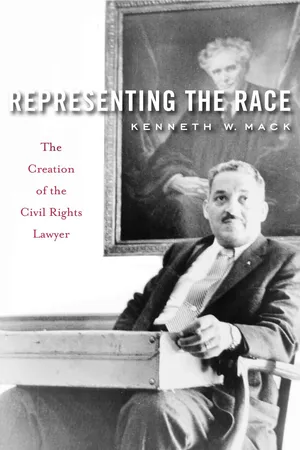
Representing the Race tells the story of an enduring paradox of American race relations through the prism of a collective biography of African American lawyers who worked in the era of segregation. Practicing the law and seeking justice for diverse clients, they confronted a tension between their racial identity as black men and women and their professional identity as lawyers. Both blacks and whites demanded that these attorneys stand apart from their racial community as members of the legal fraternity. Yet, at the same time, they were expected to be "authentic"—that is, in sympathy with the black masses. This conundrum, as Kenneth W. Mack shows, continues to reverberate through American politics today.
Mack reorients what we thought we knew about famous figures such as Thurgood Marshall, who rose to prominence by convincing local blacks and prominent whites that he was—as nearly as possible—one of them. But he also introduces a little-known cast of characters to the American racial narrative. These include Loren Miller, the biracial Los Angeles lawyer who, after learning in college that he was black, became a Marxist critic of his fellow black attorneys and ultimately a leading civil rights advocate; and Pauli Murray, a black woman who seemed neither black nor white, neither man nor woman, who helped invent sex discrimination as a category of law. The stories of these lawyers pose the unsettling question: what, ultimately, does it mean to "represent" a minority group in the give-and-take of American law and politics?
- English
- ePUB (mobile friendly)
- Available on iOS & Android
eBook - ePub
About this book
Information
Publisher
Harvard University PressYear
2012Print ISBN
9780674416956
9780674046870
eBook ISBN
9780674069565
1
The Idea of the Representative Negro
IN 1925, a young black lawyer named Raymond Pace Alexander stepped gingerly but forcefully across the color line in his hometown of Philadelphia, when he rose to give a speech before a local white civic group. Only two years had elapsed since his graduation from Harvard Law School, but he was already racking up a string of improbable courtroom victories that would soon make him one of the best trial lawyers in the city, regardless of race. That year, he also won his first major civil rights case, which broke the color bar at a Center City movie house. His fellow lawyers would soon elect him president of the John Mercer Langston Bar Association, the local professional group for black attorneys. He had much to explain to his white listeners, and he started in fast. Alexander asked the audience to empathize with the plight of “[t]he American Negro of education and high social standing in his group,” who was having more and more difficulty finding “a place to live in keeping with his means and standing.” What hope is there for harmonious race relations, he asked, “when there is no opportunity for your people to know my people of means, responsibility and position”? Very few whites, argued Alexander, come into regular contact with “the Negro of high training and education, the man of letters, the successful man in business, the artist—the professional man.” The tragic result of irrational white prejudice, argued Alexander, is that racial issues are driven by the influence of “our most unrepresentative persons.”1
Three months later, he went before a black audience and delivered a message that was entirely consistent with what he had said on the other side of the color line. Speaking before the middle-class congregation of Union AME Church in North Philadelphia, he urged his listeners to get behind an effort to stamp out the segregation that was still openly practiced in the city’s elementary schools. He offered the usual explanations. Segregated education was unconstitutional; it psychologically harmed black children; it resulted in unequal school facilities and resources. But he went further. American society, he argued, “has as its standard of supremacy the white man—his acts and achievements, his precepts and examples, his law and government.” If black Americans wanted equal rights and fair treatment, “we must study and train up to that standard … we must—of necessity—ape the white man, or consider him our preceptor, if only for the selfish purpose of gaining what he has to give us or teach us.” School segregation, he concluded, robbed segregated black children of the contacts with the white social and cultural standards that provided the benchmarks for measuring their progress on the road to responsible citizenship.2
Although they ring uneasily in modern ears, Alexander’s remarks were not the voice of accommodation to white mores in an era of segregation. Nor were they the words of a prosperous lawyer with little contact with those for whom he spoke. In fact, Alexander had only recently arrived in the comfortable middle class, after an upbringing that often brought him perilously close to poverty. Raymond Alexander’s remarks expressed, instead, a common enough 1920s-era worldview among the men and women who, two decades later, would do much to teach their fellow Americans about the meaning of integration. They called themselves representative Negroes, and they occupied an often-uncomfortable space between white desires and black hopes. One can find traces of their story in many eras of American history, including our own.
A Black Lawyer in a White Man’s Profession
The story of the representative Negro goes at least as far back as the time of the man whom Philadelphia’s black lawyers claimed as their progenitor—John Mercer Langston—and to the moment when Langston placed himself between two racial groups simply by deciding to become a lawyer. Langston is only faintly remembered today, although some have tried to claim him as a model for the nation’s first African American president. In the nineteenth century, however, it was a different matter. Langston was one of the leading public figures of his day, rivaling Frederick Douglass for preeminence in black politics and earning the trust of whites in ways that would seem noteworthy in almost any era of American history. Born in 1829 in Virginia and raised in Ohio, Langston graduated from Oberlin College and was admitted to the bar in an era when his fellow Ohioans weren’t even sure that African Americans deserved basic citizenship rights. He then somehow persuaded a steady stream of white clients to beat a path to his door. In 1855 he wrote Douglass to announce something that seemed unprecedented. Langston had been elected to local office in an all-white township. He became a popular speaker in the 1850s and won election as president of the Equal Rights League at a national black convention in Syracuse, New York, in 1864. After the Civil War, he threw himself into Republican politics and as a result was named as the inaugural dean of Howard Law School, as acting president of Howard University, and as the United States minister to Haiti. He would cap his career when he won a seat in Congress, representing his native Virginia.3
Langston was the quintessential nineteenth-century representative black man. To abolitionist-minded whites, he was a person in whom they could see a darker reflection of themselves. For them, Langston seemed to personify everything that the colored race might become once it threw off the shackles of slavery. But to black and white observers he also seemed to personify the struggles of a poorly educated mass of enslaved and free African Americans with whom he had little in common other than white racial prejudice. Langston’s improbable journey began with his decision to become a lawyer. It gave him confidence in his role in public life, and an ease among whites, which he would later put to good use. But to become a lawyer, the figure who believed that he could stand in for the aspirations of blacks would first have to prove that he was a white man.
Langston shared an important characteristic with Frederick Douglass and Booker T. Washington, the only two nineteenth-century black Americans who outclassed him in national influence: he was the product of a biracial parentage. John Mercer Langston was the son of a white Virginia slaveholder who lived openly with a formerly enslaved woman named Lucy Langston, and who sent their young son to Ohio to be educated after his death. (He was also the great-uncle of the poet Langston Hughes.) Langston bore a complexion that reflected his multiracial heritage, and it would smooth his path in the world, as it would for his successors at least through the era of Thurgood Marshall. But that did not necessarily exempt him from the reach of Ohio’s Black Laws, which, among other things, had excluded the state’s free black population from jury service, testifying against whites, the state militia, and the public schools. Voting was also limited to white males. Although the Black Laws were liberalized somewhat in 1849, black Ohioans were far from full citizens of that state.4
No law made whiteness a requirement to join the bar, but such a prerequisite was a simple extension of what had been done in other areas. But there was one loophole. Under the relevant Ohio precedents, persons of African descent could be classified as white if they were “of more than half white blood.” Many among Ohio’s free black population actually voted through the subterfuge of being classified as white, depending on the sometimes capricious decisions of local voting officials who scrutinized the complexion of each prospective voter to see if he seemed to have more than one-half white “blood.” The decision to allow a black Ohioan to vote probably depended on appearance, general reputation, and how one acted in the presence of whites. By the time he was ready to apply for admission to the bar, Langston would have been quite familiar with what it took for a black person to be recognized as an equal citizen under the laws of Ohio.5
Simply becoming a black lawyer and practicing one’s trade was a civil rights claim in a nation still unresolved on the subject of full black citizenship. In that respect, at least, the autobiographical story that Langston fashioned for himself was true. That story began on the afternoon of September 13, 1854, when Langston and Philemon Bliss, an abolitionist lawyer who had trained him, went before a panel of judges in Elyria, Ohio, to break the color barrier among that state’s bar. As Langston’s bar application sat before them, the judges openly discussed their dilemma about what to do next. Here was a black man indistinguishable from the best white applicant who could appear in their court, save for his somewhat darker complexion. That, it turned out, supplied the answer. Bliss and a local white lawyer stepped in and suggested the solution. “Where is Mr. Langston?” the chief justice inquired. “He sits within the bar,” the local sheriff replied. The chief justice bade him to stand up, then assessed his light brown skin and thin features, and without further comment swore him in as a white lawyer. It was a sign of how Langston would begin to rise in the world. Key to the beginning of his career was his ability to make whites believe that he was, as near as possible, one of them.6
Langston’s entry into the legal profession placed him at a dividing line within his state, and indeed within the country as a whole, on the subject of race and American citizenship. To set oneself on the path to law in Ohio, or indeed throughout the antebellum North, was to decide to enter a white man’s profession. Many northern states had only recently completed the transition from slavery to freedom. White northerners had gradually emancipated their slaves after the American Revolution, but that took decades and still left a small number of African Americans living as slaves or indentured servants in the North as late as the 1840s. Black children were initially barred from many northern public school systems and then segregated when they were finally admitted. Some local communities, however, allowed them to attend school with whites, and Massachusetts banned school segregation by statute in 1855. Segregation of public accommodations—hotels, restaurants, and theaters—was pervasive. In most of New England, black residents possessed the right to vote on the same terms as whites, and in several other states they possessed limited voting rights. In the rest of the country, they were barred from the polls. Langston had the good sense to make his home in Ohio’s Western Reserve, located in the northern part of the state, which had been settled by New Englanders and was one of the most abolitionist areas of the country. Southern Ohio, by contrast, was a hotbed of antiblack sentiment.7
Langston wasn’t the first person to place the question of black lawyers on the country’s agenda. Langston’s former tutor, George Boyer Vashon, was rejected by the Allegheny County, Pennsylvania, bar upon conclusion of his legal studies in 1847. Bar admission authorities ruled that since suffrage was limited to white men in that state, law practice was also. A disappointed Vashon was soon admitted in New York and decamped for Haiti. Only in New England abolitionist circles had black lawyers done better, beginning with Macon Bolling Allen, who was admitted in Maine in 1844 and promptly moved to Boston. When Boston lawyer John S. Rock decided to apply for admission to the Supreme Court bar in 1863, it produced more than a year of maneuvering that eventually drew in the abolitionist senator Charles Sumner and Chief Justice (and former treasury secretary) Salmon Chase, culminating in the black lawyer’s admission one day after Congress approved the Thirteenth Amendment. The timing was no accident. Rock’s application drew such high-level interest because in admitting him, the Court could implicitly repudiate former chief justice Roger Taney’s infamous ruling in Dred Scott that black Americans could not be citizens of the United States. As Sumner put it, “Admission of a colored lawyer to the bar of the Supreme Court would make it difficult for any restriction on account of color to be maintained anywhere.”8
To become a black lawyer was to cast one’s lot in with the mainstream of American life, and indeed it was a turning point for Langston himself. In deciding to become an attorney, Langston put aside his youthful fling with black nationalism. For half a decade, he had flirted with Martin Delany’s controversial endorsement of emigration to another land, where American-born blacks could have equal citizenship rights. At an 1849 Ohio black convention, he told his fellow African Americans that “I for one, sir, am willing, dearly as I love my native land, (a land which will not protect me however,) to leave it, and go wherever I can be free.” By August of 1854, however, Langston had experienced a change of heart. At a black emigration convention in Cleveland, he publicly broke with Delany. Arguing that “[a] colored man of science, learning and industry” could “be as much respected here as the white man,” he rejected all calls to leave the United States. America’s Constitution and its Declaration of Independence were “for freedom,” he declared, and Langston informed the delegates that he intended “to work out my destiny in Lorain County, Ohio.” Three weeks later he began that journey when he became the first black lawyer admitted to the bar outside of New England and its environs. It remained to be seen whether Langston’s admission as a white lawyer, instead of a black one, was a validation of Delany’s pessimistic stance on black citizenship, or of Langston’s own more hopeful one.9
Bar admission was certainly a triumph, but actually practicing law was another matter. There were no black judges or jurors, and free black communities in the antebellum era often made the sensible decision to shun members of their own race when looking for a lawyer who could be effective in the courts. Such communities had little paying business to sustain a lawyer in full-time practice, in any event. George Boyer Vashon, back from Haiti and practicing law in Syracuse, made so little money that his own father confessed that “I made a woful mistake in educating my son [to be] a lawyer.” John Rock declared that “[e]ven in Boston,” the colored professional “has no field for his talent.” After becoming a lawyer, he quickly obtained an appointment as a justice of the peace. His fellow black Bostonian Robert Morris had brought the precedent-setting school desegregation case of Roberts v. City of Boston along with Charles Sumner, and became a militant leader in the protests against the Fugitive Slave Act. But Morris was also known as the “Irish lawyer,” since he was sustained in practice by a poor white clientele. He married a Catholic woman, converted to her faith, and soon joined the exodus of Boston’s black leadership to the suburbs. To be a practicing lawyer and a leader in the black community, one had to earn the trust of a class of white people who often had little sympathy for the dream of black-white equality. So, too, it would be with John Mercer Langston.10
Langston’s story of how he came to be a successful lawyer was a standard tale that one could hear from his contemporaries like Morris. One could hear a version of it even a century later, from lawyers like Raymond Pace Alexander. It usually involved a high-profile case, an experienced white opponent, and a local community that was skeptical of the black lawyer’s abilities. For Langston, that narrative began soon after his admission to the bar, when he purchased a farm in all-white Brownhelm Township and set himself up as a gentleman farmer (probably with his inheritance from his father), complete with a white tenant who presumably did most of the actual farmwork. About two weeks after Langston arrived in the township, an inexperienced local lawyer named Hamilton Perry came to the farm asking for help in an upcoming trial. Perry was defending a client in a land dispute and had the misfortune to be going up against Stevenson Burke, a sharp and popular lawyer who was very good in the courtroom. Perry needed all the help he could get and told Langston that if a black lawyer took on a case involving such a popular opponent, it would confer “prestige and influence” and a “very large professional advantage.”11
Langston, never one to let an opportunity pass, was delighted to accept, and one week later the biracial defense team made their unprecedented appearance in the local township court. So many people showed up to watch the spectacle that the judge moved the trial to a nearby barn to accommodate the crowd. The trial began at 1:00 P.M., with Perry initially handling the cross-examinations with Langston’s help. But the white lawyer soon deferred to the superior expertise of his black assistant. Langston continued the defense alone, finished the cross-examinations, and put on the defense’s case. The proceedings dragged on until nine o’clock at night, with spectators still crowding the barn. After Langston and Burke’s dueling summations and the judge’s instructions, the jury apparently ruled for Langston’s client without even retiring to deliberate. Even four decades later, Langston recalled the overwhelming rush of emotions he felt after the jury verdict. “Never did [an] American lawyer leave a court house with more grateful feelings in his triumph” than Langston’s as he exulted in his victory.12
Langston’s was a common enough story, and its details were almost certainly embellished, but it captured something that would be true until at least the middle of the twentieth century. In law, success for a black person depended on the recognition of whites. It also required luck, which Langston possessed in abundance. He was fortunate enough to begin practicing just as Ohio’s temperance movement—which Langston heartily endorsed—was moving aggressively against local liquor dealers under the state anti-liquor la...
Table of contents
- Cover
- Half Title
- Title Page
- Copyright
- Dedication
- Contents
- Introduction: The Problem of Race and Representation
- 1. The Idea of the Representative Negro
- 2. Racial Identity and the Marketplace for Lawyers
- 3. The Role of the Courtroom in an Era of Segregation
- 4. A Shifting Racial Identity in a Southern Courtroom
- 5. Young Thurgood Marshall Joins the Brotherhood of the Bar
- 6. A Woman in a Fraternity of Lawyers
- 7. Things Fall Apart
- 8. The Strange Journey of Loren Miller
- 9. The Trials of Pauli Murray
- 10. A Lawyer as the Face of Integration in Postwar America
- Conclusion: Race and Representation in a New Century
- Illustrations
- Notes
- Acknowledgments
- Index
Trusted by 375,005 students
Access to over 1.5 million titles for a fair monthly price.
Study more efficiently using our study tools.
Frequently asked questions
Yes, you can cancel anytime from the Subscription tab in your account settings on the Perlego website. Your subscription will stay active until the end of your current billing period. Learn how to cancel your subscription
No, books cannot be downloaded as external files, such as PDFs, for use outside of Perlego. However, you can download books within the Perlego app for offline reading on mobile or tablet. Learn how to download books offline
Perlego offers two plans: Essential and Complete
- Essential is ideal for learners and professionals who enjoy exploring a wide range of subjects. Access the Essential Library with 800,000+ trusted titles and best-sellers across business, personal growth, and the humanities. Includes unlimited reading time and Standard Read Aloud voice.
- Complete: Perfect for advanced learners and researchers needing full, unrestricted access. Unlock 1.5M+ books across hundreds of subjects, including academic and specialized titles. The Complete Plan also includes advanced features like Premium Read Aloud and Research Assistant.
We are an online textbook subscription service, where you can get access to an entire online library for less than the price of a single book per month. With over 1.5 million books across 990+ topics, we’ve got you covered! Learn about our mission
Look out for the read-aloud symbol on your next book to see if you can listen to it. The read-aloud tool reads text aloud for you, highlighting the text as it is being read. You can pause it, speed it up and slow it down. Learn more about Read Aloud
Yes! You can use the Perlego app on both iOS and Android devices to read anytime, anywhere — even offline. Perfect for commutes or when you’re on the go.
Please note we cannot support devices running on iOS 13 and Android 7 or earlier. Learn more about using the app
Please note we cannot support devices running on iOS 13 and Android 7 or earlier. Learn more about using the app
Yes, you can access Representing the Race by Kenneth W. Mack in PDF and/or ePUB format, as well as other popular books in Social Sciences & North American History. We have over 1.5 million books available in our catalogue for you to explore.