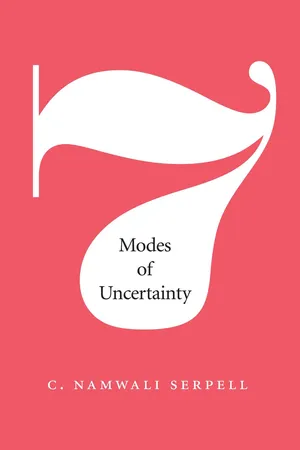
Literature is rife with uncertainty. Literature is good for us. These two ideas about reading literature are often taken for granted. But what is the relationship between literature's capacity to unsettle, perplex, and bewilder us, and literature's ethical value? To revive this question, C. Namwali Serpell proposes a return to William Empson's groundbreaking work, Seven Types of Ambiguity (1930), which contends that literary uncertainty is crucial to ethics because it pushes us beyond the limits of our own experience.
Taking as case studies experimental novels by Thomas Pynchon, Toni Morrison, Bret Easton Ellis, Ian McEwan, Elliot Perlman, Tom McCarthy, and Jonathan Safran Foer, Serpell suggests that literary uncertainty emerges from the reader's shifting responses to structures of conflicting information. A number of these novels employ a structure of mutual exclusion, which presents opposed explanations for the same events. Some use a structure of multiplicity, which presents different perspectives regarding events or characters. The structure of repetition in other texts destabilizes the continuity of events and frustrates our ability to follow the story.
To explain how these structures produce uncertainty, Serpell borrows from cognitive psychology the concept of affordance, which describes an object's or environment's potential uses. Moving through these narrative structures affords various ongoing modes of uncertainty, which in turn afford ethical experiences both positive and negative. At the crossroads of recent critical turns to literary form, reading practices, and ethics, Seven Modes of Uncertainty offers a new phenomenology of how we read uncertainty now.
- English
- ePUB (mobile friendly)
- Available on iOS & Android
eBook - ePub
Seven Modes of Uncertainty
About this book
Information
APPENDIX 1: THE VAGARIES OF THE NEW ETHICS
In metacritical accounts, the field of ethical criticism is often divided into two camps, humanistic and poststructuralist.1 Broadly speaking, critics like Lionel Trilling, Wayne Booth, Martha Nussbaum, and others invested in Aristotelian ethics are said to be of the humanist camp, invested in models of liberalism, democracy, and positive ethical relations like friendship and love. These critics follow Nussbaum’s lead in asking, “Couldn’t a text be a work of moral philosophy precisely by showing the complexity and indeterminacy that is really there in human life?”2 Critics in the camp inspired by poststructuralism focus more on the value of the alterity (“otherness” or “difference”) they see as endemic to the literary. This camp is affiliated with Robert Eaglestone, Derek Attridge, and others inspired by the work of Jacques Derrida and Emmanuel Lévinas. For these critics, the literary encounter, in Judith Butler’s words, “honors what cannot be fully known or captured about the Other.”3
Despite these divergent descriptions of the value of literature, there are many deep commonalities to these two camps, as Dorothy Hale notes in her description of what she terms the New Ethics.4 Most pertinent to the foregoing book is their shared commitment to “the self-consciously unverifiable status of the alterity that the ethical subject seeks to produce—an unverifiability that retains the post-structuralist’s skepticism about knowledge as a tool of hegemony while bestowing upon epistemological uncertainty a positive ethical content.”5 While Seven Modes of Uncertainty shares the premise that literary uncertainty bears ethical relevance, I present in this appendix a critique of problems of method that plague the New Ethics, collating critics from both sides according to how they have strayed. I isolate four vagaries of ethical literary criticism: personification, self-validation, verisimilitude, and hypostatization.
Personification
The first pervasive problem with ethical criticism is its proclivity for bringing into personified being that strange silent thing we call literature. As Michel Foucault notes in “What Is an Author?,” those “aspects of an individual, which we designate as an author (or which comprise an individual as an author), are projections, in terms always more or less psychological, of our way of handling texts.”6 This tendency is more common in humanistic criticism, as in Booth’s embodiment of texts as “friends” and Nussbaum’s comparison of reading to “love.” But even poststructuralist scholars use authorial personae to ground their claims: J. Hillis Miller’s The Ethics of Reading is actually about authors reading themselves.
Attention to literary value seems to conjure, like a spell, the specter of the author; it is no coincidence that one of Booth’s late essays is titled “The Resurrection of the Implied Author.” Booth’s invention, the “implied author,” is “the author’s ‘second self,’ ” who “chooses, consciously or unconsciously, what we read; we infer him as an ideal, literary, created version of the real man; he is the sum of his own choices.”7 The term “the implied author” seems a new name for an old problem, however, given how often critical discussions slip into claims about “the flesh-and-blood” author.
Personification is compounded by occasionally outrageous acts of critical prosopopeia, or appropriations of authorial voice: “ ‘Well, Judge Posner,’ we might imagine him saying, ‘it seems, then, that you are not a very valuable member of society, and before you die you may regret this fact. I never had a very high view of the legal profession, and my conversation with you has confirmed my view of its emotional aridity. But since you are a fascinating character, with your strange combination of intelligence and denial, quick formal perception and shallowness of feeling, I may possibly put you in my next short novel.’ ”8 Whether this attack on Richard Posner is ad hominem or merely overstated, it is striking that Martha Nussbaum doesn’t even acknowledge it as her own, diverting it through a conjured Dickens, who apparently “would not be at a loss for words” were he alive to read and contest Posner’s critique of her work.9
Personification is perhaps an understandable fallacy, as Louise Rosenblatt notes: “What is more natural than to sense the author behind the words to which we have vividly responded?”10 But the impulse to establish authorial intention obscures the difficulty—if not the impossibility—of the enterprise, as Wimsatt and Beardsley argued, followed by Roland Barthes and Foucault in a rather different vein, succeeded in yet another by Steven Knapp and Walter Benn Michaels.11 T. S. Eliot frankly admits, “in the course of time a poet may become merely a reader in respect to his own works, forgetting his original meaning, or without forgetting, merely changing.”12 This is merely with respect to meaning. Value is even muddier. If we take literary ethics to be corollary to authorial ethics, we have to account not only for the distance between the authored work and the author’s life but also for a range of ethical views within the author.
Critics often lump together under one proper noun the variety of authorial orientations in a pluriform oeuvre. Candace Vogler attributes this to the trope of antonomasia: “a name that might be variously bestowed is given to the preeminently suitable candidate.”13 Booth elides this multiplicity by describing “implied figures” as “superior versions” of real ones: “in wiping out the selves they do not like, the poets have created versions that elevate both their worlds and ours.”14 It flattens both reader and writer—smoothing out their temporal and subjective diversity—to suppose that only their best selves make contact.
It also flatters them. It is only through such euphemizing that Booth can construe the relation between implied reader and implied author as a species of friendship. In essence, a set of hypotheses about a text is personified to facilitate an attribution of positive ethical relations to the literary complex. This seems spurious, if not specious, as suggested by this aside from Booth about the disjunction between art and life: “I find my admiration for … effective maskers actually rising a bit when I learn some contemptible details about their FBPs [flesh-and-blood persons].”15
If literature is a fantasy of what authors and readers “wished [we] could be,” isn’t it just an escape from or a denial of our baser selves? This question appears in ethical philosophy under the name “the paradox of fictional emotion.” Jean-Jacques Rousseau expressed this anxiety: “In giving our tears to these fictions, we have satisfied all the rights of humanity without having to give anything more of ourselves; whereas unfortunate people in person would require attention from us, relief, consolation, and work, which would involve us in their pains and would require at least the sacrifice of our indolence.”16
Further, Vogler points out, “silent reading is … the opposite of taking the action characteristic of those very virtues of attention, concern, acknowledged vulnerability, and openness to others” we attribute to reading.17 Personification conjures improved persons while neglecting the fallen, complex, time-riven creatures we are. There is no need for these trumped-up holistic angels. While the literary experience is clearly peopled, authors and readers are best described either in terms of their potential or projected relations, or as real, flawed, changeable people.
Self-Validation
We can apportion some blame for the misconception that reading and writing make us good to the language that we use to discuss literature. Ethics, originally an unmarked word meaning the branch of knowledge pertaining to morals both good and bad, has acquired over time a positive connotation of the good. Charles Altieri notes the same slippage in the word virtue: “it brings an aura of satisfying certain deep moral values in society.” He advises a modicum of critical “embarrassment” about “taking ourselves as somehow spokespersons for self-congratulatory values in reading that are extremely difficult to state in any public language.”18 The tendency to focus only on self-affirming positive ethical values suggests critical self-validation.
This self-interest is also what leads critics to another version of this vagary: the circular thinking that finds familiar values—in familiar places—when there might be fraught, curious, or monstrous ethical experiences to be uncovered. It is a commonplace that canons create themselves; ethical literary criticism is especially prone to self-perpetuation. Subsuming authors’ words into the critical argument not only heightens the allure and authority of the literary creator, it also creates a peculiar kind of canon: authors who talk about themselves, however cryptically, get talked about. Furthermore, critics often deem certain works “ethical” simply by selecting them to analyze ethically. The knowledge that is meant to emerge from the work of criticism is thus predetermined by the philosophical lens placed on it. As Altieri notes: “This criticism insists on there being something distinctive in how concrete texts engage our moral attention, and yet it has to interpret the value of that engagement in terms of the very philosophical methods and generalizations from which the concrete reading deviates.”19
Can literature do more than affirm or exemplify preconceived knowledge? In the philosophy of art, this is called “cognitive triviality,” the practice of “isolating a moral thesis associated with or implied by an artwork and then [going] on to commend the artwork in light of its moral commitments.”20 When, as Richard Posner puts it, “the ethical position is in place before the examination begins, and furnishes the criteria of choice and shapes interpretation,” critics only reaffirm what they already believe.21 Robert Eaglestone argues of Nussbaum’s work: “all great texts properly read echo the same Aristotelian moral points, about perception, about community and about identity,” concluding that “her argument forms a self-enclosing circle by defining what to look for in a text which in turn is justified by what it finds during its search.”22 The same accusation might be turned, however, against poststructuralist work like Eaglestone’s. Critics are just as enamored with aporia or Otherness as with virtue ethics or liberal humanism.
For Dorothy Hale, both strands of ethical literary criticism are predisposed to seek alterity: “These theorists all agree that to open a novel is to open oneself up to a type of decision-making that is itself inherently ethical. For the new ethicists, the novel demands of each reader a decision about her own relation to the imaginative experience offered by novels: Will I submit to the alterity that the novel allows? An affirmative answer launches the novel reader into a transactional relation with another agent, an agent defined by its Otherness.”23 No matter its auspices—“author, characterological point of view, narrative, text, and even law”—alterity requires a prior act that makes self-subordination itself possible: “the will to believe in the possibility of alterity.”24 If you go looking for alterity, it isn’t hard to find; after decades of imperatives to honor the Other, every text seems to give back the same old Otherness.
Verisimilitude
This reflexive impulse to correlate literary uncertainty with alterity seems to be an updated version of the reflective impulse that characterizes ethical criticism, as such. Andrew Gibson, in his survey of the field in the early twentieth century, notes a “curiously naïve faith in the mimetic principle.”25 It seems to have persisted to this day. For Nussbaum the reflective relation goes both ways: “the novel is itself a moral achievement and the well-lived life is a work of literary art.”26 This relation seems to work via the transitive property: literature reflects our human reality, and ethics reflect our human reality; thus, literature reflects ethics. Humanists invoke “the way people read,” but even poststructuralists proclaim the “irresistib...
Table of contents
- Cover
- Half Title
- Title Page
- Copyright
- Dedication
- Contents
- Introduction
- I. Mutual Exclusion
- II. Multiplicity
- III. Repetition
- Appendix 1: The Vagaries of the New Ethics
- Appendix 2: Seven Modes of Uncertainty
- Notes
- Acknowledgments
- Index
Trusted by 375,005 students
Access to over 1.5 million titles for a fair monthly price.
Study more efficiently using our study tools.
Frequently asked questions
Yes, you can cancel anytime from the Subscription tab in your account settings on the Perlego website. Your subscription will stay active until the end of your current billing period. Learn how to cancel your subscription
No, books cannot be downloaded as external files, such as PDFs, for use outside of Perlego. However, you can download books within the Perlego app for offline reading on mobile or tablet. Learn how to download books offline
Perlego offers two plans: Essential and Complete
- Essential is ideal for learners and professionals who enjoy exploring a wide range of subjects. Access the Essential Library with 800,000+ trusted titles and best-sellers across business, personal growth, and the humanities. Includes unlimited reading time and Standard Read Aloud voice.
- Complete: Perfect for advanced learners and researchers needing full, unrestricted access. Unlock 1.5M+ books across hundreds of subjects, including academic and specialized titles. The Complete Plan also includes advanced features like Premium Read Aloud and Research Assistant.
We are an online textbook subscription service, where you can get access to an entire online library for less than the price of a single book per month. With over 1.5 million books across 990+ topics, we’ve got you covered! Learn about our mission
Look out for the read-aloud symbol on your next book to see if you can listen to it. The read-aloud tool reads text aloud for you, highlighting the text as it is being read. You can pause it, speed it up and slow it down. Learn more about Read Aloud
Yes! You can use the Perlego app on both iOS and Android devices to read anytime, anywhere — even offline. Perfect for commutes or when you’re on the go.
Please note we cannot support devices running on iOS 13 and Android 7 or earlier. Learn more about using the app
Please note we cannot support devices running on iOS 13 and Android 7 or earlier. Learn more about using the app
Yes, you can access Seven Modes of Uncertainty by C. Namwali Serpell in PDF and/or ePUB format, as well as other popular books in Literature & Literary Criticism. We have over 1.5 million books available in our catalogue for you to explore.